A graph minor compresses connected regions of a graph into single vertices while retaining selected connections between them. For finite simple graphs, means that some sequence of deleting vertices, deleting edges, and performing edge contractions produces up to graph isomorphism. Deleting a vertex also deletes all its incident edges; deleting an edge leaves its endpoints. The edge contraction convention here removes resulting self-loops and duplicate edges.[ref]
For an exact small example, let be the cycle graph with vertices and edges . Contract to a new vertex . The surviving edges are , giving the complete graph . Thus , although has no triangle in a graph as a subgraph. The branch sets of a graph minor are , with the original edges witnessing all three required adjacencies. The first panel of the edge contraction diagram shows this operation.
A subgraph uses existing vertices and edges; a topological minor permits a graph subdivision of the target as a subgraph, so target edges become graph paths with mutually disjoint interiors and no target vertex in an interior. An ordinary graph minor permits whole connected branch sets of a graph minor in place of target vertices. Every topological minor is a graph minor, by contracting the replacement graph paths.[ref]
The converse fails. Take the tree with edges . Contracting gives the star graph . Yet the original tree has maximum degree three, whereas every graph subdivision of retains a centre of degree of a vertex four. Hence is a graph minor but not a topological minor of this tree. The difference is that a connected branch set of a graph minor may gather connections incident to several original vertices.
The counts of vertices and edges never increase under these operations. However, the example shows that being a bipartite graph is not preserved: its graph minor contains an odd cycle. Its chromatic number also increases from two to three. A connected graph stays connected under an edge contraction, because the image of each graph path still connects its endpoints, but deletion can disconnect it. Thus one must check the particular graph property before treating it as preserved by taking graph minors.
Being a planar graph is preserved: in a crossing-free drawing, shrink a contracted edge and bring its incident edges into the merged vertex; deletion merely removes parts of the drawing. This makes a nonplanar graph minor a certificate that the original graph is nonplanar. More strongly, for a finite simple graph, being a planar graph is equivalent to having neither the complete graph nor the complete bipartite graph as a graph minor. Finding the corresponding branch sets of a graph minor settles nonplanarity even when no literal or subgraph is present. The converse is a substantial theorem, rather than a consequence of preservation alone.[ref]
A topological minor records a network pattern whose vertices remain individual junctions but whose edges may become longer routes. For finite simple graphs, means that contains a subgraph that is a graph subdivision of up to graph isomorphism. Equivalently, choose distinct branch vertices of a graph subdivision for and a graph path from to for every . These are internally vertex-disjoint paths, and no internal vertex of any is a branch vertex of a graph subdivision. Only endpoints corresponding to a shared target vertex may be shared.[ref]
The Basics (author-hosted chapter preview). §1.7, printed p. 18: subdivisions; printed p. 21: topological-minor embeddings
The graph subdivision example below replaces two edges of a triangle in a graph by routes of two and three edges while retaining its attached leaf of a graph. If the host graph also contains an extra edge , the same routes still witness a topological minor: delete when selecting the subgraph. An induced subgraph is not required. However, routes that merely connect the right pairs are insufficient: using a branch vertex of a graph subdivision as an intermediate junction, or making two routes share an internal vertex, can change the local network structure.
Every topological minor is a graph minor. In each branch path of a graph subdivision, contract all but one edge; the disjoint interiors let this shorten each route without merging distinct branch vertices of a graph subdivision. This recovers after deleting unused vertices and edges.[ref] The converse fails because an ordinary branch set of a graph minor can gather several junctions into one.
For the tree with vertices and edges , contracting produces a star graph : the branch sets of a graph minor are . Both have degree of a vertex three; each of the other four vertices is a leaf of a graph with degree of a vertex one. The new centre has four distinct graph neighbours ; its degree of a vertex is , in agreement with the edge contraction formula.
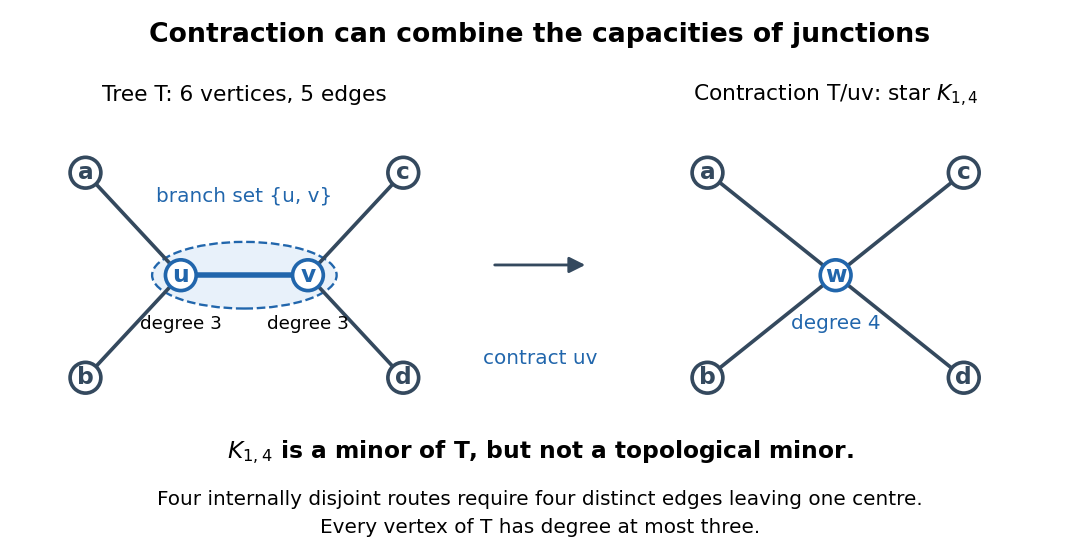
A graph minor can combine two junctions: contracting creates a star graph with a centre of degree of a vertex four
. Details. Yet is not a topological minor of . In a graph subdivision of , four branch paths of a graph subdivision must leave the centre through four different edges; sharing their first internal vertex would violate internal disjointness. Thus any host needs a vertex of degree of a vertex at least four, whereas . More generally, implies , where is the maximum degree of a graph. This bound concerns the host graph; extra unused edges may make its branch vertices of a graph subdivision have larger degrees of vertices than their target counterparts.
This distinction matters when a network's individual junctions have a limited number of connections: replacing a connection by a route preserves the number of routes meeting at each chosen junction, while contracting a connected region can combine connections from separate junctions. It also explains why a small nonplanar pattern can hide inside long routes. By Kuratowski's theorem, a finite simple graph is a planar graph exactly when it has neither the complete graph nor the complete bipartite graph as a topological minor. The obstruction is a graph subdivision inside the network, regardless of the number of intermediate vertices.
Let be even, let , and suppose a graph has disjoint nonempty vertex sets , where . Suppose each is connected or every one of its graph components meets , and each is adjacent to all but at most of the other not meeting . Assume also that no rooted separation of a graph of order below avoids of these sets. Then there are disjoint connected vertex sets such that for and each of these first sets is adjacent to all but at most of .
Here adjacency of sets means existence of an edge between them. A rooted separation of a graph is with , , no edges between and , and order . It avoids when . We prove the reduction by induction, first on the vertex count and then on the edge count; any counterexample chosen minimal in this ordering will be impossible.
We may delete edges joining two vertices of . They cannot affect rooted separations of a graph, since lies wholly on the first side. Within a branch set, their deletion can only split a graph component into graph components each containing an endpoint in , so the branch-set hypothesis also persists. An isolated vertex outside and all branch sets can be deleted. An isolated vertex is also impossible, since has order and avoids at least sets. Thus in a minimal counterexample is independent, and every isolated vertex outside belongs to a singleton branch set.
Consider a rooted separation of a graph of order exactly avoiding at least branch sets, and put . Restrict to and . Each is nonempty: any not itself avoided is adjacent to at least one of the avoided sets, and the endpoint of such an edge in must lie in . If a graph component of misses , it lies in and is a whole graph component of , with no vertex of . The original hypothesis then forces to be connected and , entirely outside . Thus each restricted set is connected or all its graph components meet . In particular every missing equals an original set outside , so all its required adjacencies from persist.
A rooted separation of a graph of avoiding restricted sets lifts to in , of the same order: an avoided restricted set misses , hence is an original set outside . The edges removed inside do not obstruct lifting, since . This proves the required separation hypothesis for . If is smaller, induction gives the desired connected sets rooted at . Moreover has disjoint graph paths from to , by the Menger theorem. Indeed a separator of smaller order between these sets would give a rooted separation of a graph of of smaller order still avoiding those original sets. Truncate the graph paths at their first visits to , label their endpoints accordingly, and adjoin each graph path to the corresponding rooted connected set. They meet only in their distinct endpoints, so this gives the desired sets for , a contradiction. Consequently in a minimal counterexample every such separation of order has and , an independent set.
Now contract any edge whose endpoints do not belong to two different branch sets. Its endpoints cannot both lie in , so the image of still has size . The branch-set conditions persist. If the contraction created a forbidden rooted separation of a graph of order below , its lift would have order below , except possibly when the contracted vertex lies in its separator. In that case the lifted order increases by one and is at most . Equality would put the contracted edge inside , contradicting the just-proved independence of for an order- separation avoiding sets. Thus the separation hypothesis also persists. Applying induction in the contracted graph and expanding the contracted vertex would produce the required disjoint connected sets. Hence every edge in a minimal counterexample joins two different branch sets.
Every vertex outside the branch sets would be isolated, since every edge joins two branch sets; such an isolated vertex could be deleted. Thus the branch sets cover the graph. Each nonsingleton branch set is therefore an independent set, and all its vertices belong to , because each of its singleton graph components must meet . Let be the union of the nonsingleton branch sets, and write . There is a matching in a graph from into . Otherwise the Hall marriage theorem gives with neighbourhood satisfying . Since is independent, is a rooted separation of a graph of order . It avoids every singleton branch set outside , of which there are at leastThe penultimate counting bound uses that the nonsingleton sets number at most , so . This contradicts the separation hypothesis.
Use that matching in a graph to make a two-vertex connected set for each terminal in ; terminals outside remain singleton sets. There are at leastunused vertices, all singleton original branch sets. Choose of them for the remaining . Every rooted contains a singleton original branch set: either its terminal, or its terminal's matched neighbour. That singleton misses at most of the selected nonterminal singleton sets. This constructs the desired family and completes the proof.
The complete graph minor density threshold isThe density here is edge count divided by order, half the average degree of a vertex. For large , this threshold has order , with the logarithm taken to base .
For each positive integer , a nonempty graph satisfying has a graph minor satisfyingThe density hypothesis is a lower bound. Reversing its inequality would be false for an edgeless graph. This auxiliary lemma can be used to establish a upper bound for the complete graph minor density threshold.
A branch set of a graph minor is the connected region representing one target vertex. For finite simple graphs and , a witness to assigns a nonempty set to each , such that the sets are pairwise disjoint, each induced subgraph is a connected graph, and every has a witnessing edge of between and . Extra edges between branch sets of a graph minor are allowed: they can be deleted. Unused vertices are also allowed.[ref]
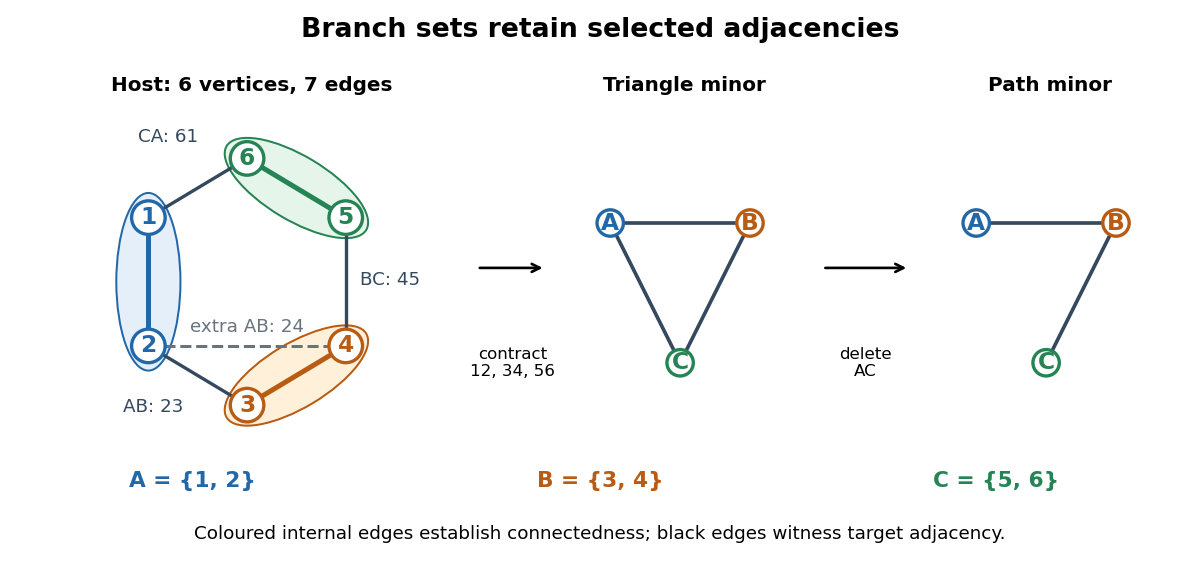
In the diagram, the host graph has vertex set and edgesChoose , , and . Their internal edges establish connectedness. The edges witness , respectively, so they form a model of the complete graph . The additional edge also joins to ; it supplies another witness for the same target edge, not a fourth target edge. Contracting and merging duplicate edges gives exactly .
The same branch sets of a graph minor also witness the path graph : retain the witnesses , and delete to remove the unwanted adjacency. This demonstrates why the definition requires an edge for every target adjacency, without forbidding other adjacencies in the host graph. For a complete graph , there are no unwanted pairs: its model consists of disjoint connected branch sets of a graph minor with an edge between every pair.
To turn a model into an operation sequence, keep a spanning tree inside each , keep one witnessing edge for each edge of , and delete all other edges and unused vertices. Contract each chosen spanning tree to one vertex. Disjointness prevents two target vertices from merging; connectedness provides the edge contractions that merge each individual region. Conversely, track the original vertices merged into every surviving vertex during a deletion-and-edge contraction sequence. They form disjoint connected branch sets of a graph minor, and each surviving edge comes from an original edge between its two regions. A list of these regions, their connecting trees, and their witnessing edges therefore gives a directly checkable certificate.
In a dense graph with many common neighbours for every pair of vertices, choose disjoint random small sets. A set is good if few vertices have no neighbour in it. The Markov inequality controls the number of bad sets, and random sampling makes almost every pair of good sets adjacent. Add unused common neighbours to connect each set and to repair the remaining missing adjacencies. If the number of used vertices stays below every common-neighbour count, this constructs disjoint branch sets of a graph minor representing a large complete graph.
An edge contraction merges the two endpoints of an existing edge. For a finite simple graph and , replace by a new vertex . Retain every edge with neither endpoint in , and join to every member ofHere and denote the original open graph neighbourhoods, and is the new graph neighbourhood. Remove the self-loop arising from and merge duplicate edges, so the result is again a simple graph. This is not deletion of , which keeps both original vertices.[ref]
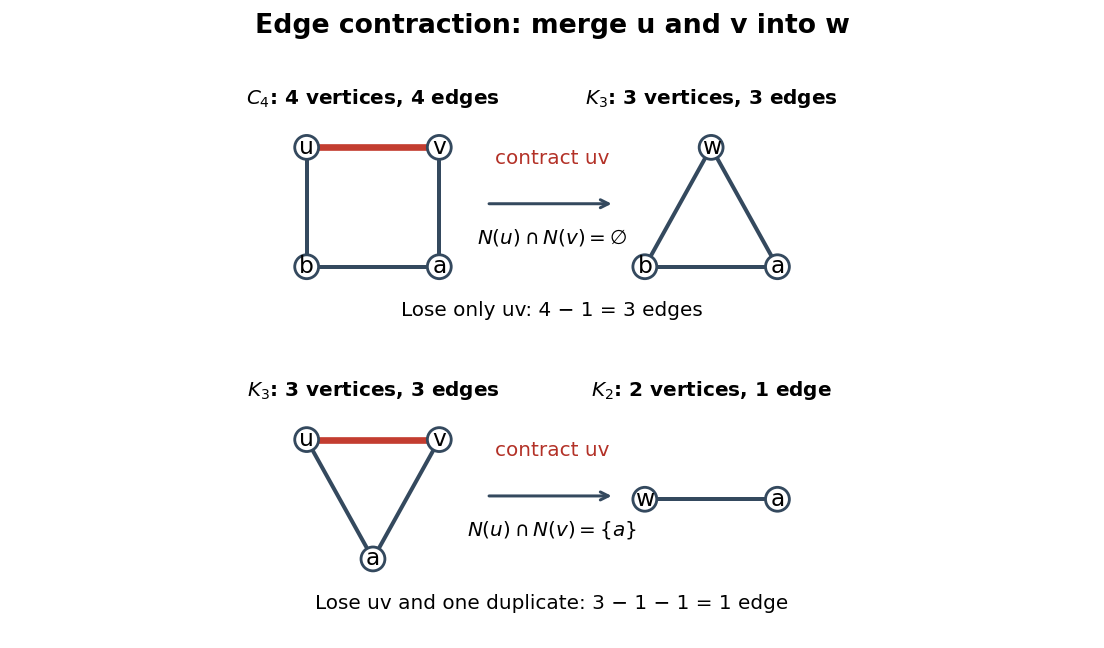
Edge contraction of a four-cycle and a triangle in a graph: common neighbours determine the lost edge count
. Details. The left example contracts in the cycle graph to give . Its endpoints have no common neighbours, so four edges become three. The right example contracts in the triangle in a graph with edges . Its endpoints have the single common neighbour , so the two edges become one edge : three edges become one.
For any such edge contraction, the exact counts areThe contracted edge accounts for one loss. Each common neighbour contributes exactly one further loss, since become a single edge . All other edges correspond one-to-one to surviving edges. In particular the new degree of a vertex isThese formulas depend on simplifying to a simple graph; a multigraph convention that retains duplicate edges has different counts. In the six-vertex branch set of a graph minor diagram, contracting loses one edge, contracting the resulting loses two because of its common neighbour , and contracting loses one. Hence its seven edges become the three edges of : .
An edge contraction can increase a degree of a vertex even while decreasing both total counts. For example, contracting in the tree with edges merges two vertices of degree of a vertex three into one of degree of a vertex four. This is the mechanism behind the distinction between a graph minor and a topological minor.
Articles by others on the same topic



The concept of a graph minor is a fundamental notion in graph theory, particularly in the study of graph structure and graph algorithms. A graph \( H \) is said to be a **minor** of another graph \( G \) if \( H \) can be formed from \( G \) by performing a series of operations that includes: 1. **Edge Deletion**: Removing edges from the graph. 2. **Vertex Deletion**: Removing vertices and incident edges from the graph.