Electronic contrast in scanning tunneling microscopy
ID: electronic-contrast-in-scanning-tunneling-microscopy

Separate geometry from electronic response in an original one-dimensional toy tunnel junction. Write the geometric surface height as , tip height as , and positive gap as . Assume low fixed tip-sample electric potential difference: the sampled energy window is narrow enough that the tip density of states is featureless and the sample local density of states varies little across that window. Neglect thermal broadening, changes of tip shape and lateral averaging. Let be the effective sample local density of states divided by a positive reference value, so it is dimensionless. Choose a spatially constant effective barrier energy , a positive coefficient with units of electric current, andHere is the Electron mass, the reduced Planck constant, and the tunnelling decay constant. This is an illustrative low-bias model, not a universal calibration formula. At fixed , taking a logarithm givesThe logarithms have dimensionless arguments. Only constant makes the recorded height differ from geometric height by a constant. Multiplying by raises the apparent height by without moving the geometric surface.
For a concrete ambiguity, choose , , lateral period , , and . CompareBoth produce exactly at . Substitution checks this without identifying with geometric height: case A has constant gap , while case B has gap and a compensating electronic factor. The chosen ranges from to , approximately to ; every gap remains positive. The chosen corresponds to electronvolts, a positive effective barrier.
At fixed tip height , both cases instead giveTheir maximum-to-minimum electric current ratio is . Thus even adding this fixed-height scan at the same electric potential difference cannot distinguish these deliberately chosen surfaces within the toy model. Independent structural information or additional electronic measurements are required. Changing electric potential difference can supply such information, but also changes the assumptions used to define and .
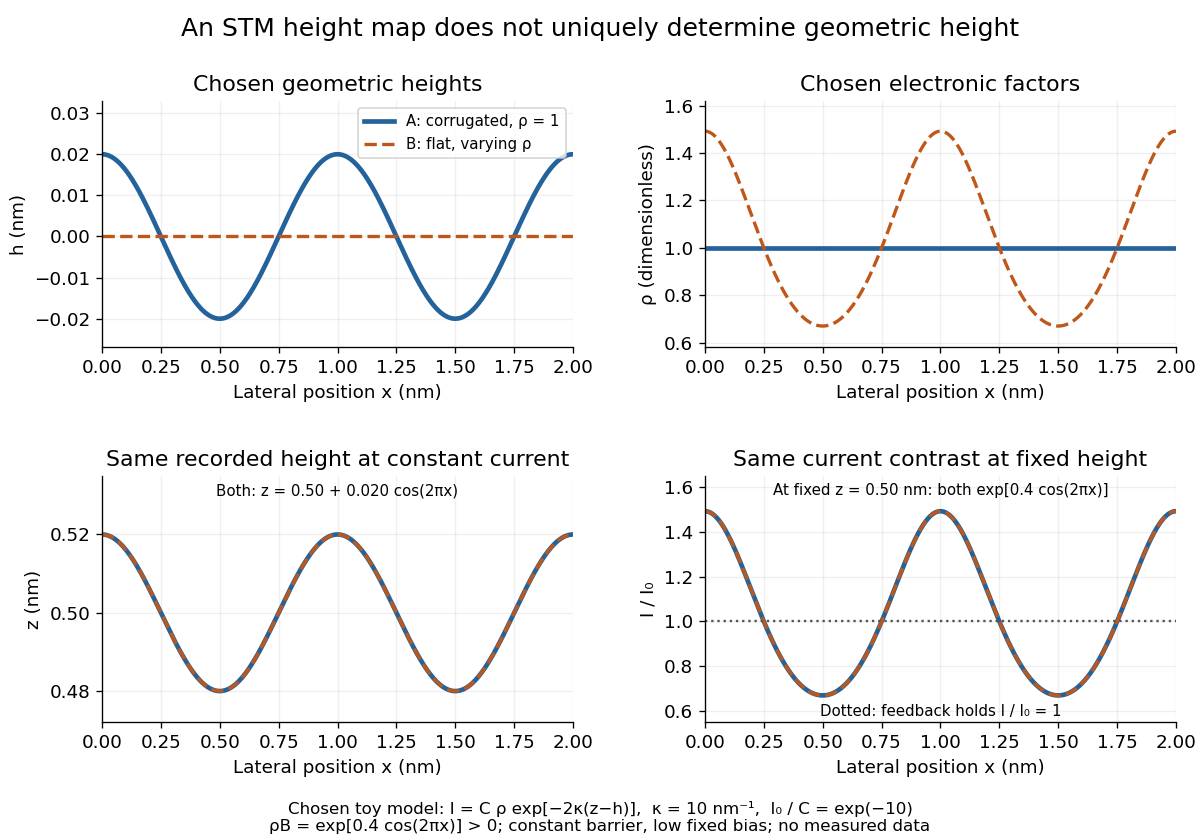
Different geometric and electronic profiles can produce the same STM image
. Original toy calculations, not measured data. The corrugated surface with constant local density of states and the flat surface with varying local density of states give identical recorded heights under constant-current scanning tunneling microscopy. They also give identical fixed-height electric current contrast at this chosen bias. Details.
New to topics? Read the docs here!