Energy dissipation of a damped pendulum
ID: energy-dissipation-of-a-damped-pendulum

For the normalized damped pendulum, the sum of kinetic energy and gravitational potential energy, divided by , isThe chain rule and the full nonlinear equation give this identity exactly, without a small-angle approximation. Here as in damped pendulum. In physical units the mechanical energy and the power of the resisting torque areThe pendulum's lost mechanical energy is transferred to the damper and surroundings; it does not violate conservation of energy. In an ideal viscous dashpot this loss is frictional heating. The exact cumulative balance is particularly useful for checking a numerical solution:
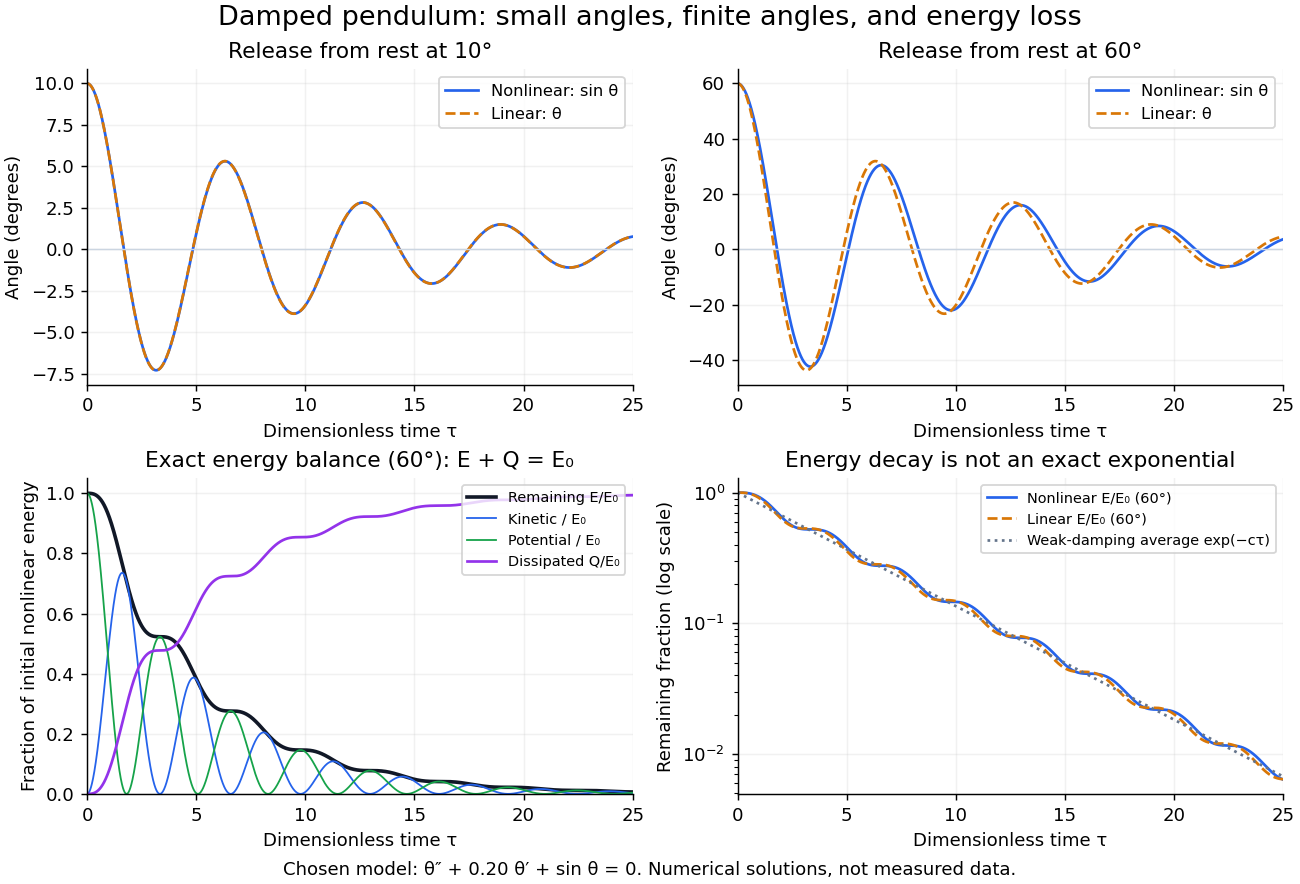
Illustrative nonlinear and linear damped pendulum solutions at 10 and 60 degrees, with exact mechanical energy transfer and loss; no measured data
. Details. 
The figure uses and release from rest. Over , the largest angular discrepancy between the nonlinear solution and the damped harmonic oscillator solution is approximately () for a release, but () for a release. Their nonlinear initial energies are and , respectively. At the remaining fractions are approximately and . These are illustrative calculations from specified initial conditions, not observations. The generator uses a Runge-Kutta method and integrates alongside the motion; halving its step and independently integrating checks the result.
For and , the first three nonlinear same-side swing intervals after a release are approximately , , and . They approach the linear-model oscillation period as the amplitude shrinks. After a release the corresponding intervals are already about , , and . This makes the experiment's period drift a quantitative test of the small-angle approximation, rather than an automatic reason to change the damping coefficient.
At a turning point, and even though the swing is losing mechanical energy over the cycle. Its potential energy there is , so measured turning angles give successive energies without estimating angular velocity. In the proposed decay experiment, multiply these values by to obtain energies in joules, then subtract adjacent same-side energies to estimate the loss over each full swing. Only for small amplitudes is . In the linear underdamped model, same-side peak energies consequently satisfy , the square of the angular amplitude ratio. For the illustrative parameters above this energy ratio is approximately . Between turning points, kinetic energy and potential energy continue to exchange while their sum decreases; the energy slope vanishes briefly at each extremum and is negative whenever the bob moves.
It is therefore inaccurate to replace the exact identity by . Even for the linear model, has . For weak damping and small angles, cycle averaging gives , so the averaged energy approximately follows while angular amplitude follows . This exponential decay is an approximation to the energy trace; the same-side peak ratio is exact within the linear model. The figure distinguishes the actual energy curves from this averaging approximation.
The energy identity also gives a global conclusion without solving the nonlinear equation. If were constant on a positive-length interval, then would vanish throughout it; the equation would force , making the entire trajectory an equilibrium. Every nonstationary trajectory therefore loses mechanical energy over every positive-length interval, even though its instantaneous derivative can vanish at a turning point. A nonconstant periodic motion would have to return to its initial mechanical energy, so it is impossible for this undriven damped pendulum. Oscillations near a stable focus are successive, shrinking swings, not a repeating cycle. Moreover, if , the angle cannot reach an upright equilibrium, whose potential energy is ; such motion stays within its original potential well. This is the usefulness of the energy description: one scalar balance controls both the observed decay and which nonlinear motions remain accessible.
New to topics? Read the docs here!