Failure-probability budget
ID: failure-probability-budget

A failure-probability budget assigns nonnegative numbers to a finite or countable family of failure events in a common probability space, with verified bounds . The union bound guarantees that the probability of any failure is at most . By De Morgan's laws and the complement rule of probability, the probability that every requirement succeeds obeysThus guarantees simultaneous success with probability at least , even when all failure events depend on the same observations. The numbers are upper allowances; adding them is not a calculation of the exact failure probability.
For three requirements, give each a failure-probability budget . The total budget is , so simultaneous success has probability at least . On a sample space of twenty equally likely outcomes, let , , and . These disjoint events attain the budget and the success bound. If instead all three failure events equal , their individual probabilities are unchanged, but exact failure has probability and simultaneous success has probability . This second model shows how overlap can leave the guarantee conservative.
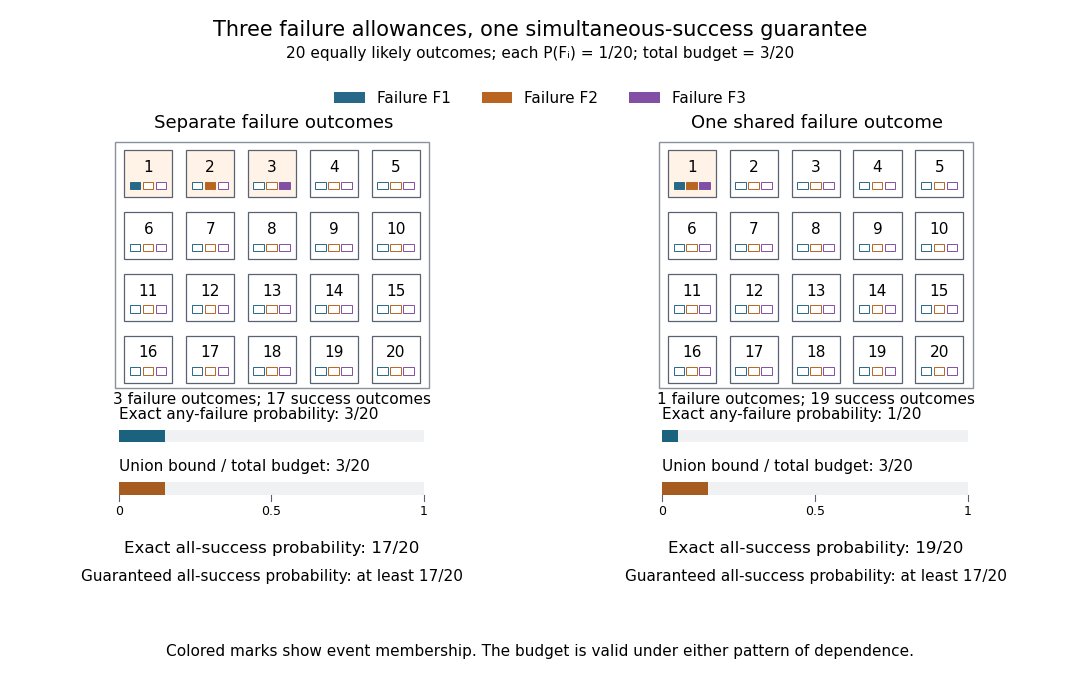
A shared failure-probability budget covers both separate failures and one common failure
. The two panels each have twenty equally likely numbered outcomes. The blue, orange, and purple marks identify membership in , , and , respectively. Their individual probabilities are in both panels. The union has three outcomes on the left and one on the right, while the union bound is in both. The event of simultaneous success is the complement of an event of any failure and contains seventeen or nineteen outcomes. These are illustrative probability models, not measured failure rates. Details.
For requirements, an equal allocation is convenient; unequal allocations also work when some requirements are harder to satisfy. For infinitely many requirements indexed by , the allocation uses total budget by the geometric series. A fixed positive allowance for every requirement instead gives an infinite sum and no positive simultaneous-success guarantee from the union bound. The individual probability bounds must cover all the failure events being combined: omitting possible failure modes leaves the resulting guarantee about the listed requirements only. The same addition of error allowances underlies the Bonferroni correction in simultaneous hypothesis tests.
New to topics? Read the docs here!