
A freely floating body at rest has no supporting contact or applied holding force. Neglecting surface tension and the buoyancy of air, its upward buoyancy balances its downward force from gravity:For a body of uniform mass density and total volume , its mass is . Substitution into Archimedes' principle givesPartial immersion is possible when . A nonuniform body uses its mean mass density instead; for a hollow body this volume must count the enclosed space that excludes water. This explains how the amount of displaced water can support a vessel whose walls alone are denser than water. [ref]
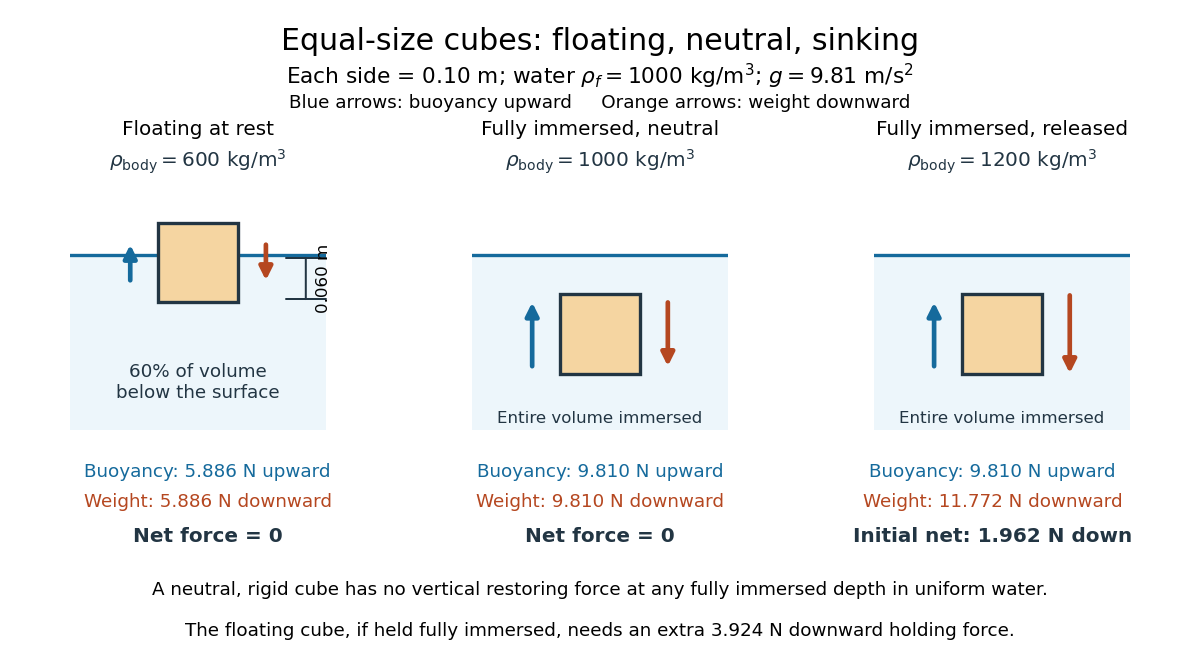
For the cube in water of mass density , the displaced fraction is : sixty percent of its volume lies below the surface. With a horizontal top and bottom, the immersed depth satisfies , soIts remaining height is , and the buoyancy is , exactly balancing its downward force from gravity.

New to topics? Read the docs here!