Buoyancy is the resultant upward force exerted by a resting fluid on an immersed body in a downward gravitational field. The fluid pushes inward, perpendicular to each part of the body's surface. Because hydrostatic pressure increases with depth, the upward push from below exceeds the downward push from above. Opposite horizontal forces cancel; buoyancy is the remaining vertical force. A sinking body still receives this upward support. [ref]
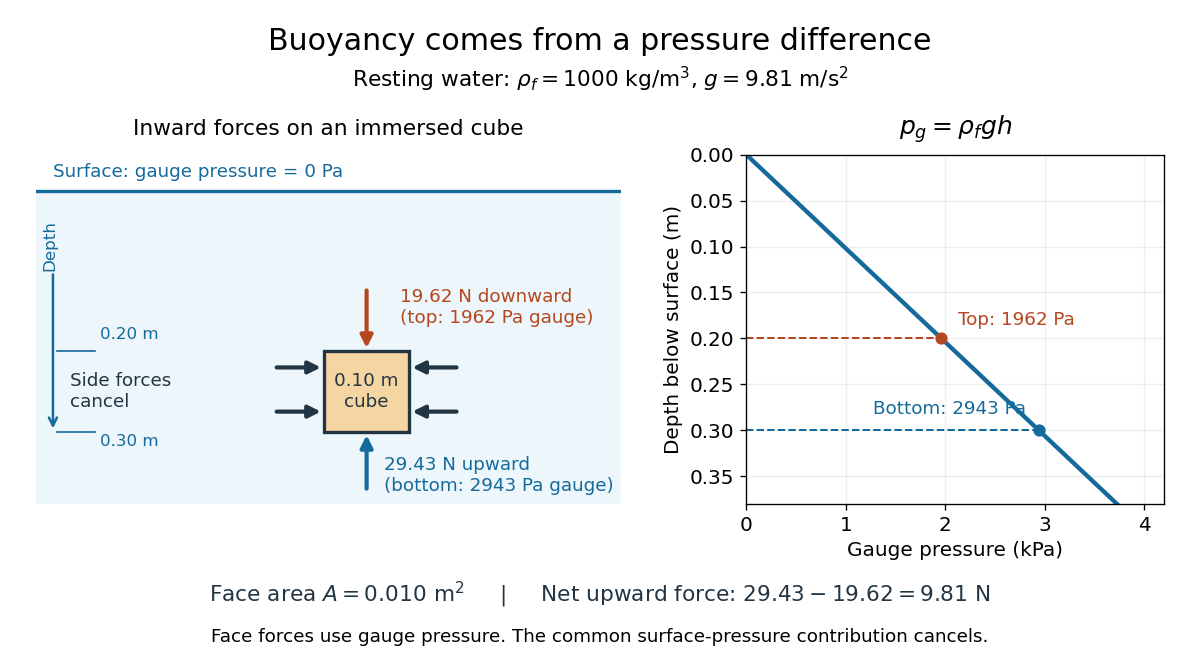
More precisely, pressure on a small surface of area with outward unit normal vector exertsThe minus sign says the force points into the body. On a cube, the top force points down, the bottom force points up, and the side forces cancel in pairs because opposite sides have the same pressure at each depth. This is a surface traction; gravity on the body itself is a separate body force. [ref]
For a computed example, stipulate resting water with constant mass density and uniform gravitational acceleration . A fully immersed cube has side , top depth and bottom depth . Each horizontal face has area , and its volume is . Its top and bottom gauge pressures areThe corresponding forces relative to the common surface pressure are downward and upward. Therefore the net buoyancy isUsing absolute pressures adds the same to both face forces, leaving their difference unchanged. Zero gauge pressure at the surface does not mean zero absolute pressure. Increasing both depths by the same amount also leaves buoyancy unchanged in this constant-mass density model.
Archimedes' principle turns this calculation into a rule for bodies of any shape. It explains floating equilibrium and lets us infer an immersed body's volume from the difference between its force from gravity and the force needed to support it. In particular, buoyancy depends on the displaced volume and the surrounding mass density, whereas the body's own mass density decides how its force from gravity compares with that support.
The centre of buoyancy is the point through which the resultant hydrostatic buoyant force acts. In a uniform fluid under uniform gravitational acceleration, it is the volume centroid of the displaced fluid. For a floating body its position generally changes when the body tilts, because the displaced volume changes shape.
For a quasihydrostatic bubbly mixture with gas void fraction , volume averaging gives the displayed mass density. A body displacing mixture volume has approximate buoyant force . A floating body of mass therefore needs ; gas release can increase its draft until the required displacement exceeds its available watertight volume. This mechanism explains a possible loss of flotation without making sinking inevitable in every gas plume. Upward liquid flow, turbulence and nonuniform bubble distributions require additional hydrodynamic forces beyond this simple mixture model.
The spatial gradient of buoyancy determines the buoyancy anomaly produced by a small parcel displacement: . Its vertical component is the squared buoyancy frequency in a stably stratified Boussinesq approximation. A horizontal component enters thermal wind and the propagation of a Boundary Rossby wave.
Magnetic buoyancy is the tendency of magnetized fluid to rise when magnetic pressure support reduces its density relative to its surroundings. For a thin flux concentration in lateral balance, . At equal temperature and composition an ideal-gas equation of state then gives , producing an upward buoyant force. Thermal exchange, magnetic tension and stable stratification modify this simple argument. In a solar dynamo, buoyant toroidal flux can emerge as tilted bipolar active regions.
Archimedes' principle states that buoyancy equals the downward gravitational weight, or weight, of the displaced fluid. In a resting fluid of constant mass density under uniform gravitational acceleration , its magnitude isHere is the volume from which the body excludes the fluid: the whole external volume for a fully immersed solid body, and just the immersed volume for a partly immersed one. The body's own mass does not enter this buoyancy formula. [ref]
A short proof outline for a fully immersed body is to imagine replacing it by exactly the fluid it displaces. The surrounding hydrostatic pressure is unchanged. That replacement fluid is at rest, so its upward pressure force must balance its downward force from gravity. The original body receives the same inward pressure forces on the same closed surface, hence the same upward buoyancy.
Equivalently, let be the displaced region, its closed surface and the upward unit direction. The divergence theorem, applied component by component to the surface integral, and hydrostatic pressure giveThis also explains why horizontal forces cancel even for an irregular shape. A spatially constant surface pressure contributes zero to the closed-surface integral. If the mass density varies with depth, replace by the mass of the displaced fluid.
The closed-surface argument assumes that the fluid applies pressure over the entire boundary of a fully immersed body. A body sealing against a tank bottom may have no fluid beneath it; then the lower-face pressure force used in the proof is absent, and a supporting contact force must be treated separately. For partial immersion, the usual buoyancy formula assumes the exposed surface receives the common atmospheric pressure, neglects the much smaller buoyancy from the air, and neglects surface tension.
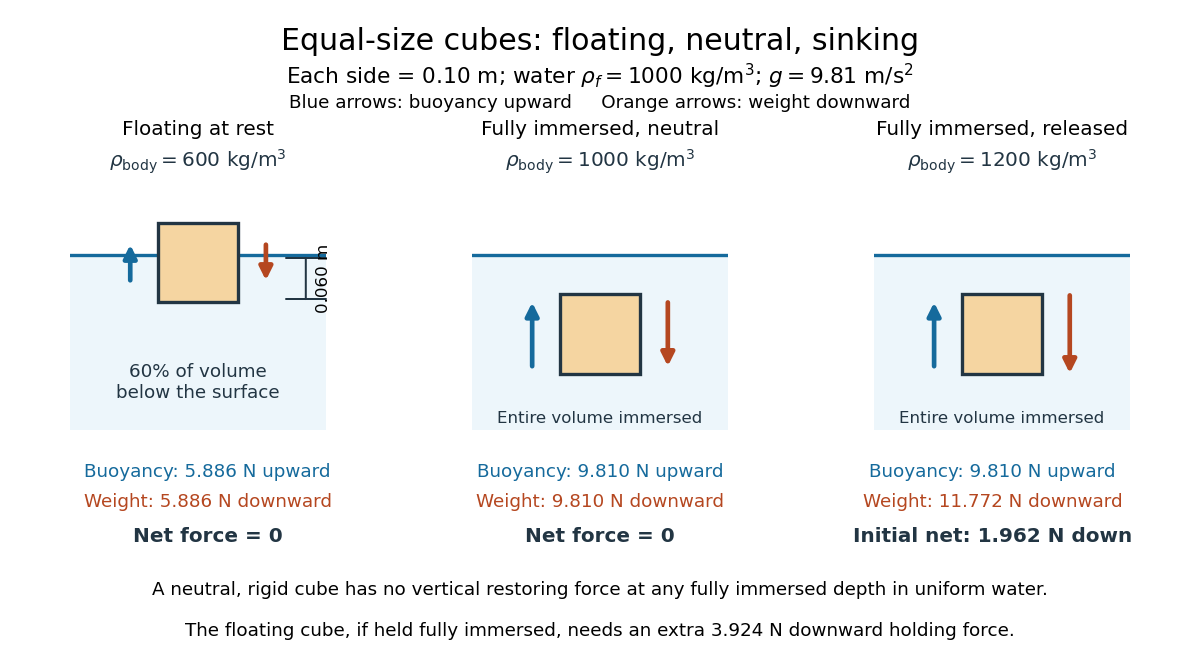
For the cube in the stipulated water, full immersion displaces , so . If its uniform mass density is , its mass is and its downward force from gravity is . To hold it fully immersed at rest requires an additional downward forceOn release from rest it initially moves upward; its eventual floating equilibrium has a smaller displaced volume. A same-size cube of uniform mass density has mass and downward force from gravity . Full immersion still gives of buoyancy, leaving an initial net downward force of . Subsequent motion also involves drag.
A freely floating body at rest has no supporting contact or applied holding force. Neglecting surface tension and the buoyancy of air, its upward buoyancy balances its downward force from gravity:For a body of uniform mass density and total volume , its mass is . Substitution into Archimedes' principle givesPartial immersion is possible when . A nonuniform body uses its mean mass density instead; for a hollow body this volume must count the enclosed space that excludes water. This explains how the amount of displaced water can support a vessel whose walls alone are denser than water. [ref]
For the cube in water of mass density , the displaced fraction is : sixty percent of its volume lies below the surface. With a horizontal top and bottom, the immersed depth satisfies , soIts remaining height is , and the buoyancy is , exactly balancing its downward force from gravity.
For a small heel of a floating body in a uniform fluid, the metacentre is the intersection of the new vertical buoyancy line with the original vertical through the centre of buoyancy. With the centre of mass a signed distance above the original centre of buoyancy, the metacentric height is . Here is the waterplane second moment of area about the heel axis and the displaced volume. Positive gives a restoring small-angle torque and negative gives instability. The formula describes local static stability, not all large-angle behaviour or effects of free liquid surfaces inside the body.
A vertical cylinder of constant cross-sectional area , partly immersed to depth in a fluid of mass density , satisfies by Archimedes' principle. A small extra downward displacement increases the buoyant force by , so . This is simple harmonic motion with the displayed angular frequency and oscillation period . The ideal model neglects fluid added inertia, drag and surface effects; it requires partial immersion throughout the motion.
Neutral buoyancy means a fully immersed body's upward buoyancy equals its downward force from gravity. For a body of fixed volume in a constant-mass density fluid under a uniform gravitational field, this occurs when its mean mass density equals the surrounding mass density. A cube of mass density in the stipulated water has mass , so both forces are .
Ideally it can remain at rest at any depth for which it stays fully immersed and clear of boundaries. Raising or lowering it changes the absolute pressure, but neither its displaced volume nor the difference between the vertical pressure forces. There is therefore no vertical restoring force toward a preferred depth in this model. Neutral buoyancy is a vertical force balance, not a claim about resistance to tilting or about a compressible body whose volume changes with pressure.
For a grain of mass density and volume in a fluid of mass density , its effective downward force is , after subtracting buoyancy from weight.
A buoyancy perturbation is the departure from a prescribed basic buoyancy field. In a fluid with constant buoyancy frequency , vertical velocity changes it according to .
In a radially stratified shearing sheet, one can normalize the scalar buoyancy perturbation by writing and . With this convention has dimensions of length, rather than temperature; is thermal diffusivity.
An isopycnal is a surface of constant mass density. In a Boussinesq approximation, it is equivalently a surface of constant buoyancy.
Articles by others on the same topic



Buoyancy is the upward force that an object experiences when it is submerged in a fluid (liquid or gas). This force is the result of pressure differences within the fluid, which are caused by the weight of the fluid itself. The concept of buoyancy is primarily explained by Archimedes' Principle, which states that an object immersed in a fluid experiences a buoyant force equal to the weight of the fluid displaced by the object.