
The formal charge of a chemical atom in a Lewis structure assigns it all of its nonbonding Electrons and half of the Electrons in its connections:Here is the neutral chemical atom's valence electron count, is the number of nonbonding Electrons assigned to it, and is the number of bonding Electrons incident on it. Count Electrons, not electron pairs: two lone pairs mean , and two double connections mean . The number gives electric charge in units of the positive elementary charge. Equal splitting is a bookkeeping convention, regardless of the actual electron density. See the IUPAC Gold Book, formal charge.
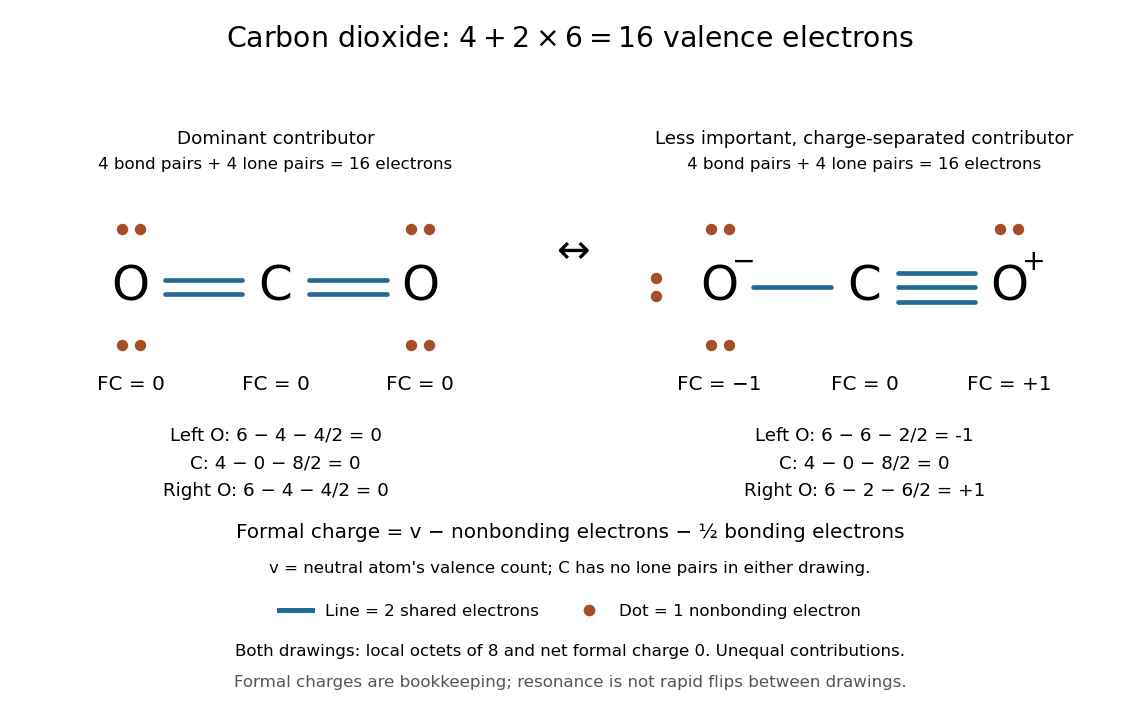
Sixteen valence electrons in two carbon dioxide Lewis structures: has zero formal charges, while has separated formal charges
. The first Lewis structure has two lone pairs on each oxygen. The second has three lone pairs on the singly connected oxygen, one on the triply connected oxygen, and none on carbon. Both use four bond pairs and four lone pairs; both satisfy the octet rule. Their contributions to chemical resonance are unequal, and the drawn formal charges are not partial atomic charges. Details.For , each oxygen has , , , giving formal charge . Carbon has , , , giving formal charge . For , the left oxygen has formal charge , carbon still has formal charge zero, and the right oxygen has formal charge . The net electric charge is zero in either drawing.
The Lewis structure with no separated formal charges is the dominant contributor in this elementary comparison; the charge-separated drawing is a less important contributor, rather than an equally dominant alternative. This is a qualitative selection rule, not a calculation of energy or numerical chemical resonance weights. See Flowers et al., Chemistry 2e, 7.4: comparing carbon dioxide structures. A zero formal charge does not imply zero partial atomic charge: the latter depends on partitioning the actual electron density, which a Lewis structure does not supply.
As a short consistency derivation, summing over all chemical atoms counts every drawn Electron once: a nonbonding Electron is assigned once, and a bonding Electron contributes half at each of its two endpoints. Thuswhere is the total drawn valence electron count. The right side is the net electric charge in units of elementary charge. This catches a wrong budget even when individual octet rule checks look plausible.


New to topics? Read the docs here!