
Take a cycle graph with four labeled graph vertices and four distinct edges . Set , , and impose periodic boundary conditions by writing . The square drawing represents a one-dimensional ring: it has no diagonal interactions and is not a two-dimensional lattice.
Call an edge between opposite Ising spins a domain wall. If is their number, the four bond products sum to , so the energy isEach domain wall costs relative to an aligned bond. Returning around the ring must return to the starting Ising spin, so is even: equivalently, . Choosing an even set of wall edges and then choosing determines the entire pattern. The state degeneracy is therefore , using a binomial coefficient.
| Domain walls | State degeneracy | Energy | Total Boltzmann factor weight |
|---|---|---|---|
The twelve middle microstates consist of eight patterns with one exceptional Ising spin and four patterns with two adjacent Ising spins and two adjacent Ising spins. The two alternating patterns have four domain walls. All microstates are shown below.
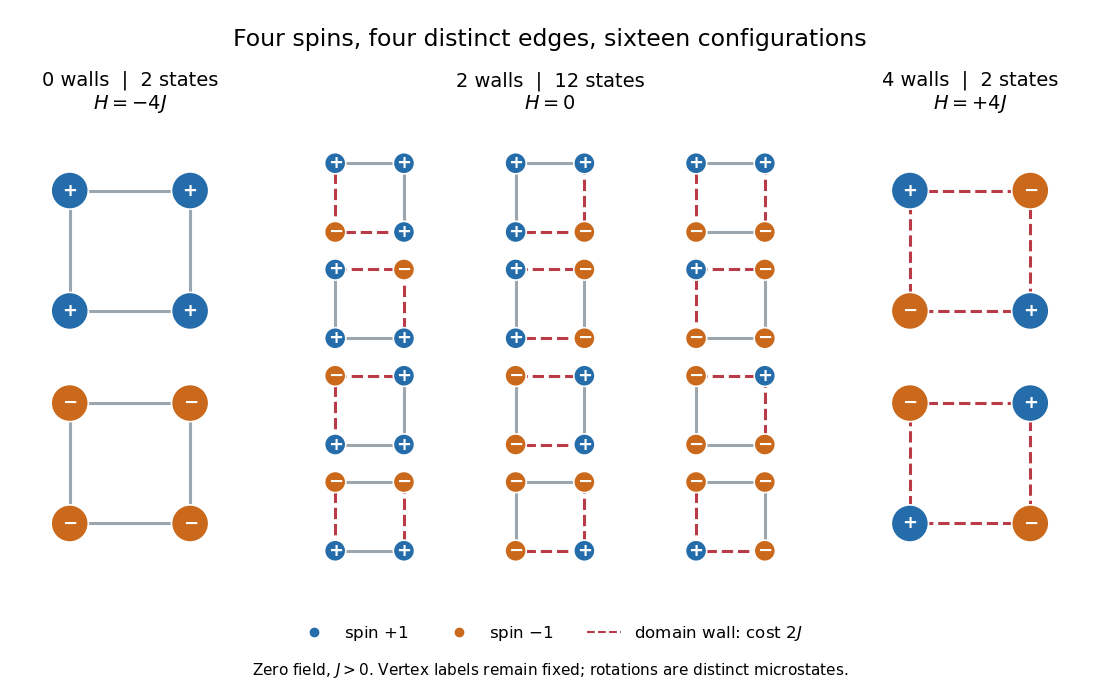

Writing , the partition function and the probability of each energy class areFor an original exact example, choose . Then , , and , , . Each aligned microstate has probability , each middle microstate , and each alternating microstate : multiply by state degeneracy before comparing whole classes. As , all sixteen microstates become equally likely, but the class probabilities approach . As , the two all-aligned microstates each have limiting probability .
New to topics? Read the docs here!