Take a cycle graph with four labeled graph vertices and four distinct edges . Set , , and impose periodic boundary conditions by writing . The square drawing represents a one-dimensional ring: it has no diagonal interactions and is not a two-dimensional lattice.
Call an edge between opposite Ising spins a domain wall. If is their number, the four bond products sum to , so the energy isEach domain wall costs relative to an aligned bond. Returning around the ring must return to the starting Ising spin, so is even: equivalently, . Choosing an even set of wall edges and then choosing determines the entire pattern. The state degeneracy is therefore , using a binomial coefficient.
| Domain walls | State degeneracy | Energy | Total Boltzmann factor weight |
|---|---|---|---|
The twelve middle microstates consist of eight patterns with one exceptional Ising spin and four patterns with two adjacent Ising spins and two adjacent Ising spins. The two alternating patterns have four domain walls. All microstates are shown below.
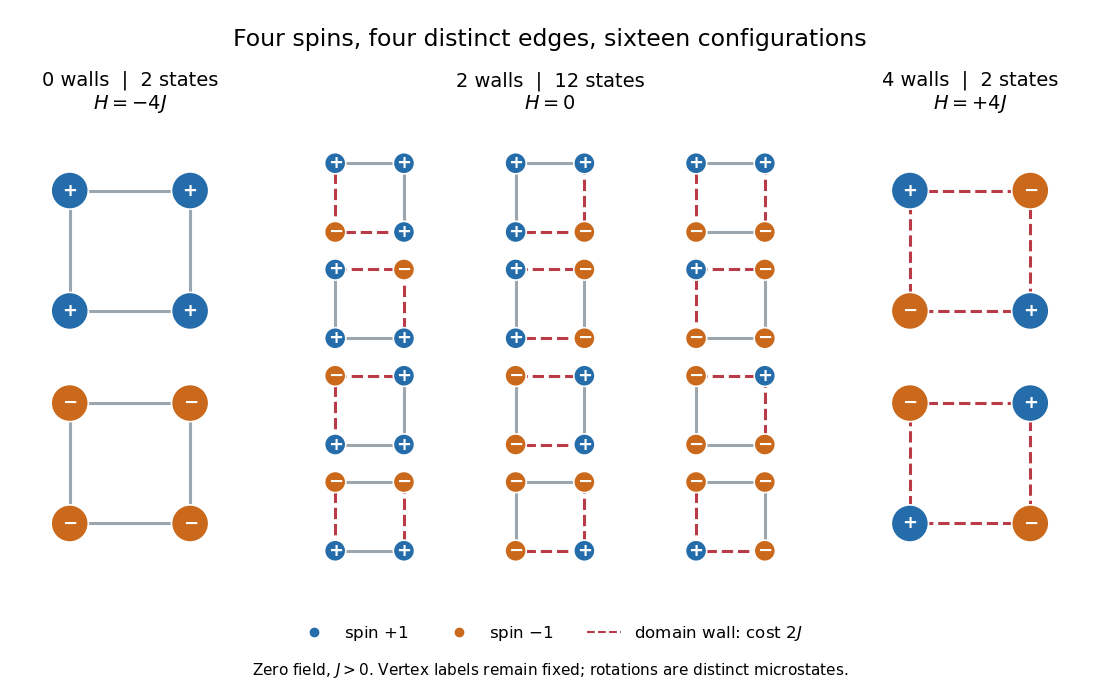

Writing , the partition function and the probability of each energy class areFor an original exact example, choose . Then , , and , , . Each aligned microstate has probability , each middle microstate , and each alternating microstate : multiply by state degeneracy before comparing whole classes. As , all sixteen microstates become equally likely, but the class probabilities approach . As , the two all-aligned microstates each have limiting probability .
The Ising ring bond correlation is the neighboring two-point correlation function in the four-spin Ising ring. All four edges are equivalent. At zero field each mean Ising spin is zero by spin inversion symmetry, so also equals the connected correlation function. Agreement gives bond product and disagreement ; thus .
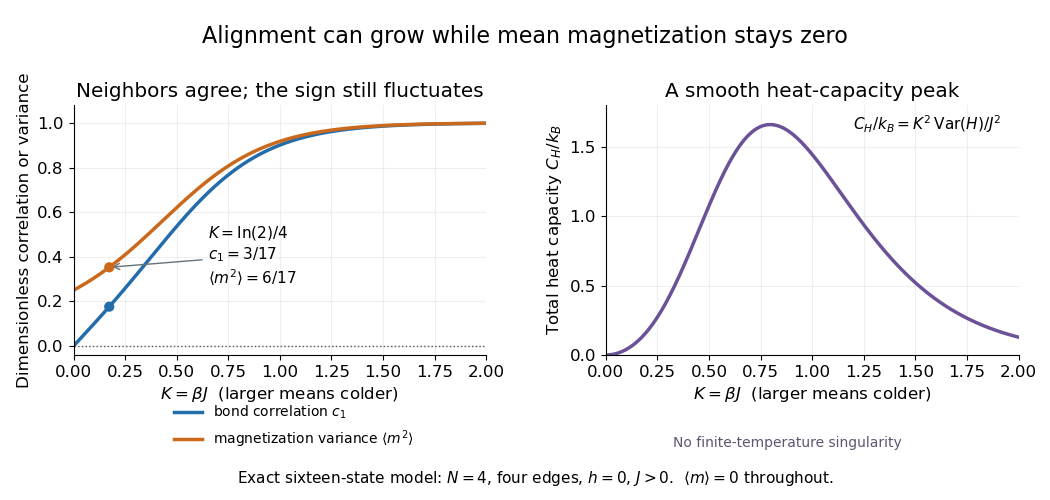
Differentiating the finite partition function with respect to inserts the sum of four bond products. ThereforeHere is internal energy. At , the class-weight calculation gives and . The agreement probability for a selected bond is , despite the exactly zero mean spin magnetization.
A second derivative gives the energy variance, and hence the heat capacity at fixed and :To see the variance identity directly, a derivative of an expected value under weights inserts , where . The factor follows from . At the same exact example, . The heat capacity vanishes both as and as : at high temperature its dimensionless factor vanishes, while at low temperature excited microstates become exponentially rare.
Define the instantaneous spin magnetization . Global reversal sends to without changing the zero-field energy. Pairing every microstate with its reversed partner proves at every positive temperature, even when almost all probability lies on the two fully aligned patterns. A vanishing mean does not imply weak alignment: the limiting probability distribution is half at and half at .
The Ising ring magnetization fluctuations measure this distinction through variance. In the class, both patterns have . Among the patterns, eight have and four have ; the two patterns also have . ConsequentlyIt equals at , approaches for four independent fair Ising spins at , and approaches as . Unlike the energy variance, the spin magnetization variance remains large in the low-temperature symmetric mixture.

The same thermal fluctuation controls the field response. Allow to vary before setting it to zero; differentiating the Boltzmann distribution inserts , givingThis is a spin-normalized magnetic susceptibility with respect to the energy-valued parameter ; conversion to physical magnetization and magnetic field requires the magnetic moment and sample volume factors.
For finite , is a finite positive sum of exponential functions. Its free energy is a real analytic function for , so the smooth heat capacity peak here is not a critical phase transition. Spontaneous magnetization concerns the order of limits: first a thermodynamic limit, then removal of a symmetry-breaking field. The four-spin Ising ring alone establishes neither that limit nor any two-dimensional Ising model result.[ref]
Statistical Physics by David Tong. §5.2.3, paragraph beginning with the analytic finite partition sum: phase transitions require the thermodynamic limit
Articles by others on the same topic
There are currently no matching articles.