Frequency and wavelength peaks of Planck's law
ID: frequency-and-wavelength-peaks-of-planck-s-law

At a fixed temperature, the frequency maximizing and the wavelength maximizing in Planck's law are different ways of describing the same black-body radiation. They are maxima of different densities. The inverse relation between frequency and wavelength does not preserve those maxima because its interval-conversion factor varies with wavelength.
For a short extremum calculation, substitute into , leaving a positive constant times . Substitute into , leaving a positive constant times . Setting each derivative to zero givesSelect the positive roots: and . Although solves the rearranged equations, it is an endpoint, not either peak. For or , the function initially increases, its derivative crosses zero once, and it eventually becomes negative. Hence it has exactly one positive root. Each density tends to zero at both ends, so this root gives its unique maximum. The bisection method brackets these roots in and .
Consequently Wien's displacement law givesThese constants agree with NIST's tabulation. [ref] The wavelength peaks at , , and are , , and . Doubling temperature halves this peak wavelength.
At , the frequency peak is , whose converted wavelength is . The peak is instead , corresponding to about . These numbers are compatible: equal-width frequency bins and equal-width wavelength bins partition the same radiation differently. Specifying which density was maximized is essential when using a peak to infer temperature.
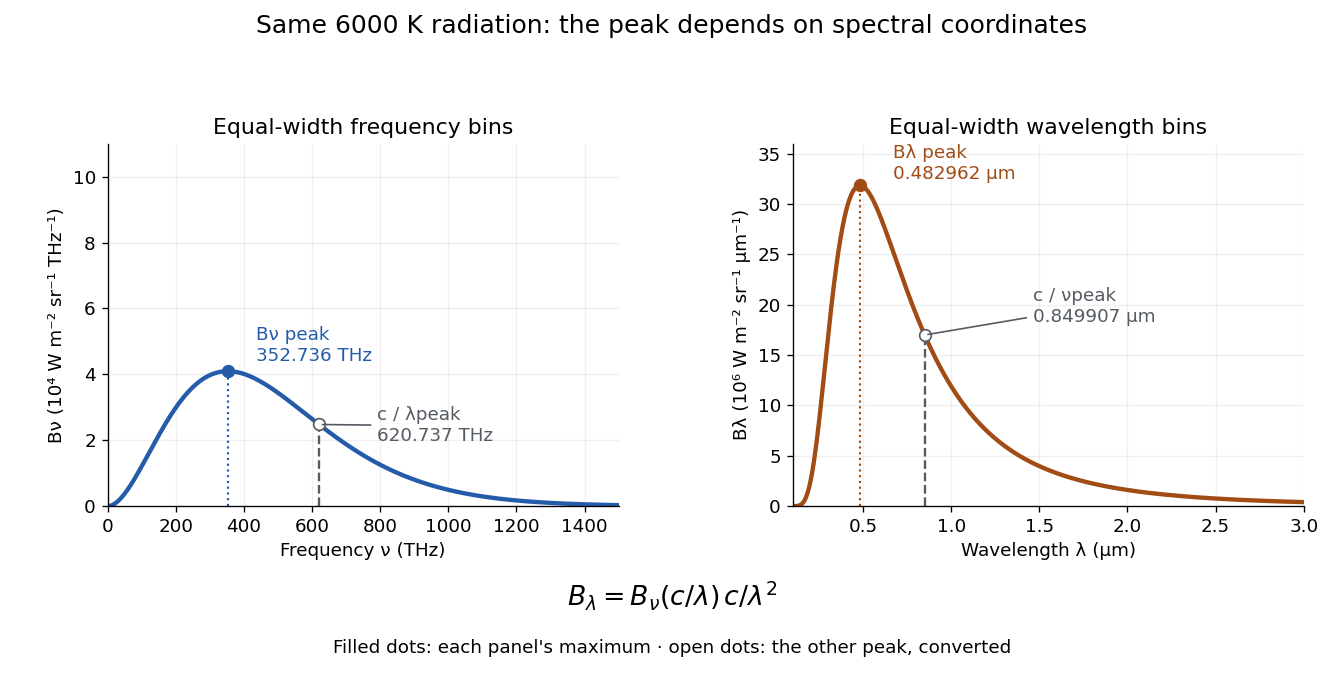
One spectrum, two spectral-coordinate peaks
. The left panel plots the Planck function per terahertz and marks its frequency peak. The right panel plots the same black-body radiation per micrometre and marks its wavelength peak. Dashed lines locate the counterpart of the other panel's peak. The converted frequency peak at is not the peak at : the change of variables changes density heights through . Details.
New to topics? Read the docs here!