Fringing field of a capacitor
ID: fringing-field-of-a-capacitor

The fringing field of a capacitor is the nonuniform electric field near the edges of its electrical conductors, extending outside the gap. For a parallel-plate capacitor, neglecting it is useful when the gap is much smaller than both plate widths; the approximation is less reliable when these lengths become comparable.
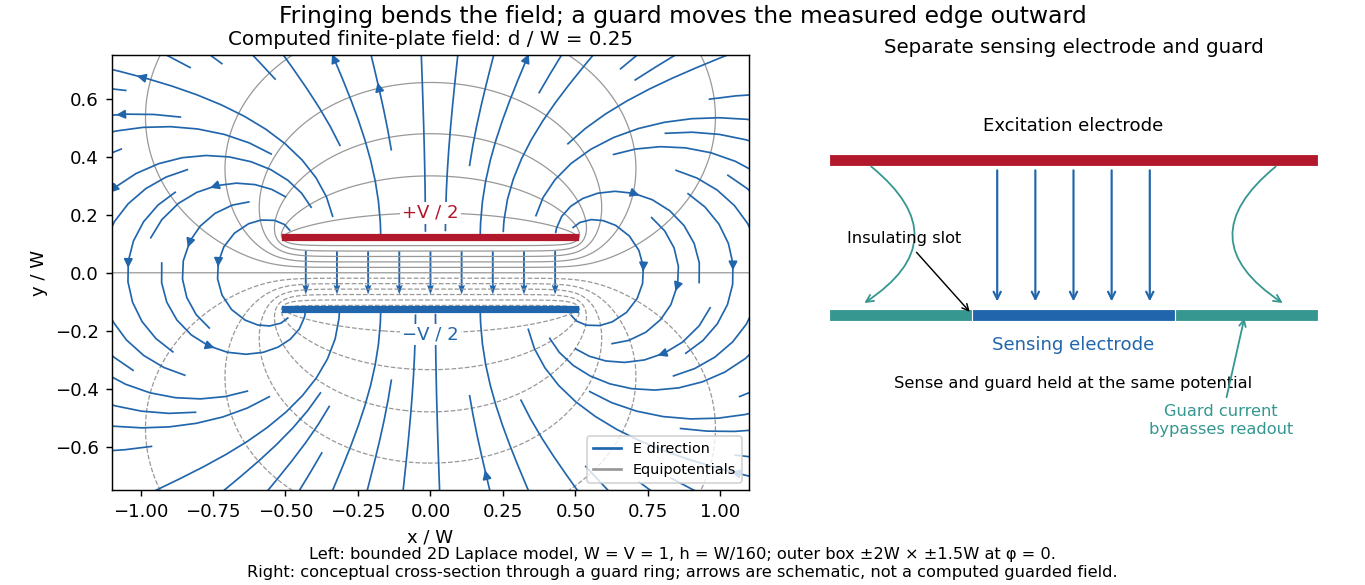
Finite plates break the translational symmetry of the infinite-plate model. Each conductor in electrostatic equilibrium is an equipotential, so the electric field must meet a smooth conducting surface normally. Near an edge, the equipotentials curve into the surrounding space and the electric field changes both direction and magnitude. The surface charge density adjusts to enforce the conducting boundary conditions; it is not uniform all the way to a sharp edge. The electrostatic boundary conditions at a conductor explain why zero electric field inside the metal does not imply zero electric field just outside it.
The practical issue is where the nearly uniform region ends. A probe near the centre can support while a probe close to an edge detects a lateral component and a different magnitude. A total capacitance reading also includes electric flux outside the simple footprint. The fringing field of a capacitor can therefore matter in permittivity measurements even when a central electric field measurement looks nearly ideal. Keysight's three-electrode fixture diverts the fringe contribution away from the measured response.[ref]
Materials Measurement: Dielectric Materials. Solution: fringe capacitance and the three-electrode 16451B fixture

New to topics? Read the docs here!