A conductor in electrostatic equilibrium is an electrical conductor at rest whose mobile charge carriers have finished redistributing, with no maintained bulk electric current. In the ideal macroscopic model,A residual bulk electric field would drive further electric charge redistribution. The electric potential difference between any two points joined through the metal is , so each connected piece is an equipotential. Gauss's law then gives zero net bulk charge density. This is a statement about net macroscopic electric charge, not the absence of positive atomic nuclei and negative electrons. Excess electric charge is represented by surface charge density; atomic surface structure is outside this continuum model. [ref].
The word inside must distinguish metal from a cavity in a conductor. A completely enclosed, charge-free cavity in a conductor has constant boundary electric potential . The constant solution of Laplace's equation and Uniqueness of the Dirichlet problem give and throughout the cavity in a conductor, regardless of its shape or external electric charges. Grounding is unnecessary for this inward electrostatic shielding; an isolated enclosure can change its overall electric potential without producing an internal electric field. Zero enclosed net electric charge alone would only give zero electric flux. A positive and negative pair inside a cavity in a conductor can have zero total electric charge and a nonzero electric field. [ref].
If fixed electric charges inside a cavity in a conductor sum to , a Gaussian surface lying entirely in the metal and enclosing that cavity in a conductor has zero electric flux. Thus the total induced inner-wall electric charge is . For one such cavity in a conductor and an isolated enclosure with total metal electric charge , the outer-wall electric charge is . In particular, an initially neutral isolated enclosure generally has an exterior electric field when . For fixed internal sources, external changes only shift the constant electric potential inside an isolated enclosure, leaving the internal electric field unchanged. [ref]
https://arxiv.org/abs/1609.04248. Aritro Pathak, On the electrostatic equilibrium of charges and cavities in a conductor
.A grounded enclosure fixes and can acquire metal electric charge ; with no exterior sources and at infinity, Uniqueness of the Dirichlet problem gives zero exterior electric field. With external sources present, the exterior electric field need not vanish, but it is independent of the internal sources at fixed grounded boundary electric potential. [ref]
https://www.feynmanlectures.caltech.edu/II_05.html#Ch5-S10. Feynman, Leighton and Sands, II.5.10: shielding by a closed grounded enclosure
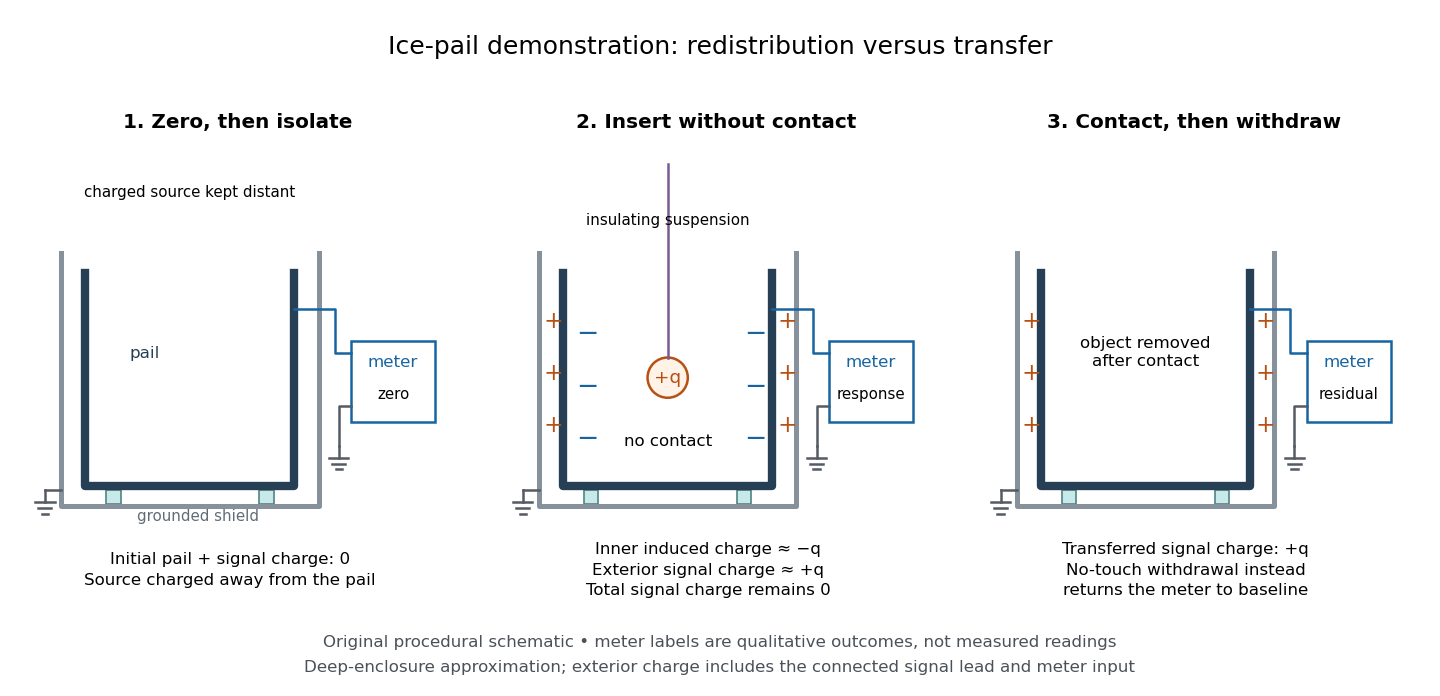
.Faraday's ice pail experiment makes the distinction between redistribution and transfer visible. In his letter of 4 February 1843, Faraday described an insulated pewter pail connected by wire to a gold-leaf electrometer, and a brass ball suspended on a long dry silk thread to reduce the hand's influence. He discharged the pail and charged the ball away from it. Lowering the ball without contact produced leaf divergence, which grew during entry and became approximately independent of further depth; withdrawing it collapsed the leaves. Contact with the bottom transferred electric charge, and the withdrawn ball was discharged. The readout was leaf divergence, not a direct map of the internal electric field. These observations distinguish electrostatic induction from contact transfer of electric charge. [ref]
https://physics.kenyon.edu/EarlyApparatus/Static_Electricity/Faradays_Ice_Pail/Faraday_Ice_Pail.html. Thomas B. Greenslade Jr., Faraday Ice Pail, reproducing Faraday's 1843 letter
.For a modern version of Faraday's ice pail experiment, connect an insulated inner metal pail to the signal input of a high-input-impedance electrometer, with its reference lead and an outer shield grounded. Zero and momentarily ground the pail, then isolate the signal side. Lower a charged paddle deeply without touching and record the electric potential difference; withdraw it and check return to zero. Repeat with contact, then withdrawal: a residual reading indicates transferred electric charge. Reverse the paddle's sign and repeat. The electrometer reads volts; inferring electric charge requires the effective capacitance of pail, cable and input, so a stable reading at fixed geometry is a relative measure, not automatically a value in coulombs. Keep supports clean, nearby charged objects distant, and the operator grounded; humidity can cause leakage. [ref]
https://cdn.pasco.com/product_document/Basic-Electrostatics-Sys-Manual-ES-9080B1.pdf#page=13. PASCO, Basic Electrostatics System manual, equipment description and demonstration 1A
.

A complementary electrostatic shielding demonstration uses a charged hollow metal enclosure, a small metal sampling ball on an insulating handle, and an electrometer. Discharge the sampling ball between trials; touch it to the exterior, withdraw it, and transfer its collected electric charge to the electrometer. Repeat by touching the inner wall without touching the exterior during withdrawal. The exterior sample produces a response, whereas the inner sample gives a null within instrument sensitivity. This compares accessible surface responses rather than assuming a perfectly spherical enclosure. [ref]
https://www.feynmanlectures.caltech.edu/II_05.html#Ch5-S8. Feynman, Leighton and Sands, II.5.8: inner and outer sampling of a charged conductor
. Useful additional controls are an uncharged enclosure baseline, a repeat exterior sample to verify sensitivity, and repeated trials at different depths. An access hole, charged handle, leakage or disturbed surface charge density limits the inference; a null bounds detectable transfer, rather than proving an exactly zero electric field. An open pail's depth plateau tests good enclosure empirically. Neither demonstration establishes shielding of arbitrary time-dependent electromagnetic fields.Connecting a conductor to a large reference reservoir fixes its electric potential, conventionally at zero, while allowing electric charge to enter or leave. Grounding does not fix the conductor's net electric charge. In electrostatics, its surface is then a prescribed-potential boundary for Poisson's equation.
Place an infinite sheet of surface charge density at between grounded conducting planes , in vacuum. Reflection symmetry and Gauss's law give in the two gaps. Integrating the electric field with zero electric potential at the conductors gives . Each facing conducting surface carries induced surface charge density . For , an electron released from rest at a plate reaches the sheet with kinetic energy ; its nonrelativistic speed follows from .
A cavity in a conductor is a void surrounded by an electrical conductor; completely enclosed is the essential qualification in exact electrostatic shielding arguments. At electrostatic equilibrium, the surrounding connected metal is an equipotential. An empty closed cavity in a conductor has constant electric potential and zero electric field, even if the metal is isolated and charged. An occupied closed cavity in a conductor generally has a nonzero electric field; its inner-wall total electric charge cancels the total electric charge of the internal sources. These are distinct statements, illustrated by Faraday's ice pail experiment.[ref]
Ideal Conductors. Richard Fitzpatrick, Ideal Conductors, equations 2.127 and the following uniqueness argument: a charge-free enclosed cavity
A spherical cavity of radius filled with fixed uniform charge density and surrounded by a grounded conductor has electric field inside and zero electric field outside the conductor when no external sources are present. Gauss's law supplies the interior electric field; integration from gives the displayed electric potential. Its stored electrostatic energy is , obtained by integrating over the cavity. Grounding permits the conductor's net electric charge to change.
Electrostatic shielding decouples interior and exterior electric fields using a conductor in electrostatic equilibrium. Exterior sources cannot produce an electric field in an empty closed cavity in a conductor, whether grounded or isolated. Outward independence requires grounding: internal sources can affect an isolated enclosure's exterior, as in Faraday's ice pail experiment. Grounding makes the exterior solution independent of internal sources, while allowing exterior sources' own response. Openings and changing electromagnetic fields need additional analysis.[ref]
The Feynman Lectures on Physics, Volume II by Richard Feynman and others. II.5, §5–10, concluding paragraphs on inward shielding and closed grounded enclosures
The electrostatic boundary conditions at a conductor relate the one-sided total electric fields at a smooth metal–vacuum interface. Choose a unit normal from metal into the adjacent vacuum, let and be the two limiting electric fields, and let be the signed surface charge density. A thin Gaussian pillbox with cap area has outward cap normals on the vacuum side and on the metal side. As its height tends to zero, its side electric flux tends to zero for bounded local electric fields, leavingThe minus sign comes from the second outward cap normal, not from the sign of the electric charge. A shrinking rectangular loop across the interface and the zero closed line integral in electrostatics give continuity of the tangential component:For a conductor in electrostatic equilibrium, , henceThus positive surface charge density gives an electric field away from metal and negative surface charge density gives an electric field toward metal. The derivative uses the same chosen unit normal, from the vacuum side. The ideal surface layer has no unique electric field value on the layer itself; these are limiting values. Ordinary surface electric charge preserves continuity of electric potential; an ideal electric dipole sheet would require a different model. [ref]
https://farside.ph.utexas.edu/teaching/em/lectures/node70.html. Richard Fitzpatrick, Boundary conditions for E and D: pillbox and loop conditions
.Here “exterior” means just outside the metal, including the vacuum within a cavity in a conductor. On a spherical inner wall of radius , its unit normal from metal into the cavity in a conductor is . A central positive point charge gives there, soThe outward normal of the cavity in a conductor as a volume is instead ; confusing these two unit normals reverses the inferred sign. For a stipulated spherical enclosure with inner radius , outer radius , no external sources and total isolated metal electric charge , spherical symmetry and Gauss's law give the analytical modelIts outer surface charge density is . Grounding to with zero electric potential at infinity instead gives and zero exterior electric field, while preserving the same nonzero electric field inside the charged cavity in a conductor.
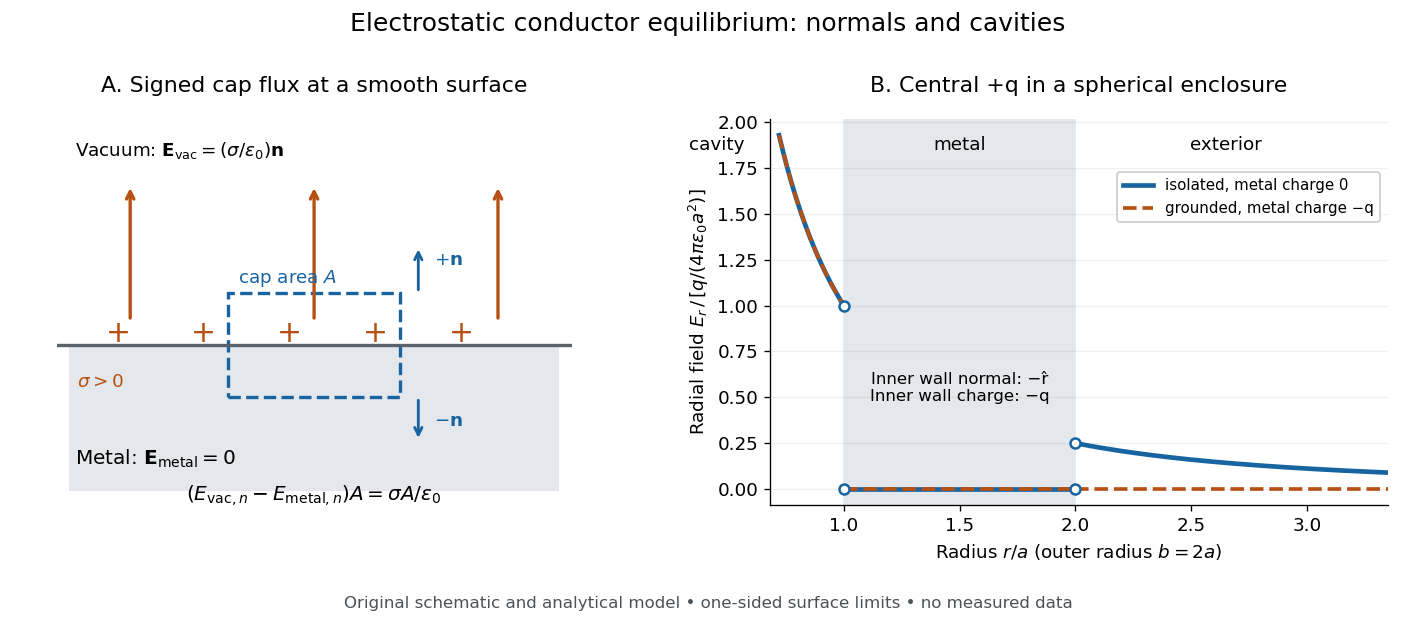
Signed Gaussian pillbox accounting and an analytical charged cavity in a conductor
. Original schematic and analytical model, not measured data. Left: the two cap normals give the normal electric field jump at a positive metal–vacuum surface. Right: a central positive point charge in a spherical enclosure with ; solid blue is an isolated initially neutral enclosure, and dashed orange is a grounded enclosure. Both have zero electric field in the metal and the same nonzero electric field in the cavity in a conductor. The jumps show one-sided limits, with the point-source singularity excluded. Details.
As a numerical sign check, stipulate , , and . The inner electric field is approximately along , but and . An isolated neutral enclosure has on the outer wall, approximately and just outside. Multiplying each surface charge density by its spherical surface area recovers the signed wall electric charges.
The local result uses the total electric field, including all induced and imposed sources. The factor follows from the zero metal-side electric field; a symmetric isolated sheet in vacuum instead has magnitude on each side. [ref]
https://www.feynmanlectures.caltech.edu/II_05.html#Ch5-S9. Feynman, Leighton and Sands, II.5.9: why a conductor differs from an isolated charge sheet
. At sharp corners, limiting electric fields can be singular and the smooth local pillbox argument needs care. In material outside the metal, use the normal free-charge jump of the electric displacement field and the material's permittivity, as in electrostatic interface boundary conditions. [ref]https://farside.ph.utexas.edu/teaching/em/lectures/node70.html. Richard Fitzpatrick, Boundary conditions for E and D: free and bound surface charge
.Surface charge density is electric charge per unit area. At a conductor in electrostatic equilibrium it equals for the normal pointing out of the conductor.
Two widely separated conducting spheres of radii connected by a thin wire have equal potentials, so a total charge divides as
Two connected concentric spherical shells form one equipotential conductor. In the absence of charge in the inner cavity, all net charge lies on the exterior surface of the outer shell.
A neutral conducting sphere of radius in the field has exterior potential and induced surface chargeThe surface integral of is zero.
A grounded hemispherical boss of radius on the grounded plane in an otherwise uniform downward electric field has the displayed exterior electric potential, with . It vanishes both on the hemisphere and on the surrounding plane, and tends to at large distance. The outward normal field gives surface charge on the hemisphere and on the plane at cylindrical radius . The apex field is , so a field-limited breakdown voltage is reduced by a factor three. For a capacitor with finite spacing , this is a leading local approximation; it is not an exact solution on the distant second plate.
Articles by others on the same topic
There are currently no matching articles.