Electric flux measures how much electric field crosses a chosen oriented surface, with a sign distinguishing the two crossing directions. A strong electric field running along a surface contributes nothing to its electric flux: only the normal component counts. This lets Gauss's law turn a potentially complicated electric field into one number recording the net enclosed electric charge.
For a surface with chosen unit normal , the electric flux is the surface integralHere is positive surface area, while is the vector area element. The dot product makes electric flux a signed scalar, rather than a vector like the electric field. Its SI unit is : electric field measured using the newton per coulomb, multiplied by surface area in square metres. Reversing the orientation of a surface replaces by and reverses the electric flux. Calling it electric flux does not imply that electric charge is moving through the surface. [ref]
https://www.feynmanlectures.caltech.edu/II_03.html#Ch3-S2. Feynman lectures II.3, §3–2: flux of a vector field
.For an open patch in a plane, with surface area and a constant electric field, the unit normal is constant and the surface integral simplifies toThe angle is between the electric field and the chosen unit normal, not between the electric field and the plane. The cosine describes the signed projected surface area seen by the electric field. Thus electric flux is positive for , zero at , and negative for . [ref]
https://openstax.org/books/university-physics-volume-2/pages/6-1-electric-flux. Ling, Sanny and Moebs, University Physics II, §6.1: electric flux
.For example, take and , so . Three choices of angle giveKeeping the patch fixed and reversing its unit normal gives and changes to . The electric field and physical patch have not changed. If the electric field is instead tangent to the patch, its dot product with the unit normal vanishes: electric flux is zero even though .
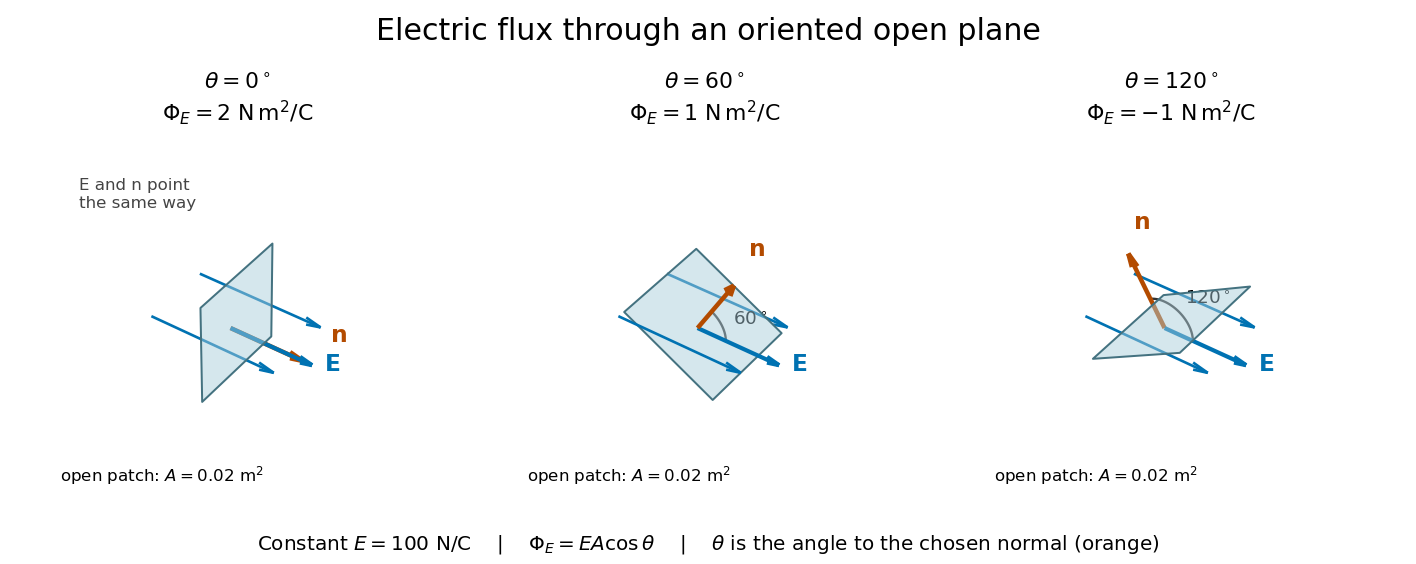
Three open patches in a plane in a constant electric field: the angle to the chosen unit normal gives electric fluxes of 2, 1 and minus 1 newton square metres per coulomb
. Details. For a closed surface enclosing a volume , choose the outward unit normal. Gauss's law givesHere is the vacuum permittivity, and is the signed total electric charge inside. The electric field in the surface integral includes all sources, including external electric charges. Assume no ideal point charge lies on the integration surface. Zero enclosed electric charge implies zero total electric flux; it does not imply zero electric field everywhere on the closed surface or inside it. Positive and negative contributions to the surface integral can cancel. [ref]
https://openstax.org/books/university-physics-volume-2/pages/6-2-explaining-gausss-law. Ling, Sanny and Moebs, University Physics II, §6.2: outward flux and enclosed charge
.To see the cancellation with sources inside, place point charges at and at , where , , and both lie inside the sphere of radius centered at the origin. This separated pair has the electric dipole geometry. Its enclosed electric charge is , so its total outward electric flux is zero. At the point on the sphere, Coulomb's law and the superposition principle give the individual electric fieldsThe components cancel and the positive components add:For the stipulated approximation and , this is about along positive . At , the outward unit normal is , so this nonzero electric field is tangent to the sphere. At other points of the sphere, its normal component can be positive or negative. The source-field formula applies away from the two point charges, where the electric field has zero divergence; it is singular at the sources. [ref]
https://www.feynmanlectures.caltech.edu/II_04.html#Ch4-S2. Feynman lectures II.4, §§4–1 and 4–2: electrostatic sources and superposition
.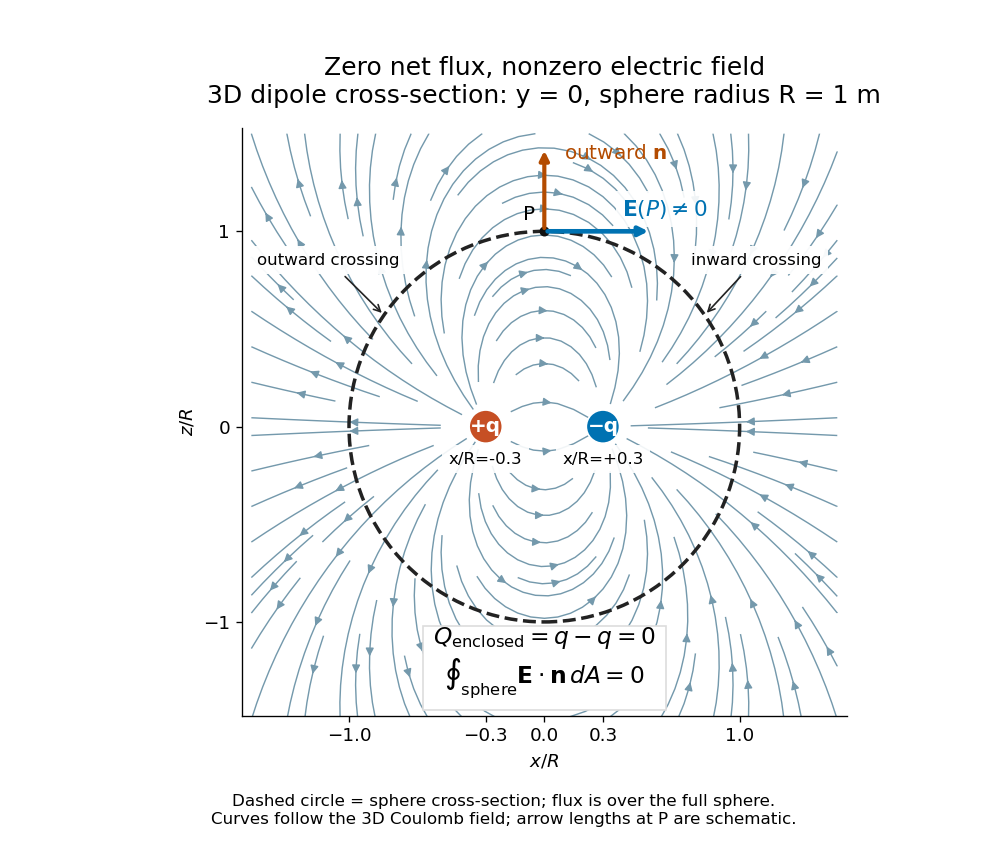
Cross-section of the three-dimensional electric field of two opposite point charges inside a unit-radius sphere: zero total electric flux coexists with a nonzero tangential electric field at the top
. Details. The diagram shows streamlines of the three-dimensional electric field in the section . The circle is a cross-section of the sphere, not the integration surface: Gauss's law uses the entire three-dimensional surface integral. A two-dimensional line integral of outward field around that circle would be a different quantity, with units rather than the electric flux units .
Articles by others on the same topic



Electric flux is a measure of the quantity of electric field passing through a given area. It is a concept from electromagnetism, specifically related to Gauss's law, which describes how electric charges create electric fields and how those fields behave through surfaces.