
The Hadamard gate is the unitary operatorwhere is the identity operator. It maps the computational basis to the Hadamard basis:
These outputs have equal computational-basis measurement probabilities, but their relative quantum phase differs. Applying another Hadamard gate sends them to different definite outputs. Calling this gate a classical coin toss would discard precisely the information that makes this possible. [ref]
https://quantum.cloud.ibm.com/learning/en/courses/basics-of-quantum-information/single-systems/quantum-information. Watrous, IBM Quantum Learning, unitary operations on qubits
.Starting from , compare two quantum circuits, reading matrix products from right to left:Here is the Pauli Z gate. After the first Hadamard gate, the probability amplitudes are . Inserting changes them to without changing their squared magnitudes. At the final gate, the contributions to output zero cancel and those to output one add. Without , cancellation occurs at output one instead. This is controlled interference, with the quantum phase determining which answer emerges.
The same calculation works for any phase gate :For example, gives , while gives . The output-one amplitude at is : its two complex contributions add before the Born rule is applied. A phase gate alone leaves the populations unchanged; recombination converts its relative quantum phase into observable probabilities.
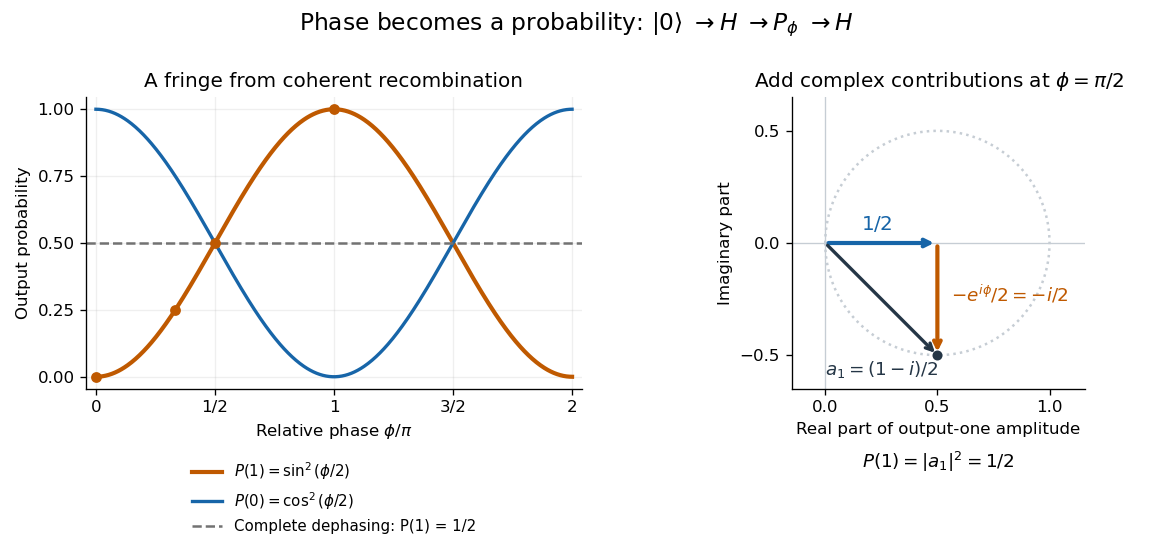
Hadamard interference: a relative phase changes output probabilities through complex amplitude addition; the dotted circle traces the output-one amplitude as the phase varies
. Details. If quantum decoherence completely removes the computational basis coherence between the gates, the intermediate density matrix becomes . Both the phase gate and final Hadamard gate leave unchanged, so for every . The disappearing fringe explains why preserving quantum coherence matters: it enables the gate sequence to carry phase information into the final measurement.

The Hadamard gate takes or (quantum states with probability 1.0 of measuring either 0 or 1), and produces states that have equal probability of 0 or 1.


New to topics? Read the docs here!