
The harmonic series is the positive seriesIts partial sums are the harmonic numbers . Although the individual terms tend to zero, grows without bound, so the harmonic series is not a convergent series. This is a basic warning against using the size of one term as a bound on all the terms still to come.
The growth is slow enough to be visually deceptive. The partial sums at are approximately . Adding ten times as many terms increases the accumulated total by roughly , rather than multiplying the total by ten. The telescoping series has similarly vanishing terms but approaches the finite sum one.
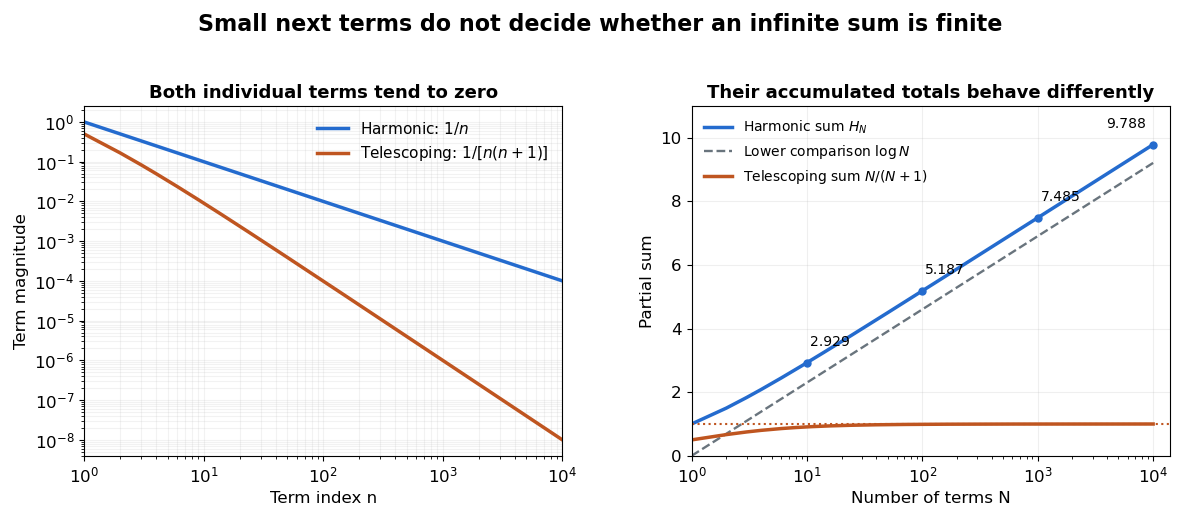

A short block argument proves the divergence without trusting a finite plot. For each integer , the block from through contains terms, each at least . ThereforeEvery doubling supplies at least another half, and arbitrarily many doublings are possible. A collection of tiny terms can still have a substantial combined contribution. See Jiří Lebl, Basic Analysis I, Example 2.5.11 for this grouping proof.
Integral comparison sharpens the growth estimate. Here denotes the natural logarithm. Since is a strictly decreasing function for positive , comparison of rectangles with the integral givesThus the divergence is logarithmic. The finer difference tends to the Euler--Mascheroni constant, approximately ; the harmonic number expansion supplies higher-order corrections. This turns the counterexample into a usable quantitative estimate of accumulated reciprocal contributions.
Euler's De progressionibus harmonicis observationes, written in 1734 and published in 1740, studies these sums beyond the yes-or-no question of convergence. Sections 2–3 compare long blocks to show continued growth, and later sections compare the sums with logarithms and calculate the constant offset. The [ref]
https://scholarlycommons.pacific.edu/euler-works/43/. Euler Archive record, E43
identifies the dates and original publication; [ref]https://download.uni-mainz.de/mathematik/Algebraische%20Geometrie/Euler-Kreis%20Mainz/E43.pdf. Alexander Aycock's translation of Euler's original paper
makes the calculations accessible. This is not a claim that Euler first discovered divergence: the paper's interest includes measuring how slowly a divergent sum grows. New to topics? Read the docs here!