A telescoping series has partial sums in which internal contributions cancel. The basic pattern is , for which finite summation givesOnly the two boundary terms survive. If tends to a finite limit of a sequence , the series consequently sums to . The cancellation is exact for each finite ; the infinite result then follows by a limit of a sequence.
For example, partial fraction decomposition givesThe first three terms are , with partial sum . The first five have partial sum . Taking the limit of a sequence gives the concise answer
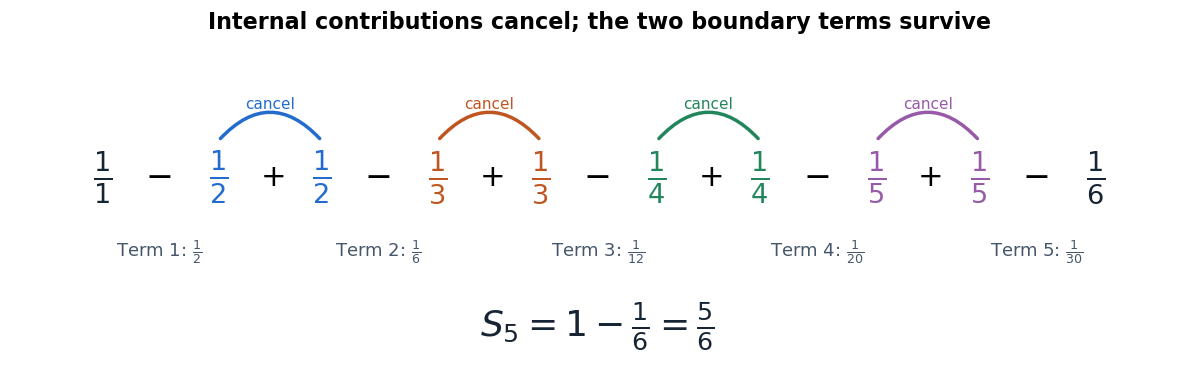
Five reciprocal-product terms cancel internally, leaving only the first and last boundary contributions
. Matching colors pair the negative in one term with the positive in the next. The cancellation leaves , the fifth partial sum, rather than the full infinite sum. Details.
The appeal is that a long calculation becomes a boundary calculation. It works whenever the summand is a successive difference, not only for rational functions. For instance, gives partial sum , so its series diverges despite the cancellation. A telescoping series therefore need not be a convergent series: one must still examine the surviving boundary term.
For the telescoping series , the remainder after the first terms is exactlyThus , , and . This supplies an exact stopping rule: to make the absolute error at most , 999 terms suffice. Requiring strictly less than instead needs at least 1000 terms.
The next term, , is smaller than the full remaining sum by a factor of . For example, after 99 terms the next term is , while the remainder is . The term test for divergence concerns individual terms; a reliable numerical approximation needs a bound on the whole remaining sum.
Articles by others on the same topic
There are currently no matching articles.