Image and preimage of a function
ID: image-and-preimage-of-a-function

The image of a function asks which outputs a chosen set of inputs reaches. A preimage asks which inputs reach a chosen set of outputs. Both constructions apply to every function, including one that loses information by sending several inputs to the same output. Their difference is useful whenever a transformation must be followed forward or a condition on its result must be traced back.
Consider the function withEvery input has exactly one output, but zero has two inputs and three has none. The full image of a function is , a proper subset of the codomain . Selecting inputs gives image . Selecting outputs instead gives preimage .
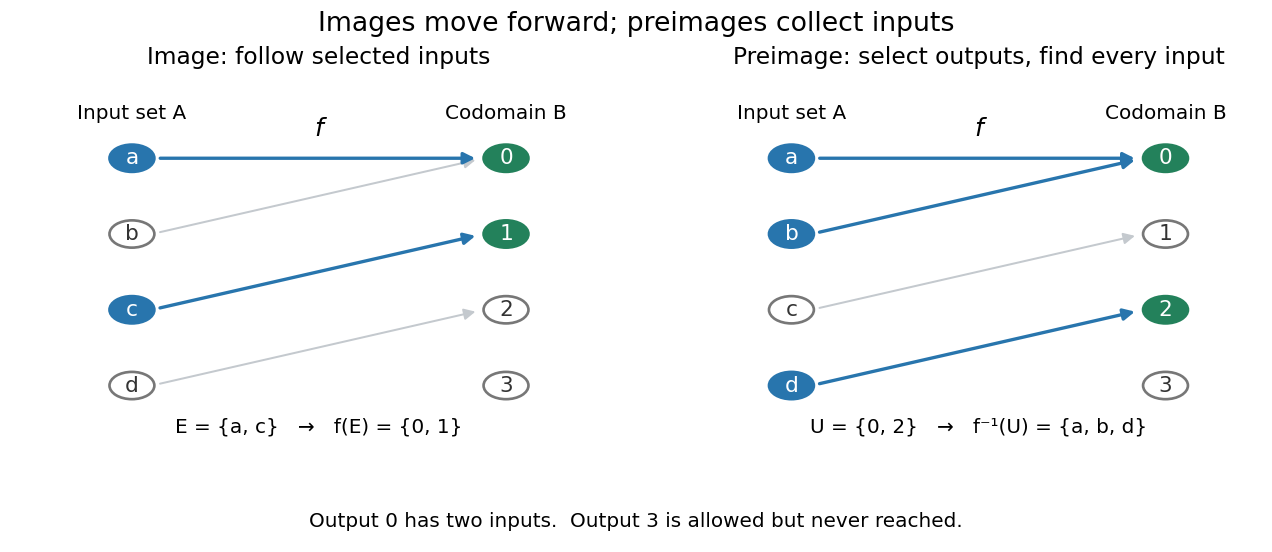

The function is not injective, because , and is not surjective onto , because three is absent from its image. Restricting only the codomain to makes the same rule surjective; it remains noninjective. This separates the output set actually reached from the target set specified in the definition. The definitions of images of a function and preimages, including the distinction from an inverse function, are given in Richard Hammack, Book of Proof, §12.6: Image and Preimage.
New to topics? Read the docs here!