The image of a function asks which outputs a chosen set of inputs reaches. A preimage asks which inputs reach a chosen set of outputs. Both constructions apply to every function, including one that loses information by sending several inputs to the same output. Their difference is useful whenever a transformation must be followed forward or a condition on its result must be traced back.
Consider the function withEvery input has exactly one output, but zero has two inputs and three has none. The full image of a function is , a proper subset of the codomain . Selecting inputs gives image . Selecting outputs instead gives preimage .
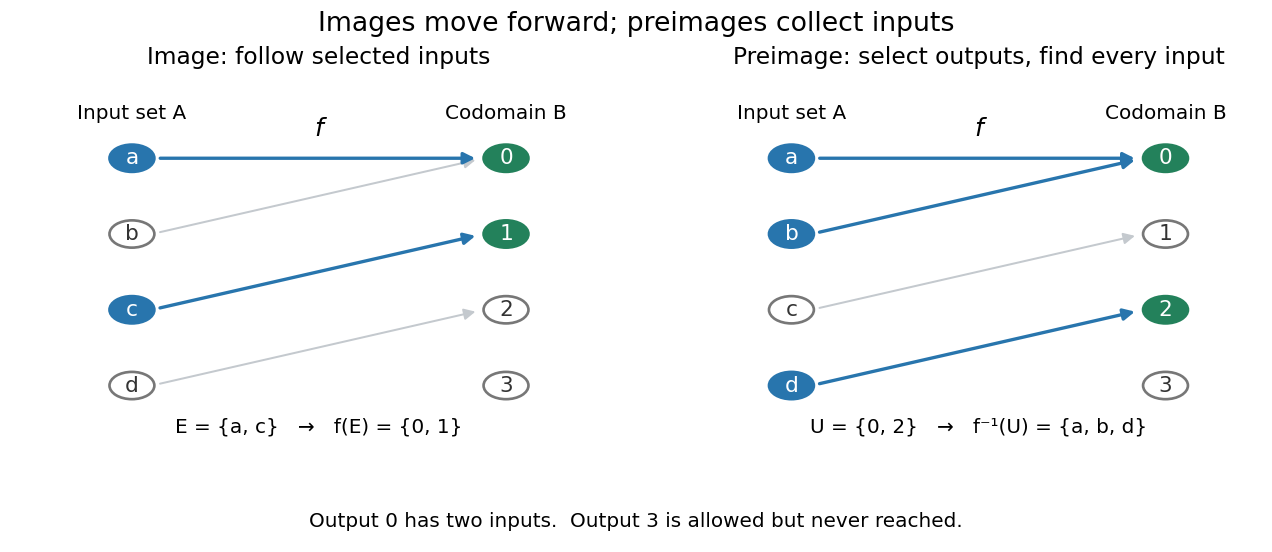

The function is not injective, because , and is not surjective onto , because three is absent from its image. Restricting only the codomain to makes the same rule surjective; it remains noninjective. This separates the output set actually reached from the target set specified in the definition. The definitions of images of a function and preimages, including the distinction from an inverse function, are given in Richard Hammack, Book of Proof, §12.6: Image and Preimage.
For a function and a subset , its image isThe full image of a function is . The set notation ignores repeated outputs: in the finite example above, , rather than a list containing zero twice. A function collision can therefore reduce the cardinality of an image.
Images of a function preserve unions:An output reached from the union is reached from at least one of its two input sets. For intersections, however, onlyholds in general. In the finite example, take and . Their intersection is the empty set, so . But , giving . Distinct witnesses in the two input sets can produce the same output.
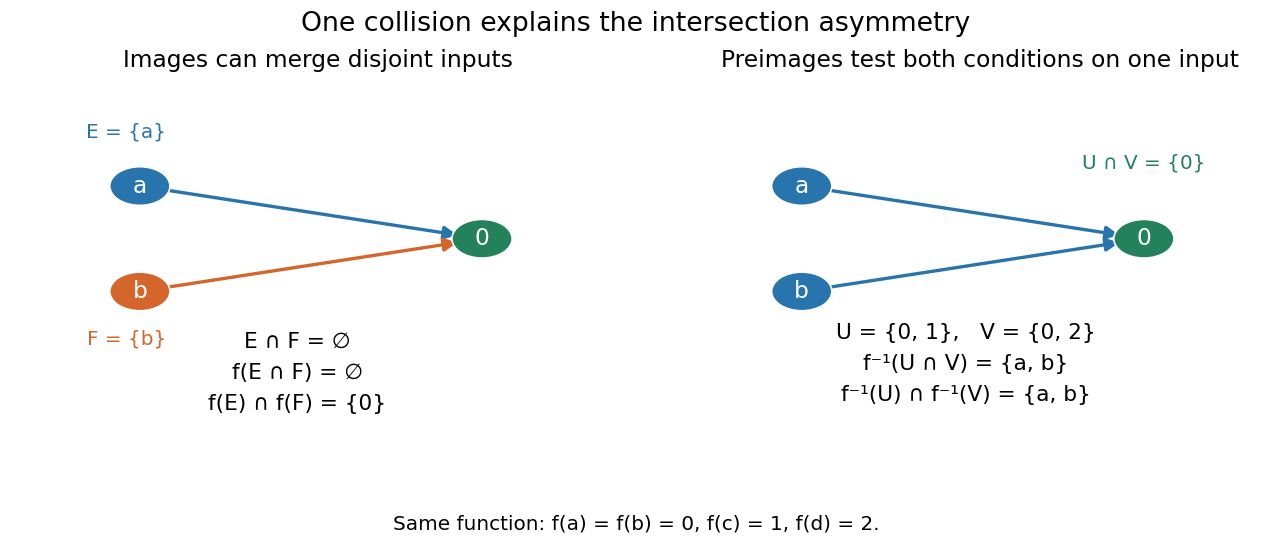
An image of a function can merge disjoint inputs, while a preimage tests both output conditions on the same input
. Details. 
For an injective function, an output shared by and must come from the same input. That input lies in , so equality holds. Conversely, preserving intersections for every pair of input subsets forces injectivity: two distinct inputs with the same output would give the singleton counterexample above. The image and preimage laws are stated in Jiří Lebl, Basic Analysis I, Propositions 0.3.15–0.3.16; the finite example makes the missing reverse inclusion visible.
For a function and a subset , its preimage isIt is a subset of the original domain of a function. The notation does not require an inverse function: the preimage of a singleton set can have no members, one member, or many members. In the finite example, , and . The preimage of a singleton set is also its fiber of a function.
For subsets , preimages preserve both unions and intersections:For the intersection, the same input belongs precisely when its single output belongs to both and . There is no opportunity to choose different witnesses, which is what made the image counterexample fail. The identities also hold for arbitrary families of output subsets.
In the finite example, choose and . ThenThe intersection of the two preimages is exactly the same set . Complements are preserved with respect to the appropriate source and target sets:For example, the unused output three contributes no extra input: with , both sides of the complement identity are . See Lebl, Proposition 0.3.15: preimages of unions, intersections and complements.
This makes preimages useful for transporting conditions. The solution set of is , and a zero set is a preimage of zero. Requiring two output conditions takes the intersection of their preimages. In topology, a continuous function pulls every open set back to an open set; a measurable function pulls the specified measurable sets in its codomain back to measurable sets in its domain of a function. These definitions use preimages because their set operations remain consistent even when the function is noninjective.
Let be a linear map between finite-dimensional vector spaces and a vector subspace of . The preimage is a vector subspace containing . To compute its dimension, choose a basis of and a basis of . Lift each to with . Then is a basis of : applying proves linear independence, and subtracting a suitable linear combination of the lifts reduces every element of the preimage to the kernel. This proves the displayed formula without using the rank-nullity theorem. Taking then proves the rank-nullity theorem itself.
Articles by others on the same topic
There are currently no matching articles.