
An incompressible flow preserves the volume of each moving fluid element. Its local condition is zero velocity divergence, . Combined with mass conservation, it says that each parcel's mass density stays unchanged as it moves. This does not require every parcel to have the same mass density: an initially nonuniform distribution can be transported without compression. Nor does incompressibility require a constant velocity or constant pressure.
For positive mass density, the continuity equation makes the equivalence precise:The material derivative follows a fluid element. Thus if and only if the velocity field is a divergence-free vector field. The distinction between following a parcel and observing a fixed position prevents confusing incompressibility with an unchanging density field. [ref]
https://uclnatsci.github.io/2021/Electromagnetism-Fluids-and-Waves/fluids/conservation.html. UCL, Conservation law derivations, sections 30.1–30.2
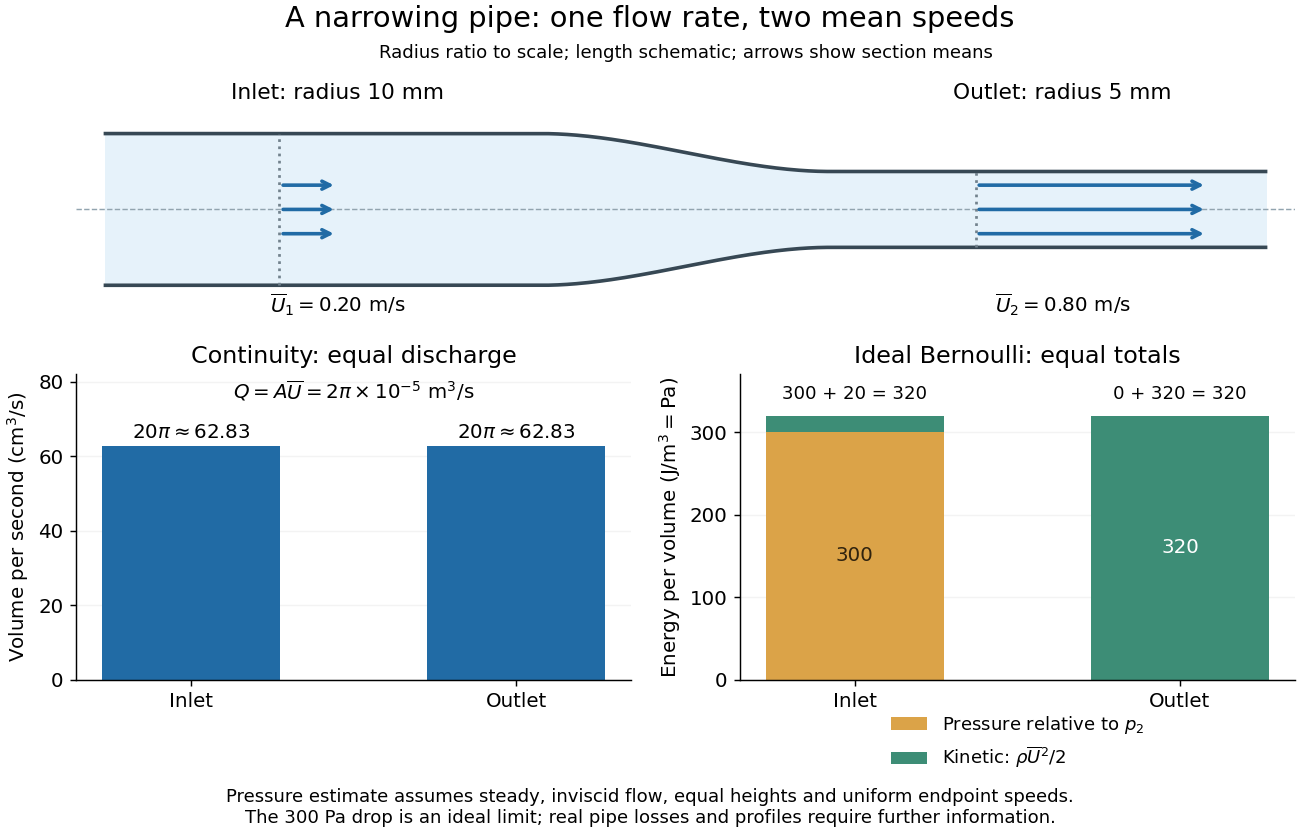
For a rigid pipe with impermeable walls, no leaks and steady flow, mass conservation at constant mass density implies a constant volumetric flow rate:Here points downstream, is the section's area and is the mean normal velocity, not necessarily the centreline speed. No assumption of inviscid flow or a uniform velocity profile is needed. If unequal amounts entered and left a fixed segment, its mass would accumulate, contradicting steady flow.
For a worked example, take horizontal water flow with stipulated mass density , inlet radius , outlet radius and inlet mean velocity . The circular areas giveThe radius halves, the area falls to one quarter, and the mean velocity quadruples. The mass flow rate is . The same amount of water passes both sections each second; narrowing changes its speed rather than compressing it. The Reynolds number and Bernoulli's principle discussions use this same example to examine viscous effects and the additional assumptions needed to calculate pressure.


Incompressible flow refers to fluid flow in which the fluid density remains essentially constant throughout the flow field. This assumption is commonly applied in fluid dynamics, especially for liquids and gases at low speeds, where changes in pressure and temperature do not lead to significant changes in density. ### Key Characteristics of Incompressible Flow: 1. **Constant Density**: The most fundamental characteristic of incompressible flow is that the fluid density does not change with pressure or temperature variations within the flow.
New to topics? Read the docs here!