
An infimal convolution is the cheapest way to split a prescribed total between two costs. Suppose two activities contribute and to a required total , costing and . Their combined cost is optimized over all splits , rather than charging both activities for the entire total.
For proper extended-real functions on a real vector space , defineThe definition does not require convexity. An infinite cost forbids that contribution, as with an indicator functional of a constraint set. If no split has two finite costs, set ; if the costs of admissible splits are unbounded below, . Thus proper inputs need not produce a proper extended-real function. The notation denotes the same operation. See Parikh and Boyd, Proximal Algorithms, §3.1 for the standard convex analysis definition and its connection to the Moreau envelope.
An infimum is a best lower bound, whereas a minimum is a value realized by some split. Writing in place of requires an attaining pair . For convex functions, mixing two nearly optimal splits and applying convexity to each cost proves that their infimal convolution is convex whenever it is proper; one must use nearly optimal splits because exact minimizers need not exist. Its convex conjugate is whenever the extended real number arithmetic is well defined; see conjugate of an infimal convolution for the precise identity. This turns the optimization over splits into addition in the conjugate variables.
Two quadratic costs: share the load according to its price. Let and let the convex quadratic functions beFor fixed , eliminate . The derivative of the total cost is , so equal marginal costs giveThe cheaper activity receives more of a positive total: when and , . Completing the square gives an exact certificate for every competing split:Consequently the infimum is a unique minimum, andThe effective quadratic coefficient is , with . It is smaller than either or : allowing both activities reduces the cost compared with assigning everything to either one. If , each receives half the total and . This is a simple quadratic optimization problem whose answer preserves the form of the original costs.
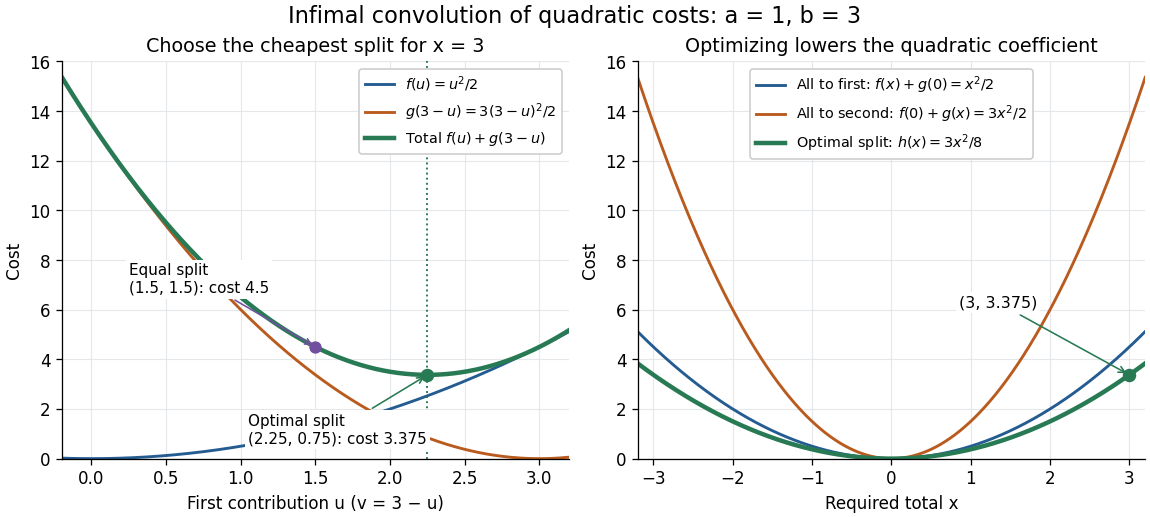
Optimizing the split of two quadratic costs gives a cheaper quadratic total cost
. An exact illustrative calculation, not measured data: , and give and cost , compared with cost for an equal split. The right panel compares the optimized cost with assigning the whole total to either activity. Details.
Smoothing a corner by splitting its cost. Take the absolute value function and the convex quadratic function , with . This infimal convolution is the Moreau envelope of the absolute value function:Here is the sign function, with . The optimal is soft thresholding. In the central region, the quadratic function carries the whole total; outside it, stays at and the absolute value function carries the excess. At the result is the Huber loss in the normalization near zero and outside. Its derivative is for and outside, so the corner becomes a continuous change of slope. Parikh and Boyd's [ref]
https://web.stanford.edu/~boyd/papers/pdf/prox_algs.pdf#page=18. §3.1 discussion of Moreau smoothing
uses twice this normalization for the Huber loss; the explicit formula here fixes the convention. This is also the one-dimensional case of the existing Moreau envelope of the Euclidean norm.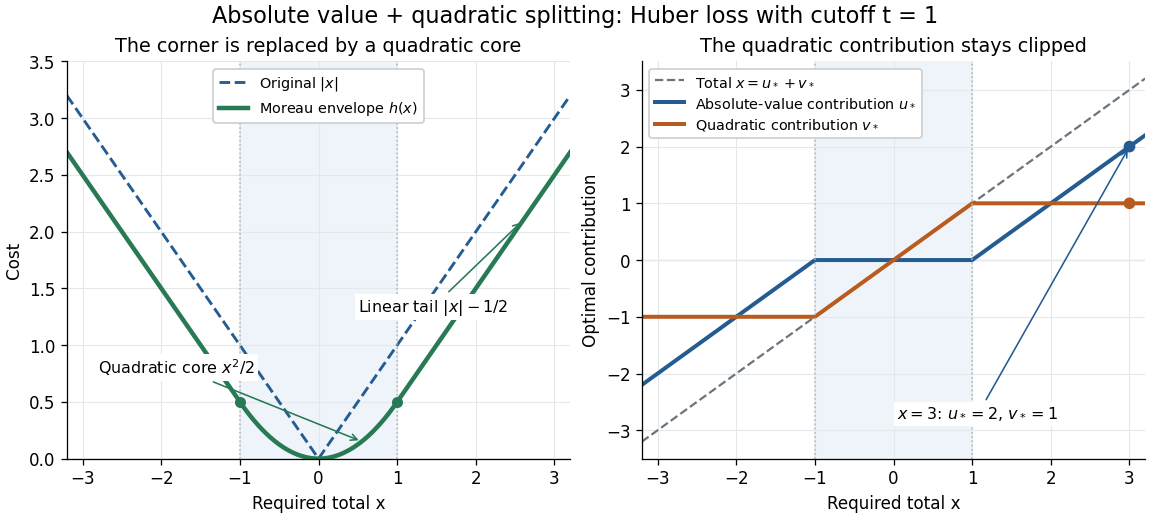

New to topics? Read the docs here!