Initial and boundary data for evolution equations
ID: initial-and-boundary-data-for-evolution-equations

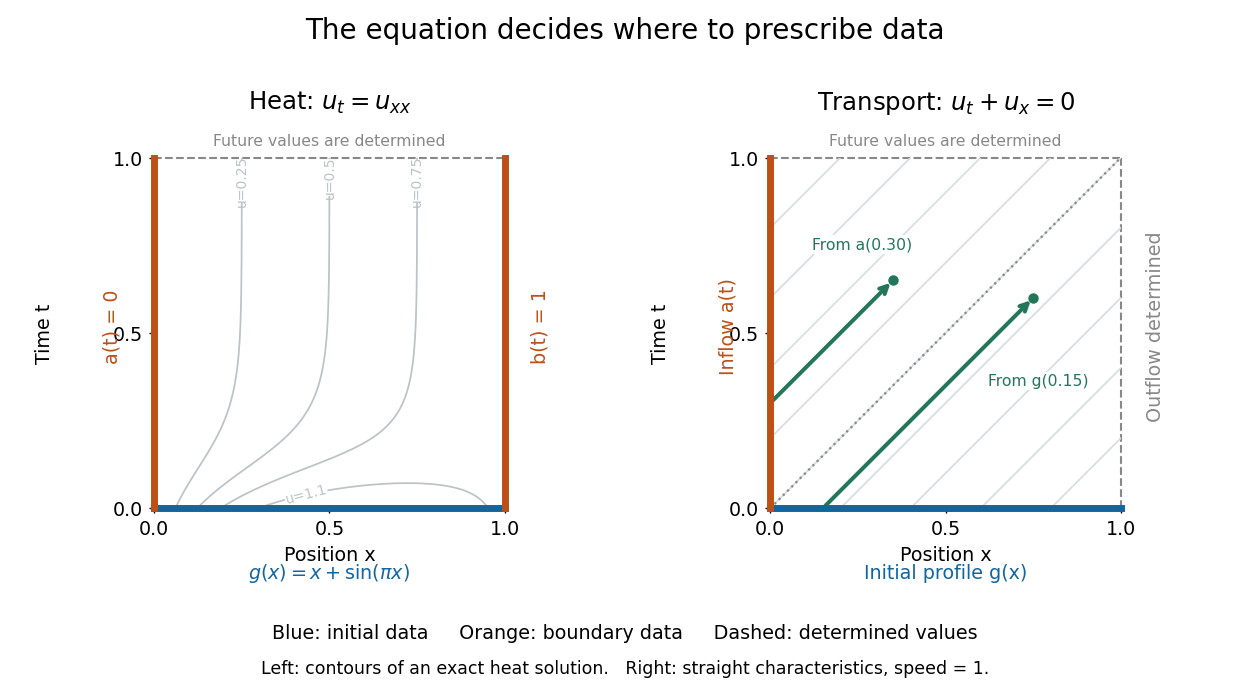
On , , an initial condition gives the starting profile. For the heat equation, Dirichlet boundary conditions , can model ends held at prescribed temperatures. Alternatively, zero Neumann boundary conditions describe insulated ends in the constant-conductivity model. These choices can produce different evolutions from the same initial condition.
For a continuous classical solution reaching the corners, the Dirichlet boundary data must satisfy and ; higher smoothness can require further compatibility. In dimensionless variables, a complete worked heat equation problem isIts exact classical solution is . The straight profile is the equilibrium; the extra bump decays. Substituting verifies the equation and every datum, and the energy estimate proves uniqueness among smooth solutions with these data.
For the transport equation with on the same interval, prescribe an inflow transport boundary condition only at . Backtracking a characteristic curve gives if , and otherwise. Values at are determined by this formula; independently prescribing them can make the problem inconsistent.[ref]

New to topics? Read the docs here!