
An integer partition of a nonnegative integer is a multiset of positive integers whose sum is : repetitions matter, but the order of the summands does not. Equivalently, write its parts in decreasing order, allowing equality:The notation says that is an integer partition of . The partition count counts all integer partitions of , with any number of parts. Zero has one empty integer partition, so . The partition of an integer article develops the same objects in representation theory of the symmetric group.[ref]
Enumerative Combinatorics, Volume 1 (second-edition draft) by Richard Stanley. section 1.7, definitions of partitions and diagrams
Computed example. The seven integer partitions of five are exactlyThus . Sorting each list of positive summands into decreasing order prevents repetitions in this enumeration. Grouping by largest part verifies completeness: largest parts contribute respectively possibilities. For largest part , the remaining is either or ; for largest part , the remaining uses only and , giving or .
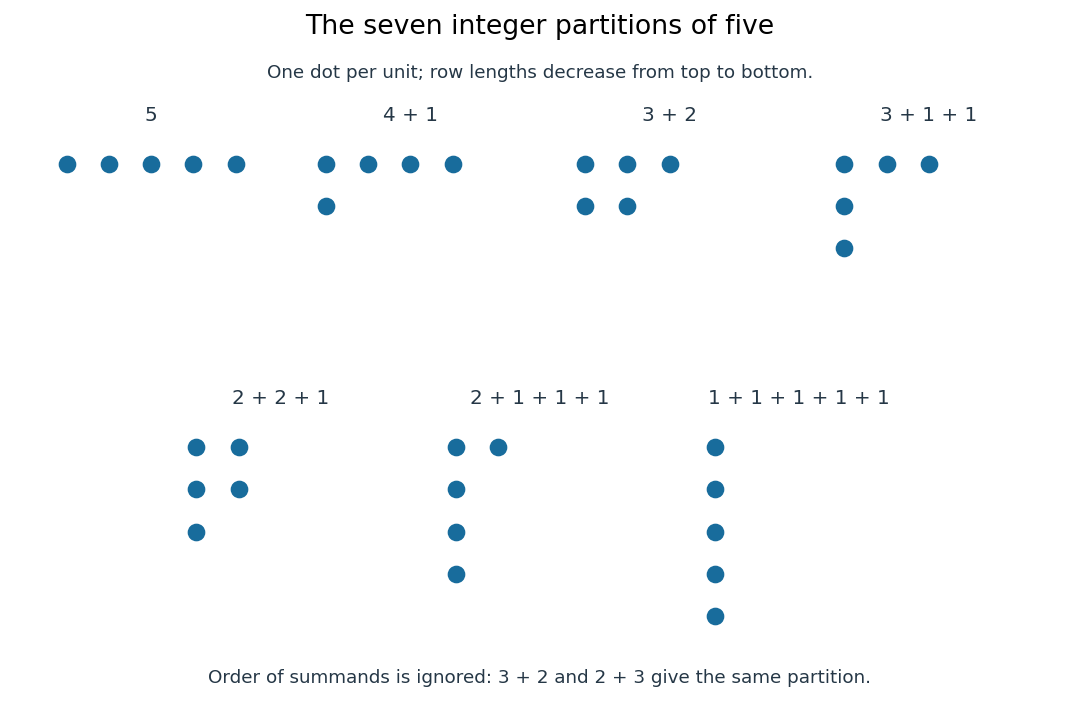
All seven integer partitions of five, drawn as Ferrers diagrams: each row has as many dots as its part
. Details. 
An integer partition keeps sizes without named positions. The compositions of an integer and are different tuples, but sorting either gives the same integer partition . A weak composition of an integer also retains its empty first position; dropping its zero and sorting gives that same integer partition. Conversely, a set partition records which distinct elements belong to each block. For example, the set partitions and differ even though both have the same integer partition of block sizes.
The Ferrers diagram makes an integer partition into a shape. For , the column lengths are : exchanging rows and columns gives its conjugate partition . Exchanging again recovers , so this operation is a bijection. In particular, the three integer partitions of five with at most two parts are , , and ; their conjugate partitions , , and are precisely the three with largest part at most two. This visible symmetry explains the equal counts for these two restrictions. The square-cell version is the existing Young diagram.
Counting by a generating function. An integer partition is determined by its multiplicities , the number of parts equal to . Its size condition is . Consequently its ordinary generating function isProof outline. Choose the term from the th geometric series. The product contributes exactly when those multiplicities describe an integer partition of , once for each such integer partition. As a formal power series, each coefficient is determined by finitely many factors: factors with contribute only their constant term to the coefficient of . For , multiplication through gives up to degree five, independently recovering . Restricting the factors gives the generating function for partitions with bounded parts. This is useful because restrictions on summands become choices of factors, while conjugate partitions turn restrictions on numbers of rows into restrictions on row lengths.[ref]
Enumerative Combinatorics, Volume 1 (second-edition draft) by Richard Stanley. section 1.8, conjugation and partition generating functions
New to topics? Read the docs here!