
An inverse function reverses a bijection. For , it is a function satisfyingEquivalently, for all and for all . We write . The superscript denotes reversal through function composition; it does not mean the pointwise multiplicative inverse . The preimage notation for a set is also distinct: a preimage exists even when no inverse function exists.
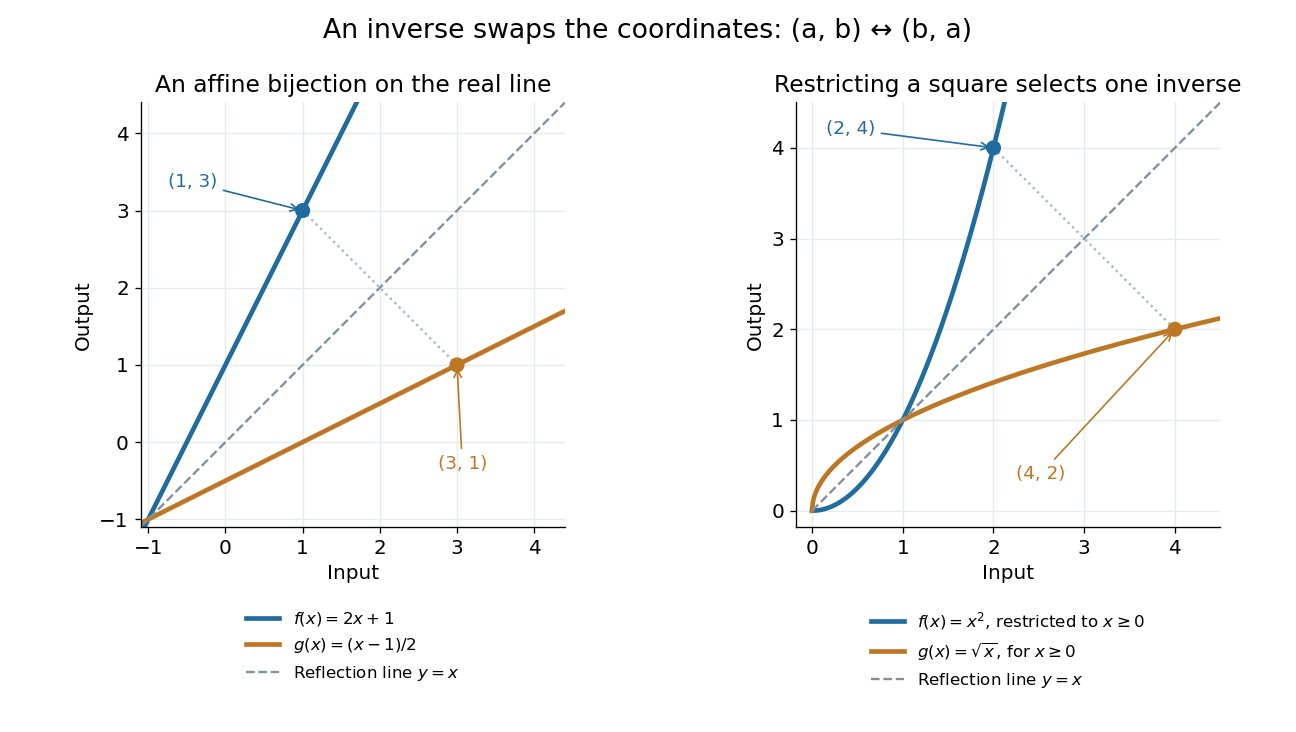
For a computed example, let be . Solving for gives . Thus and ; direct substitution gives and throughout the real line. In contrast, , which does not undo .
Why must be a bijection? If , applying gives , proving injectivity. For any , the equation supplies a source element, proving surjectivity. Conversely, a bijection supplies exactly one predecessor for each , defining a unique inverse function. A left inverse or right inverse requires only one of the two composition identities.
For on the real line, the equation has two solutions, , so its arrows cannot be reversed as one function on all inputs. The restriction to removes that ambiguity. As a bijection from onto , it has inverse function . The identity explains why works on the restricted domain of a function but fails for negative . [ref]
https://openstax.org/books/calculus-volume-1/pages/1-4-inverse-functions. OpenStax, inverse functions and domain restrictions
.
An inverse function swaps the input and output coordinates
. Left: the function graphs of and its inverse function are reflections across the line ; the points and correspond. Right: the nonnegative restriction and the square root have the same reflection relation. Their displayed portions lie in the first quadrant or on its boundary. Details.More generally, lies on the graph of a function precisely when lies on the graph of a function of its inverse function. This coordinate swap explains the geometric reflection and the horizontal line test. It also explains why inverse sensitivity is reciprocal locally: the inverse function rule divides by the original derivative at the corresponding input, when that derivative is nonzero.


New to topics? Read the docs here!