Jump response of a localized analyzing function
ID: jump-response-of-a-localized-analyzing-function

Let be an integrable function with at least one vanishing moment. For a unit jump discontinuity , where is the Heaviside step function, substitution into the coefficient givesThe signed integral of the whole analyzing function is zero, but the jump discontinuity cuts through its support of a function and usually leaves an unbalanced partial integral. At fixed relative position with nonzero partial integral, the coefficient decays as , slower than the Taylor remainder bound on a smooth region. “Edges survive” means this relative contrast: the normalized coefficients still tend to zero as .
For an original exact comparison, use the smooth polynomial at . The Haar wavelet and the second-difference analyzing function giveThe linear term cancels for ; it remains for . For the fixed unit jump discontinuity , choose so that at every scale. Then
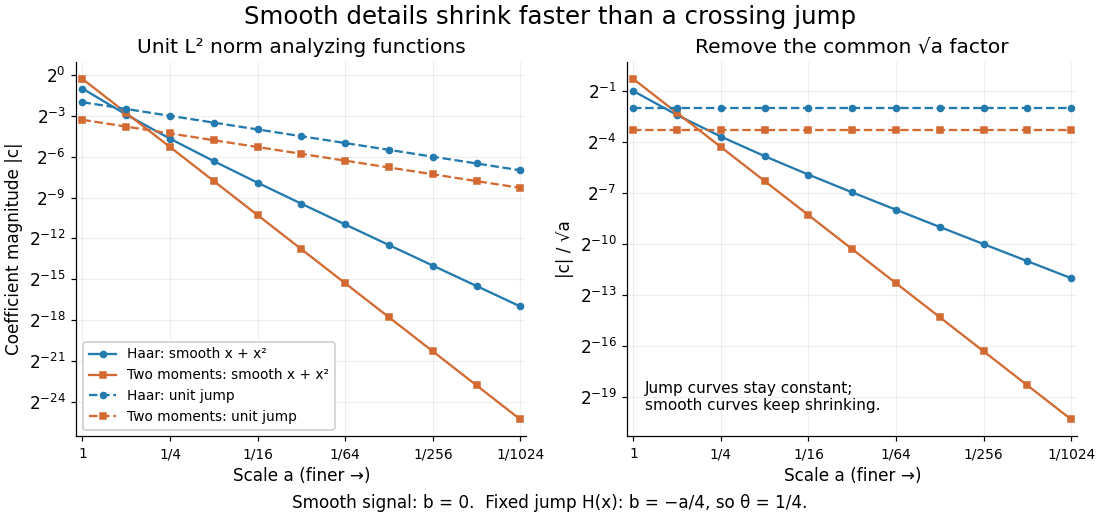

Position matters. If an analyzing function's support of a function lies entirely on one constant side of the jump discontinuity, its coefficient is zero. Even a crossing can cancel: has zero partial integral at . A jump discontinuity on a dyadic interval boundary can likewise escape finer Haar wavelets whose supports do not cross it. These examples describe particular functions and normalizations, not a universal ranking of wavelets for signal processing.
New to topics? Read the docs here!