
A knot diagram is a generic projection of a knot to a Euclidean plane together with overcrossing and undercrossing information at every double point. Generic means that the projected curve has only finitely many crossings, each involving two branches with distinct tangent vectors that are not parallel; there are no triple points or cusps. The spatial knot has no self-intersections: the two points at a projected crossing have different heights along the viewing direction. A gap in the lower strand records which one passes underneath.
Forgetting the over/under information leaves a knot shadow. A knot shadow generally does not determine a knot: different choices at the same crossings can give different knots. Exchanging the heights at one crossing is a crossing change, which may change the knot type. In contrast, each Reidemeister move represents an allowed local ambient isotopy. Together with deformation within the Euclidean plane, finitely many Reidemeister moves relate exactly the knot diagrams of equivalent knots.
For a concrete computed example, project the torus knot above onto the Euclidean plane with coordinates , retaining as height. Since , equal projected points require their longitudinal angles to agree, so distinct parameter values differ by or . Equating the radii then gives exactly four unordered pairs, with all parameters in units of :At each pair, the two heights are opposite and have absolute value ; the projected tangent vectors are not parallel. Thus these are verified crossings of a knot diagram, and the positive-height branch passes over the negative-height branch when viewed from positive .
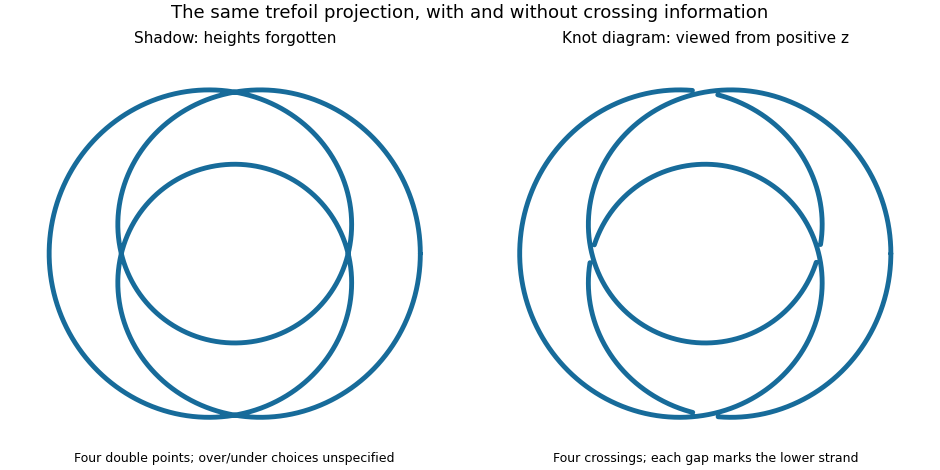

If denotes the number of crossings in a knot diagram of , then is the crossing number of a knot. The illustrated trefoil knot has but ; the unknot can have arbitrarily large while . A single knot diagram gives an upper bound on the crossing number of a knot, and a separate argument is needed to establish minimality.
New to topics? Read the docs here!