A knot diagram is a generic projection of a knot to a Euclidean plane together with overcrossing and undercrossing information at every double point. Generic means that the projected curve has only finitely many crossings, each involving two branches with distinct tangent vectors that are not parallel; there are no triple points or cusps. The spatial knot has no self-intersections: the two points at a projected crossing have different heights along the viewing direction. A gap in the lower strand records which one passes underneath.
Forgetting the over/under information leaves a knot shadow. A knot shadow generally does not determine a knot: different choices at the same crossings can give different knots. Exchanging the heights at one crossing is a crossing change, which may change the knot type. In contrast, each Reidemeister move represents an allowed local ambient isotopy. Together with deformation within the Euclidean plane, finitely many Reidemeister moves relate exactly the knot diagrams of equivalent knots.
For a concrete computed example, project the torus knot above onto the Euclidean plane with coordinates , retaining as height. Since , equal projected points require their longitudinal angles to agree, so distinct parameter values differ by or . Equating the radii then gives exactly four unordered pairs, with all parameters in units of :At each pair, the two heights are opposite and have absolute value ; the projected tangent vectors are not parallel. Thus these are verified crossings of a knot diagram, and the positive-height branch passes over the negative-height branch when viewed from positive .
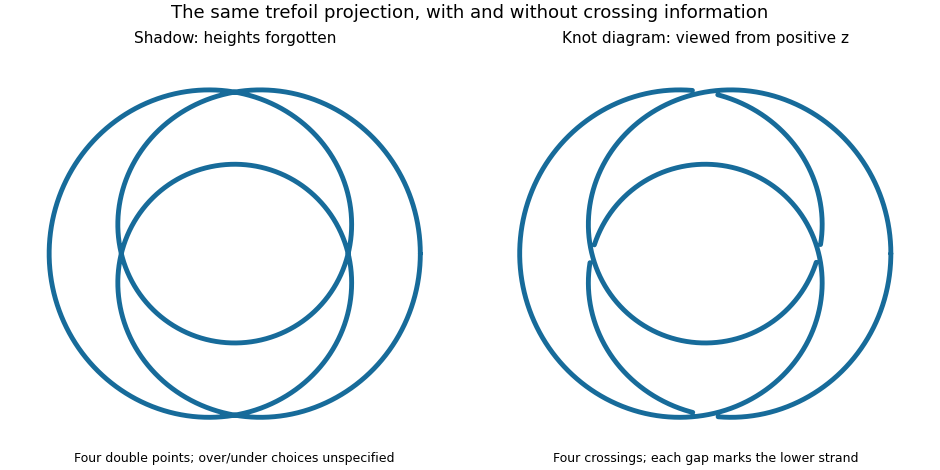

If denotes the number of crossings in a knot diagram of , then is the crossing number of a knot. The illustrated trefoil knot has but ; the unknot can have arbitrarily large while . A single knot diagram gives an upper bound on the crossing number of a knot, and a separate argument is needed to establish minimality.
A knot shadow is the curve in the Euclidean plane underlying a knot diagram after its overcrossing and undercrossing information has been erased. At a crossing the two local branches still continue across one another; the drawing does not specify which lies higher in space.
A crossing change exchanges the overpassing and underpassing strands at one crossing of a knot diagram. It generally changes the knot; unlike a Reidemeister move, it is not an isotopy. Two oriented band moves realize a crossing change as a genus-one knot cobordism.
An unknotting crossing is a crossing whose crossing change converts a knot into the unknot. It gives a genus-one knot cobordism to the unknot, and hence slice genus at most one after capping with a disk in .
A Gauss code records the successive crossings encountered when traversing an oriented knot diagram. Each crossing label occurs twice; overpassing/underpassing data and crossing signs make the code sufficient to recover its Wirtinger presentation and smoothing counts. Labels are arbitrary and cyclic starting points represent the same traversal.
Number the visits along an oriented knot diagram, and let exchange the two visits to each crossing. At an oriented smoothing, an incoming strand follows the outgoing strand of the other visit. Thus the cycles of the displayed permutation are exactly the Seifert circles. Their count gives the Seifert algorithm genus without requiring a separate drawing of the smoothed diagram.
A knot diagram is reduced when it has no nugatory crossing, equivalently no crossing can be isolated from the rest of the diagram by a circle meeting the diagram only at that crossing.
An alternating knot diagram alternates between overcrossings and undercrossings while traversing its component.
The Tait conjectures concern reduced alternating knot diagrams: they minimize the crossing number of a knot, have an invariant diagram writhe, and are related by flypes. These formerly conjectural assertions are now theorems; the first is the Tait crossing-number theorem.
Every reduced alternating diagram of a link has the minimum possible number of crossings. This result is one of the former Tait conjectures.
It is the minimum-crossing assertion among the Tait conjectures.
The three Reidemeister moves are local changes of a link diagram that create or remove a kink, create or remove two opposite crossings, or slide one strand past a crossing. Two diagrams represent isotopic links exactly when they are related by planar isotopy and finitely many Reidemeister moves.
Articles by others on the same topic
There are currently no matching articles.