For nonzero coprime integers , the torus knot lies on a standard unknotted torus in the three-sphere and winds times meridionally and times longitudinally. Here a meridian of a solid torus goes around the small cross-section of the doughnut, while the longitudinal direction goes around its central hole. The integers count signed turns, so changing one sign gives the mirror of a link of the torus knot. In this article is always the meridional count and the longitudinal count.
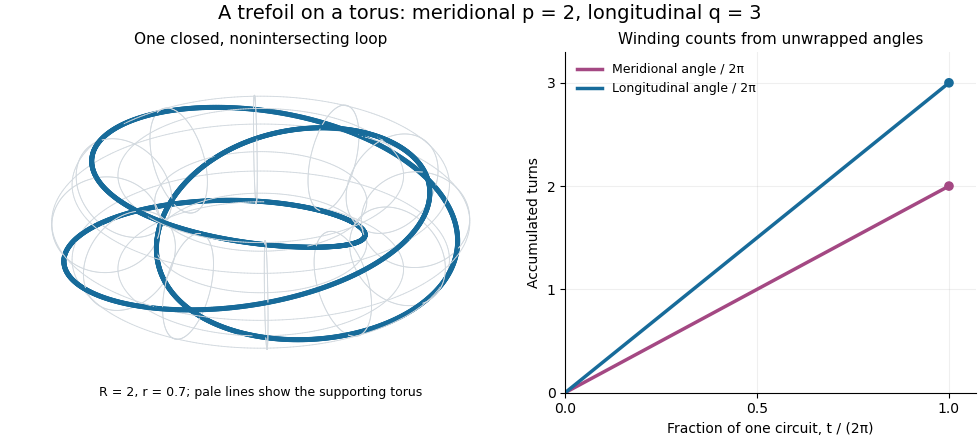
An explicit parametric curve in three-dimensional Euclidean space iswhere . Its cylindrical radius satisfies , the equation of the supporting torus. Its meridional angle is and its longitudinal angle is : this checks the convention directly rather than relying on the picture. Its squared speed isIf two parameter values give the same point, their difference satisfies . Bézout's identity for the coprime integers then gives . Thus the loop closes and is an injective function on the parameter circle, with nonzero derivative; it is a smooth embedding.
For example, , , , produces a trefoil knot. During one circuit the meridional angle changes by and the longitudinal angle by . The supporting torus is a guide for construction, not a constraint on later ambient isotopies: the knot may move off it. This family makes arithmetic visible as geometry: the coprime integers determine whether a single traversal visits the whole loop without repetition.
The coprime integers hypothesis matters. If the greatest common divisor is , the same parametric curve retraces a single component times; it does not automatically draw different components. The corresponding torus link is instead the full set of points on the torus whose angles satisfy , with meridional angle and longitudinal angle . It has disjoint components, each with winding counts . For instance, the torus link consists of two parallel loops and is a Hopf link, whereas substituting into simply traces one of those loops twice.
For coprime p,q with absolute values at least two, the knot group is . Its nontrivial central element maps nontrivially to the abelianization. A meridian , where , has infinite order in the quotient . A composite knot group would be an amalgamated free product of proper factors over its meridian subgroup, whose center lies in that subgroup. Then z would be a meridian power, contradicting the infinite order of the meridian modulo z.
// Target: geometric-group-theory.bigb
The trefoil is the torus knot . It is the simplest nontrivial knot by crossing number of a knot: . A standard three-crossing alternating knot diagram is reduced, so the Tait crossing-number theorem establishes minimality. The four-crossing knot diagram shown below also represents the trefoil knot, illustrating that a particular projection need not achieve that minimum. Its Seifert genus is one.
Here is a small algebraic certificate that a trefoil knot cannot be deformed into an unknot. One Seifert matrix for a trefoil knot isTaking the determinant gives the Alexander polynomial of a knotwhere allows multiplication by a Laurent unit in the Laurent polynomial ring. No such multiplication turns this three-term Alexander polynomial of a knot into the unknot's value . Since the Alexander polynomial of a knot is a knot invariant, this computation rules out every possible ambient isotopy between the two knots; it does not merely rule out the deformations we happened to try.
The knot group supplies another certificate. The presentation maps onto the symmetric group by and , since both sides of the relation map to the identity. These images generate a non-abelian group, so the knot group cannot be the unknot's infinite cyclic group. However, a trefoil knot and its mirror of a link have isomorphic knot groups: the abstract knot group alone does not distinguish all knots.
Articles by others on the same topic


A torus knot is a special type of knot that is tied on the surface of a torus (a doughnut-shaped surface). More formally, a torus knot is defined by two integers \( p \) and \( q \), where \( p \) represents the number of times the knot winds around the torus's central axis (the "hole" of the doughnut) and \( q \) represents the number of times it wraps around the torus itself.