A knot is the image of a smooth embedding , considered up to ambient isotopy. The circle supplies a closed loop with no free ends; the smooth embedding condition rules out self-intersections and requires a nonzero tangent vector in a regular parametrization. The equivalent convention uses the three-sphere: removing a point outside the knot identifies the remaining space with three-dimensional Euclidean space by stereographic projection.
More precisely, knots are equivalent if there is a smooth family of diffeomorphisms of the ambient space, for , such that is the identity and . Every intermediate remains a smooth embedding. This ambient isotopy allows bending, stretching and moving a loop, but neither cutting it nor letting strands cross through each other. We compare the embedded images rather than their parametrizations; an oriented knot additionally remembers a direction of travel.
For a worked example, start with , where is taken modulo , and useBoth scale factors stay positive, so each is a diffeomorphism. At the circle becomes the ellipse , yet its knot type is still the unknot. Exact lengths and angles are therefore irrelevant to knot type; self-intersection is the obstruction that the deformation must avoid.
The unknot is the knot type represented by the planar circleEquivalently, an unknot is a knot that bounds a smoothly embedded disk in the three-sphere. The disk must itself be embedded; merely filling a loop with a map that is allowed to intersect itself does not establish that the knot is an unknot. Flattening a neighborhood of an embedded spanning disk explains why this criterion recovers the planar circle.
A complicated drawing can still represent an unknot. Starting with a crossing-free knot diagram of , insert a small kink by a type I Reidemeister move. The resulting knot diagram has one crossing, but removing the kink exhibits the same unknot. Repeating in separate small regions gives knot diagrams of the unknot with arbitrarily many crossings, although the crossing number of a knot is . A drawing's apparent complexity is therefore not a certificate of knotting.
The normalized Alexander polynomial of a knot and Jones polynomial of the unknot are both , and its knot group is the infinite cyclic group , because the knot exterior is a solid torus. These are useful comparison values. In particular, a nonconstant Alexander polynomial of a knot certifies that a knot is not an unknot, but the converse fails: nontrivial untwisted Whitehead doubles also have Alexander polynomial of a knot .
The connected sum removes a short unknotted arc from each of two oriented knots and joins the four endpoints by an orientation-compatible pair of arcs.
Every nontrivial oriented knot is a finite connected sum of knots of prime knots, uniquely up to permutation and oriented link isotopy. Existence follows by induction from additivity of Seifert genus. For uniqueness, compare complete decomposing sphere systems for a knot and remove their intersection circles by the prime-ball exchange lemma. Once a prime ball is disjoint from both systems, its factor can be removed from both; induction then matches all factors.
A splitting sphere meets a knot transversely in two points. It is trivial when one of the resulting one-string tangles is boundary-parallel in its three-ball; otherwise it exhibits a nontrivial connected-sum decomposition.
A finite collection of disjoint splitting spheres of a knot encodes a connected sum of knots. Cut along every sphere and fill each spherical boundary with a three-ball containing a straight arc joining its two marked endpoints. The resulting oriented knots are the factors. The system is complete when its nontrivial factors are prime knots.
In a complete decomposing sphere system for a knot, a disk inside a prime-factor ball that meets the knotted arc once cuts its factor into a connected sum of knots. One side must be an unknot. Replacing the ball by the side carrying the prime factor therefore preserves the unordered factor list. A disk missing the arc cuts off an empty ball and gives the same conclusion. After a small transverse perturbation, such a replacement removes an innermost intersection circle with another sphere system. If a chosen innermost disk contains both marked points, another innermost disk, or its complementary disk when it is the only intersection, contains neither. Iterating produces a prime-factor ball disjoint from both systems. The replacement changes only the location of a joining arc in the intervening punctured ball; capping the other boundaries still recovers the same oriented factors.
For nonzero coprime integers , the torus knot lies on a standard unknotted torus in the three-sphere and winds times meridionally and times longitudinally. Here a meridian of a solid torus goes around the small cross-section of the doughnut, while the longitudinal direction goes around its central hole. The integers count signed turns, so changing one sign gives the mirror of a link of the torus knot. In this article is always the meridional count and the longitudinal count.
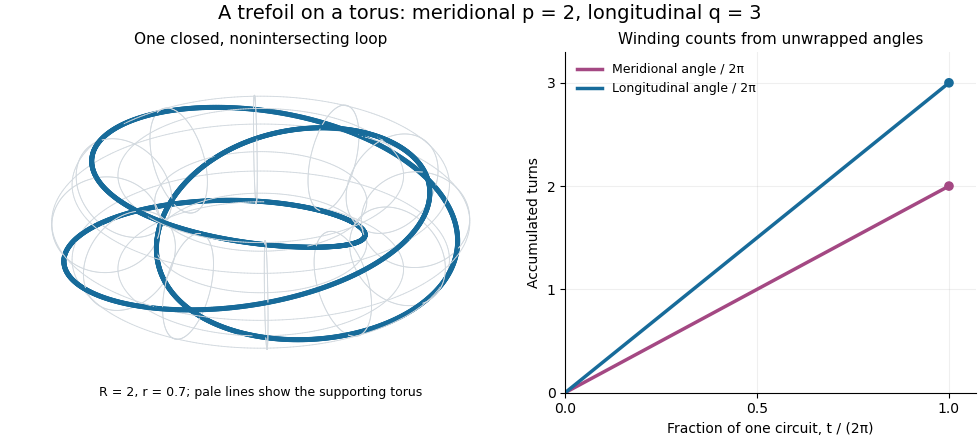
An explicit parametric curve in three-dimensional Euclidean space iswhere . Its cylindrical radius satisfies , the equation of the supporting torus. Its meridional angle is and its longitudinal angle is : this checks the convention directly rather than relying on the picture. Its squared speed isIf two parameter values give the same point, their difference satisfies . Bézout's identity for the coprime integers then gives . Thus the loop closes and is an injective function on the parameter circle, with nonzero derivative; it is a smooth embedding.
For example, , , , produces a trefoil knot. During one circuit the meridional angle changes by and the longitudinal angle by . The supporting torus is a guide for construction, not a constraint on later ambient isotopies: the knot may move off it. This family makes arithmetic visible as geometry: the coprime integers determine whether a single traversal visits the whole loop without repetition.
The coprime integers hypothesis matters. If the greatest common divisor is , the same parametric curve retraces a single component times; it does not automatically draw different components. The corresponding torus link is instead the full set of points on the torus whose angles satisfy , with meridional angle and longitudinal angle . It has disjoint components, each with winding counts . For instance, the torus link consists of two parallel loops and is a Hopf link, whereas substituting into simply traces one of those loops twice.
For coprime p,q with absolute values at least two, the knot group is . Its nontrivial central element maps nontrivially to the abelianization. A meridian , where , has infinite order in the quotient . A composite knot group would be an amalgamated free product of proper factors over its meridian subgroup, whose center lies in that subgroup. Then z would be a meridian power, contradicting the infinite order of the meridian modulo z.
// Target: geometric-group-theory.bigb
The trefoil is the torus knot . It is the simplest nontrivial knot by crossing number of a knot: . A standard three-crossing alternating knot diagram is reduced, so the Tait crossing-number theorem establishes minimality. The four-crossing knot diagram shown below also represents the trefoil knot, illustrating that a particular projection need not achieve that minimum. Its Seifert genus is one.
Here is a small algebraic certificate that a trefoil knot cannot be deformed into an unknot. One Seifert matrix for a trefoil knot isTaking the determinant gives the Alexander polynomial of a knotwhere allows multiplication by a Laurent unit in the Laurent polynomial ring. No such multiplication turns this three-term Alexander polynomial of a knot into the unknot's value . Since the Alexander polynomial of a knot is a knot invariant, this computation rules out every possible ambient isotopy between the two knots; it does not merely rule out the deformations we happened to try.
The knot group supplies another certificate. The presentation maps onto the symmetric group by and , since both sides of the relation map to the identity. These images generate a non-abelian group, so the knot group cannot be the unknot's infinite cyclic group. However, a trefoil knot and its mirror of a link have isomorphic knot groups: the abstract knot group alone does not distinguish all knots.
A satellite knot is obtained by embedding a patterned solid torus into a tubular neighborhood of a companion knot .
A pattern is a knot inside a solid torus. Embedding that torus as a tubular neighborhood of produces the satellite .
The winding number is the integer represented by the pattern in the first homology of the solid torus, equivalently its algebraic intersection number with a meridional disk.
For a pattern of winding number ,whenever the relevant signatures are defined by nonsingular forms. The usual averaged convention extends the identity through roots.
A Whitehead double is the satellite formed with the Whitehead pattern, which has winding number zero and whose image on the unknot is an unknot. The Satellite formula for the Alexander polynomial therefore gives for every untwisted Whitehead double.
A Seifert surface for an oriented knot is a compact connected oriented surface with oriented boundary .
A Hopf band is an annulus with one full twist whose boundary is a Hopf link. Plumbing it with another band adds a generator to the first homology of a Seifert surface. Its core has self-linking number or , depending on the twisting convention.
A Seifert hypersurface for an oriented codimension-two submanifold is an oriented codimension-one submanifold having it as boundary. For a closed oriented surface in , an integral meridional map from the complement to the circle, with angular behavior near the surface, supplies a Seifert hypersurface by taking a regular value.
Apply the oriented smoothing to every crossing of an oriented knot diagram, fill the resulting Seifert circles by disjoint disks at suitable heights, and reconnect them by twisted bands at the original crossings. The boundary is the original knot. If the connected surface has disks and bands, its Euler characteristic is and its genus is .
A Seifert circle is a component of the crossing-free diagram obtained by oriented smoothing at every crossing. These circles bound the disks used in the Seifert algorithm.
The Seifert genus is additive under connected sum of knots:The upper bound comes from boundary-connected-summing minimal Seifert surfaces, while the reverse inequality follows by cutting any Seifert surface for the connected sum along a splitting sphere.
For oriented curves on a Seifert surface, the Seifert form iswhere is a positive normal push-off of .
A Seifert matrix represents the Seifert form in an integral basis of . Its skew-symmetrization represents the intersection form of the surface and is unimodular.
Cut a knot exterior along a Seifert surface and stack copies to form its infinite cyclic cover. Linking-dual generators for the homology of the cut-open piece give the positive and negative inclusion matrices and in row convention. The gluing relations therefore have matrix . The H0 gluing map is multiplication by and is injective, so these relations present the entire Alexander module of a knot. Its order is the determinant, up to a Laurent unit.
The Conway polynomial is normalized by for the unknot, zero for a split unlink with more than one component, and the skein relation . For a knot, the symmetric Alexander polynomial with value one at is . This fixes the Laurent-unit ambiguity of the Seifert-matrix presentation of the Alexander module.
The symmetric Alexander polynomial normalized by the Conway polynomial is uniquely fixed for a knot. Its sign matters in the signed Jones evaluation at minus one, whereas the knot determinant retains only the absolute value.
A minimal-genus Seifert surface has a -by- Seifert matrix . Each entry of has degree at most one, so its determinant has breadth of a Laurent polynomial at most . This lower bound on Seifert genus need not be sharp: an untwisted Whitehead double can have Alexander polynomial of a knot and positive Seifert genus.
Assume . A nontrivial connected sum of knots has positive genus summands, and additivity of Seifert genus applies. Its Alexander polynomial of a knot is the product of the summand polynomials. If the polynomial is irreducible, one summand has unit polynomial; the other must then have polynomial breadth , exceeding twice its strictly smaller genus. This contradicts the Alexander breadth bound on Seifert genus. Irreducibility without the full-degree hypothesis alone does not imply primeness.
Every Laurent polynomial satisfying and is the Alexander polynomial of a knot up to multiplication by a unit .
The Alexander module is the first integral homology of the infinite cyclic cover of a knot exterior. Its deck transformation makes it a module over , and its first elementary ideal determines the Alexander polynomial of a knot.
Boundary-connected-summing Seifert surfaces gives a block-diagonal Seifert matrix, because basis curves in the separated summands have zero linking. The Seifert-matrix presentation of the Alexander module is block diagonal too. Thus the Alexander modules form a direct sum and their Alexander polynomials of a knot multiply up to a unit.
Given a presentation of a knot group, apply abelianization to the Fox derivatives . The resulting matrix over is an Alexander matrix; suitable maximal minors recover the Alexander polynomial of a knot.
For a reduced knot diagram with two adjacent starred regions, a Kauffman state chooses one corner at every crossing so that every unstarred region contains exactly one chosen corner. Terms in a determinant expansion of a Dehn-presentation Alexander matrix correspond bijectively to these states.
The knot determinant is . It is also the order of the first homology of the two-fold cover of branched over .
For , the Levine-Tristram signature is the signature of the Hermitian matrixIt is locally constant away from unit roots of the Alexander polynomial of a knot.
At , this becomes the signature of a knot.
The knot signature is the signature of the symmetrized Seifert matrix. Equivalently it is the signature of the double branched covering of over a pushed-in Seifert surface. At it agrees with the Levine-Tristram signature. It is additive under connected sum of knots, changes sign under reflection, and obeys . State the ambient orientation and push-off convention when assigning a sign.
For a reduced connected alternating knot diagram, its knot signature is , where counts circles in the all- bracket smoothing state and counts positive crossings. The convention is that the -smoothing at a positive braid crossing is the oriented smoothing, and a positive trefoil knot has knot signature . Reversing the global knot signature convention negates the formula.
Two Seifert forms are algebraically concordant when their difference is metabolic. Stable equivalence classes form the algebraic concordance group.
A nonsingular Seifert form on a -dimensional space is metabolic when it vanishes on a -dimensional subspace called a metabolizer.
The metabolizer is a half-dimensional subspace on which the Seifert form restricts to zero.
The algebraic concordance group over a field is the Witt group of nonsingular Seifert forms over , modulo metabolic forms.
An isometric structure consists of a finite-dimensional vector space , a nonsingular symmetric bilinear form , and a -isometry with the required nondegeneracy at . Metabolic isometric structures are quotiented out to form .
The Witt group of isometric structures identifies two isometric structures when their orthogonal difference is metabolic.
For an irreducible symmetric Laurent polynomial , the primary component isfor sufficiently large . Distinct symmetric primary components are orthogonal, so restriction defines a projection .
Extending an algebraic-concordance class from to a p-adic field detects torsion invisible over the real numbers. For , an odd-dimensional second-residue form generates the order-four part of the local Witt group.
The knot exterior is , where is an open tubular neighborhood of the knot. It is homotopy equivalent to the knot complement .
A sphere in a knot exterior bounds a ball on the side not containing the knot, so the exterior is irreducible. A compression disk for its boundary torus would cut the exterior to a manifold with sphere boundary; irreducibility makes that manifold a ball, and reversing the compression gives a solid torus exterior. Its meridian disk has boundary a preferred knot longitude, so adjoining the boundary annulus gives a spanning disk for the knot, which is then an unknot. The Loop theorem therefore makes the peripheral fundamental group injective for every nontrivial knot. In particular its knot group contains an injected copy of the torus group and cannot be cyclic.
The abelianization of a knot group is infinite cyclic. Nielsen changes of a two-generator free basis reduce its exponent vector to . In the cyclic-cover cellular chain complex, the first boundary is then , whose kernel is a free rank-one Laurent module. Quotienting by the lifted relator boundaries gives a cyclic module, regardless of the number of relators. A noncyclic Alexander module therefore obstructs every two-generator knot-group presentation.
Give every region of a knot diagram a generator and set the generator of the unbounded region to the identity. At a crossing, reading the four incident regions cyclically gives a relation , with the cyclic order reversed if the opposite convention is chosen. These relations form the Dehn presentation of the knot group.
An Alexander numbering assigns an integer to every region of an oriented link diagram so that crossing an oriented arc from right to left increases the integer by one. Under abelianization, a Dehn region generator with number maps to .
A Wirtinger presentation has one meridional generator for every arc of a knot diagram and one conjugacy relator at every crossing. For a connected diagram one crossing relator is redundant, giving a deficiency-one presentation of the knot group.
A Wirtinger generator is the meridian of a knot associated with an arc of a knot diagram between successive undercrossings. The overpassing meridian conjugates the incoming meridian to the outgoing meridian, with exponent determined by the crossing sign.
A meridian is an oriented simple closed curve on the boundary of a knot exterior that bounds a disk in the removed tubular neighborhood and has linking number one with the knot.
The infinite cyclic cover corresponds to the kernel of the abelianization . Its deck group is generated by , so its cellular chains and homology are modules over .
An alternating knot is a knot admitting an alternating knot diagram. A nonalternating diagram can still represent an alternating knot; the property of the knot is existential over its diagrams.
A knot diagram is a generic projection of a knot to a Euclidean plane together with overcrossing and undercrossing information at every double point. Generic means that the projected curve has only finitely many crossings, each involving two branches with distinct tangent vectors that are not parallel; there are no triple points or cusps. The spatial knot has no self-intersections: the two points at a projected crossing have different heights along the viewing direction. A gap in the lower strand records which one passes underneath.
Forgetting the over/under information leaves a knot shadow. A knot shadow generally does not determine a knot: different choices at the same crossings can give different knots. Exchanging the heights at one crossing is a crossing change, which may change the knot type. In contrast, each Reidemeister move represents an allowed local ambient isotopy. Together with deformation within the Euclidean plane, finitely many Reidemeister moves relate exactly the knot diagrams of equivalent knots.
For a concrete computed example, project the torus knot above onto the Euclidean plane with coordinates , retaining as height. Since , equal projected points require their longitudinal angles to agree, so distinct parameter values differ by or . Equating the radii then gives exactly four unordered pairs, with all parameters in units of :At each pair, the two heights are opposite and have absolute value ; the projected tangent vectors are not parallel. Thus these are verified crossings of a knot diagram, and the positive-height branch passes over the negative-height branch when viewed from positive .
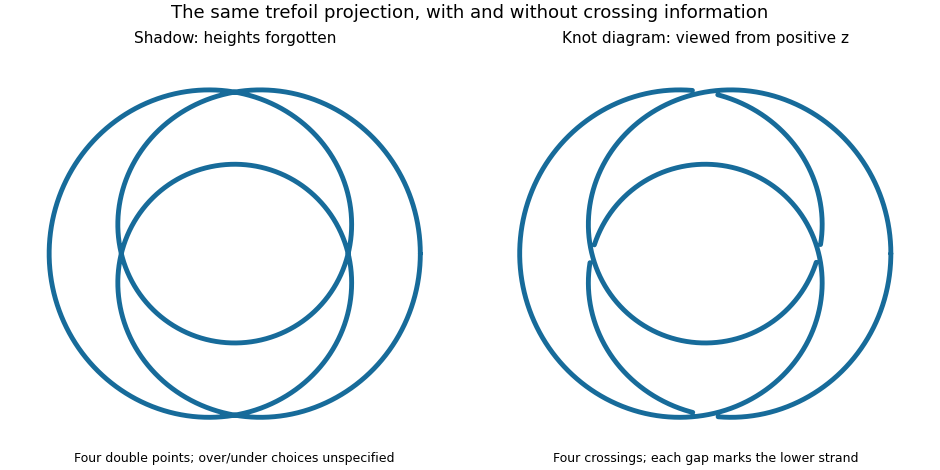


If denotes the number of crossings in a knot diagram of , then is the crossing number of a knot. The illustrated trefoil knot has but ; the unknot can have arbitrarily large while . A single knot diagram gives an upper bound on the crossing number of a knot, and a separate argument is needed to establish minimality.
A knot shadow is the curve in the Euclidean plane underlying a knot diagram after its overcrossing and undercrossing information has been erased. At a crossing the two local branches still continue across one another; the drawing does not specify which lies higher in space.
A crossing change exchanges the overpassing and underpassing strands at one crossing of a knot diagram. It generally changes the knot; unlike a Reidemeister move, it is not an isotopy. Two oriented band moves realize a crossing change as a genus-one knot cobordism.
An unknotting crossing is a crossing whose crossing change converts a knot into the unknot. It gives a genus-one knot cobordism to the unknot, and hence slice genus at most one after capping with a disk in .
A Gauss code records the successive crossings encountered when traversing an oriented knot diagram. Each crossing label occurs twice; overpassing/underpassing data and crossing signs make the code sufficient to recover its Wirtinger presentation and smoothing counts. Labels are arbitrary and cyclic starting points represent the same traversal.
Number the visits along an oriented knot diagram, and let exchange the two visits to each crossing. At an oriented smoothing, an incoming strand follows the outgoing strand of the other visit. Thus the cycles of the displayed permutation are exactly the Seifert circles. Their count gives the Seifert algorithm genus without requiring a separate drawing of the smoothed diagram.
A knot diagram is reduced when it has no nugatory crossing, equivalently no crossing can be isolated from the rest of the diagram by a circle meeting the diagram only at that crossing.
An alternating knot diagram alternates between overcrossings and undercrossings while traversing its component.
The Tait conjectures concern reduced alternating knot diagrams: they minimize the crossing number of a knot, have an invariant diagram writhe, and are related by flypes. These formerly conjectural assertions are now theorems; the first is the Tait crossing-number theorem.
Every reduced alternating diagram of a link has the minimum possible number of crossings. This result is one of the former Tait conjectures.
It is the minimum-crossing assertion among the Tait conjectures.
The three Reidemeister moves are local changes of a link diagram that create or remove a kink, create or remove two opposite crossings, or slide one strand past a crossing. Two diagrams represent isotopic links exactly when they are related by planar isotopy and finitely many Reidemeister moves.
A twist knot is obtained by closing two strands with a clasp after inserting a row of half-twists. Every nontrivial twist knot has Seifert genus one; a standard reduced alternating diagram with crossings in the twist region has crossings.
The figure-eight knot is the unique knot of crossing number of a knot four. It is prime, alternating, and has Alexander polynomial of a knot up to a unit.
The fundamental group of the figure-eight knot complement has the displayed two-generator one-relator presentation. It follows from the Artin automorphism of a braid for by eliminating the third meridian from its fixed-generator presentation.
Articles by others on the same topic
There are currently no matching articles.