
The Laplacian takes the divergence of a scalar field's gradient. For a real-valued function on an open region of Euclidean space, with continuous partial derivatives through order two, its expression in a Cartesian coordinate system isThus the Laplacian, also called the Laplace operator, adds the coordinate second derivatives; equivalently it is the matrix trace of the Hessian matrix. Its output is another scalar field.[ref]
The Feynman Lectures on Physics, Volume II by Richard Feynman and others. Volume II, §2–7, equations 2.52–2.54: divergence of a gradient and the Cartesian Laplacian
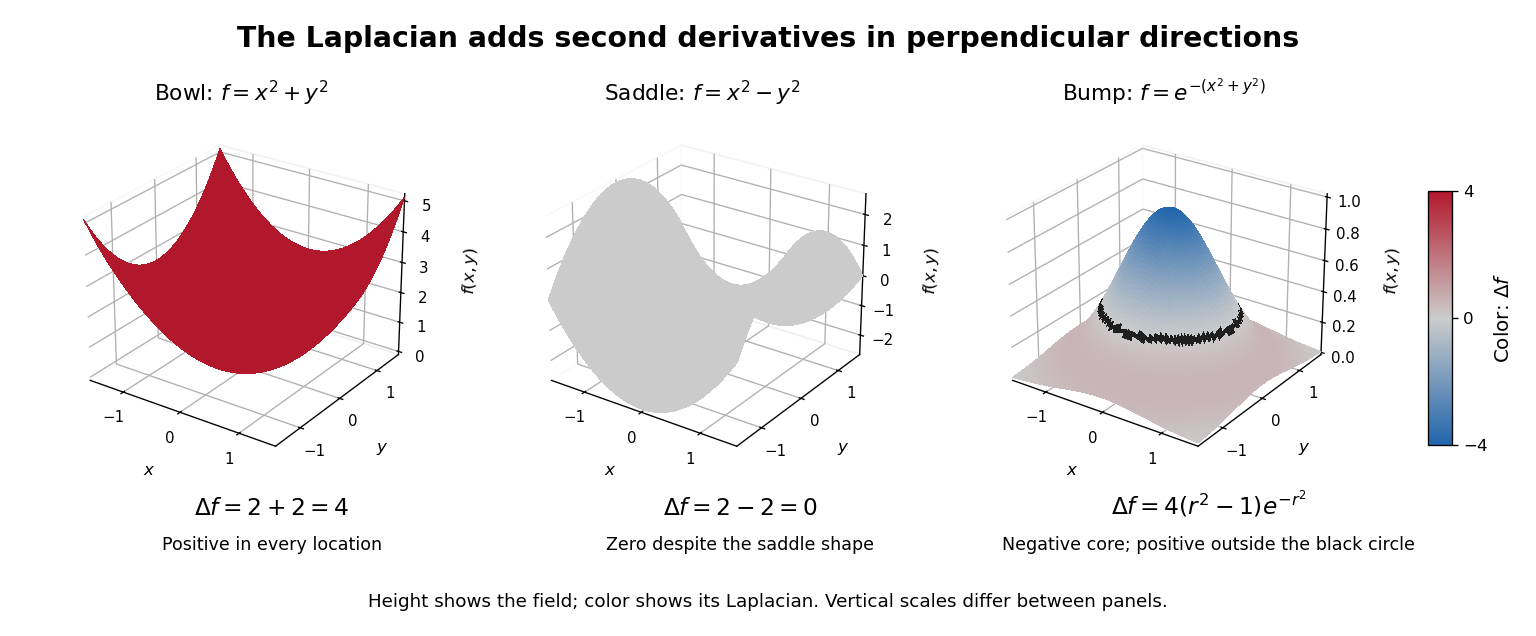
Three original examples distinguish shape from this sum. The bowl has . The saddle instead has : opposite second derivatives cancel. It is a harmonic function, although its graph of a function is not a plane. For the Gaussian function , with , differentiation givesIts Laplacian is negative inside the circle of radius one, zero on that circle, and positive outside it. The Gaussian function itself is positive throughout: its value and its Laplacian describe different properties.

The sum does not favor a particular orientation. Under a change of Cartesian coordinate system represented by an orthogonal matrix , the Hessian matrix becomes . The cyclic property of the trace and preserve its matrix trace. This makes the Laplacian useful when the behavior depends on spatial differences equally in every direction, rather than on the arbitrary choice of axes.
For a vector field, the Euclidean Laplacian acts separately on components expressed in a fixed Cartesian coordinate system. Components in a position-dependent basis require differentiating that basis too; applying a scalar formula separately to polar components omits those terms.[ref]
The Feynman Lectures on Physics, Volume II by Richard Feynman and others. Volume II, component formula following equation 2.54 and final paragraph of §2–8: fixed rectangular components
The scalar formula in Laplacian in polar coordinates is valid away from ; smoothness at the origin must be handled in coordinates that remain regular there. New to topics? Read the docs here!