
For a diatomic molecule, let be the two masses and their fixed separation. The distances from the centre of mass are and . A perpendicular axis through the centre of mass therefore has moment of inertiaThe reduced mass here is not the electric dipole moment, for which we use . For a longer linear molecule, replace by , where is each distance along the axis from the centre of mass. In the point-mass idealization, the axial moment of inertia is zero; turning about that axis changes no nuclear positions, so no independent axial rotational degree of freedom is included.
For the field-free linear rigid rotor, assume a fixed internal quantum state with no electronic angular momentum or electronic spin, and omit couplings to nuclear spin. The rotational Hamiltonian is . Its orientation wavefunctions are spherical harmonics , and its angular momentum eigenstates satisfywhere and . Each belongs to angular momentum eigenstates distinguished by the magnetic quantum number , an instance of degenerate energy levels. The Planck constant is ; is the frequency-valued rotational constant. Notice that the energy eigenvalues scale as , not .
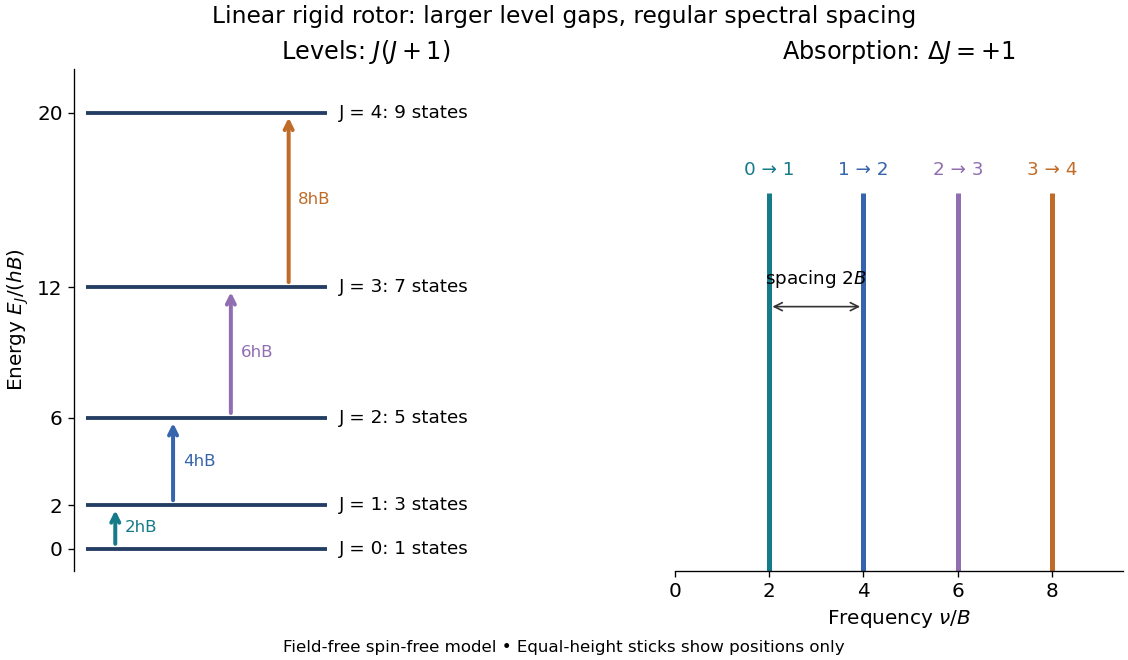
Linear rigid rotor: increasing gaps between energy eigenvalues and equally spaced transition frequencies
. Original dimensionless model: . Upward arrows show photon absorption with ; the sticks show positions only, not measured or predicted intensities. The states at each energy eigenvalue are represented by one horizontal line. Details.
Subtracting consecutive energy eigenvalues givesThus increasing level gaps produce a regularly spaced series of lines at , with spacing . Allowed positions do not guarantee that every line is visible: electric-dipole selection rules, occupation of the initial quantum state, and instrument response also matter.
New to topics? Read the docs here!