For a diatomic molecule, let be the two masses and their fixed separation. The distances from the centre of mass are and . A perpendicular axis through the centre of mass therefore has moment of inertiaThe reduced mass here is not the electric dipole moment, for which we use . For a longer linear molecule, replace by , where is each distance along the axis from the centre of mass. In the point-mass idealization, the axial moment of inertia is zero; turning about that axis changes no nuclear positions, so no independent axial rotational degree of freedom is included.
For the field-free linear rigid rotor, assume a fixed internal quantum state with no electronic angular momentum or electronic spin, and omit couplings to nuclear spin. The rotational Hamiltonian is . Its orientation wavefunctions are spherical harmonics , and its angular momentum eigenstates satisfywhere and . Each belongs to angular momentum eigenstates distinguished by the magnetic quantum number , an instance of degenerate energy levels. The Planck constant is ; is the frequency-valued rotational constant. Notice that the energy eigenvalues scale as , not .
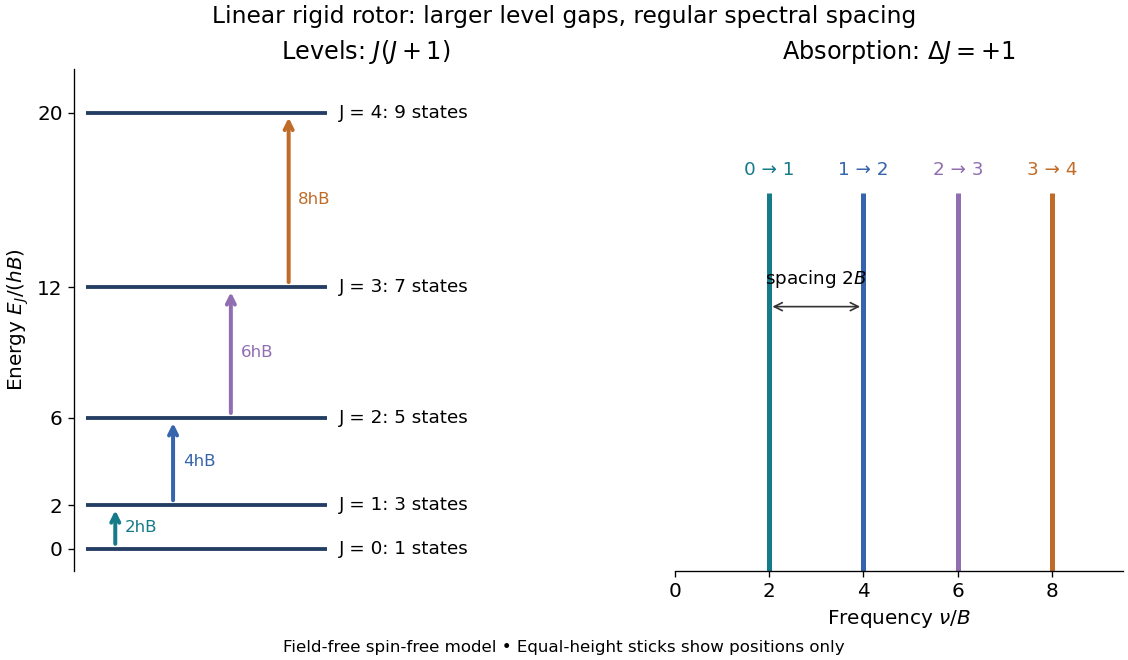
Linear rigid rotor: increasing gaps between energy eigenvalues and equally spaced transition frequencies
. Original dimensionless model: . Upward arrows show photon absorption with ; the sticks show positions only, not measured or predicted intensities. The states at each energy eigenvalue are represented by one horizontal line. Details.
Subtracting consecutive energy eigenvalues givesThus increasing level gaps produce a regularly spaced series of lines at , with spacing . Allowed positions do not guarantee that every line is visible: electric-dipole selection rules, occupation of the initial quantum state, and instrument response also matter.
For a linear rigid rotor, rotational temperature expresses the rotational energy constant in kelvins: , where is the perpendicular moment of inertia. With all integer allowed and degeneracies , its rotational canonical partition function is . It approaches at low temperature and at high temperature. The latter limit gives mean rotational energy and heat capacity per rotor.
In this article the rotational constant is a frequency,Its dimensions are , since the Planck constant has dimensions and a moment of inertia has dimensions . Some authors instead call the energy-valued rotational constant; this is the convention in the earlier synthetic molecular beam electric resonance diagram. A third convention uses the spectroscopic wavenumber , with the speed of light. Always check units before using .
If is known and the two masses are specified, the rigid two-atom model gives the bond length . This is why rotational spectroscopy can constrain molecular geometry. A real fitted constant can depend on molecular vibration, so this inference alone does not establish an equilibrium bond length.
For the field-free, spin-free linear rigid rotor in one fixed internal quantum state, the electric-dipole interaction is . A nonzero permanent electric dipole moment along the molecular axis allows pure rotational photon absorption with and photon emission with . The matrix element between initial and final quantum states must be nonzero: the existence of an energy gap alone is insufficient. Relative to a chosen axis, polarization of an electromagnetic wave along selects ; transverse polarization of an electromagnetic wave permits .[ref]
Lecture 24 Supplement: Energy levels of a Rigid Rotor by Dudley Herschbach. printed pp. 2–3: dipole transition integrals, polarization and selection rules
Hydrogen chloride and carbon monoxide are examples with a permanent electric dipole moment. By symmetry, molecular hydrogen and carbon dioxide have no permanent electric dipole moment in the ideal symmetric internal state. They still rotate and have rotational energy eigenvalues, but the simple permanent-electric dipole spectrum described here is absent. This restriction concerns this interaction and these assumptions, not every possible way of detecting molecular rotation.
Changing an isotope changes a mass and therefore the moment of inertia. If the bond length is held fixed, and every corresponding transition shifts by the same fractional amount. This leading inverse-reduced mass scaling is also used in the more complete diatomic formulation.[ref]
1Σ-Ground State Molecules. §2a, equations (4)–(5): isotope dependence of rotational constants and reduced mass
For a deliberately stipulated carbon monoxide example, take , , , , for both isotopic forms, and . The integer masses are simplifying inputs, not accurate isotopic atomic masses; the shared bond length is an imposed model assumption. Calculation givesIn particular,The heavier form's calculated line is rather than , a decrease of about . These are model predictions from the stated inputs, not published measured frequencies. An isotope changes the spacing as well as the first line; the shift is not a fixed additive offset for the whole spectrum.
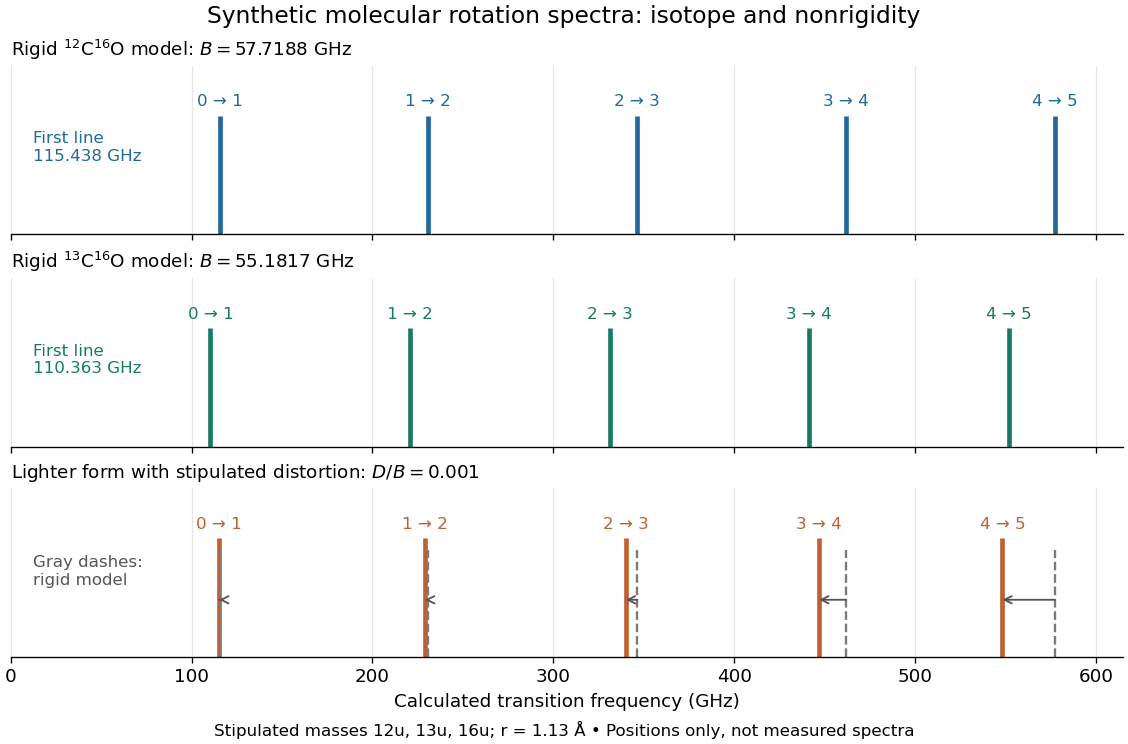
Synthetic rotational spectroscopy comparison: a heavier isotope compresses the rigid spectrum, while centrifugal distortion bends the spacing pattern
. Original equal-height sticks for through , using only the stipulated masses and bond length above. The lower panel additionally stipulates for the lighter form and compares with dashed rigid positions. Neither heights, distortion constant nor line frequencies are measured data; no thermal-population or instrument model is included. Details.
Articles by others on the same topic
There are currently no matching articles.