Lysosomal enzyme latency
ID: lysosomal-enzyme-latency

Lysosomal enzyme latency is the difference between the enzyme activity accessible to an added substrate before disruption of the surrounding membrane and the activity revealed after disruption. Low accessible activity can reflect separation of enzyme from substrate, rather than absence of enzyme. This is an assay-accessibility statement, not a claim that the intact lysosome is inactive in the living biological cell.[ref]
Exploring Cells with a Centrifuge by Christian de Duve. Christian de Duve, Exploring Cells with a Centrifuge (Nobel Lecture, 12 December 1974), printed pp. 157–159, enzyme-latency discussion and Figure 6
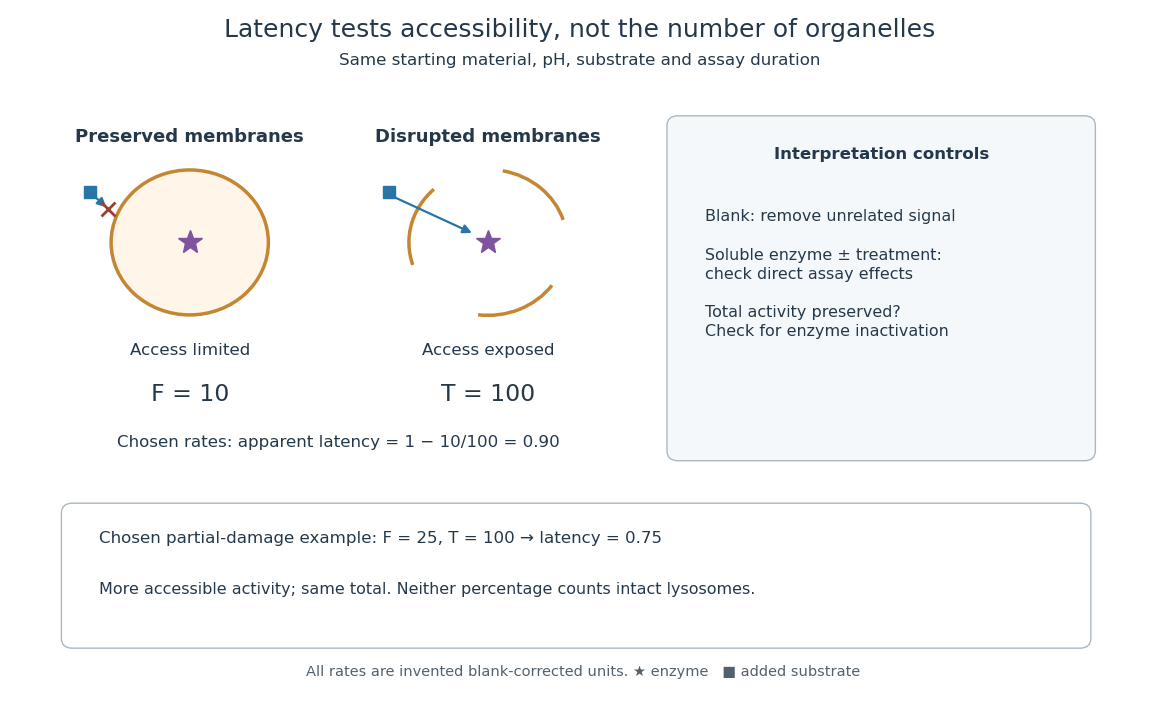
Lysosomal enzyme latency: matched assay conditions and disruption controls
. Original assay-logic diagram and explicitly chosen activity example. The values , and are arbitrary blank-corrected rate units, not historical observations. The soluble-enzyme comparison is an additional control proposed for the schematic, not an asserted measurement from the rat-liver acid-phosphatase latency experiment. Details.
Let be the blank-corrected initial rate measured with a membrane-preserving preparation and the rate after a treatment that exposes all assayable enzyme. Use matched amounts of starting material, pH, substrate and measurement time. Define the apparent latent fraction byThis definition requires more than a large treated signal. Disruption must preserve enzyme activity, and the treatment must not independently alter the readout. A soluble-enzyme comparison with and without treatment helps test direct activation or inhibition; an appropriate blank tests signal unrelated to enzyme-catalysed hydrolysis. These are controls for interpreting the constructed assay, rather than additional historical observations.
For a deliberately chosen example, take and arbitrary rate units. Then : ninety percent of the assayable activity was initially inaccessible. After hypothetical partial damage, with unchanged gives . The preparation has lost latency without gaining total assayable activity. These percentages describe activity accessibility; they do not count intact lysosomes. Unequal enzyme contents, partial leakage and mixed particle populations prevent that identification. If , the formula is negative, flagging failure of this simple accessibility interpretation rather than a negative population of hidden enzymes.
To check the logic, divide the same uniformly mixed preparation into two equal portions. If dilution halves both measured rates, , so is unchanged. In contrast, comparing an undiluted untreated portion with a diluted treated portion changes the ratio artificially. Normalization to the same amount of original material is therefore part of the definition, not an optional numerical correction.
New to topics? Read the docs here!