
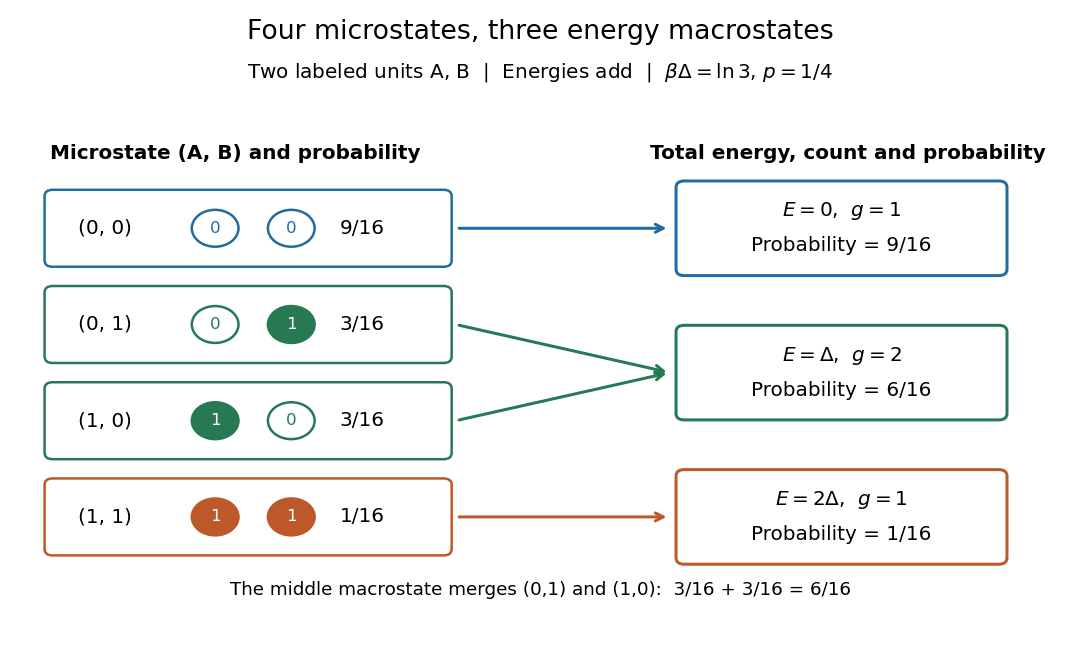
A macrostate groups microstates sharing prescribed coarse data. The grouping depends on what is retained: here retain only total energy. For the two distinguishable two-level systems, the macrostates have state degeneracies . Although two units are not macroscopic in size, they make this loss of information visible: knowing does not tell us which unit is excited.
At inverse temperature , each unit's excited-state probability is . Their independence gives microstate probabilities in the order above. Adding within each macrostate givesThe total expected value of energy is therefore , matching two units each with expected value of energy . Equal state degeneracies would give the wrong answer: macrostate probabilities combine counting with the Boltzmann factor. At very high positive temperature, all four microstates become equally likely, but these three macrostate probabilities approach .

New to topics? Read the docs here!