
Martha Chase was a researcher and coauthor, with Alfred Day Hershey, of the 1952 study now known as the Hershey-Chase experiment. Their work asked how the DNA and protein components of Bacteriophage T2 participated in infection and production of new phage particles.[ref]
Independent functions of viral protein and nucleic acid in growth of bacteriophage by A. D. Hershey and Martha Chase. Published byline, Introduction and Summary
The experiment used isotope labelling to follow the components separately: phosphorus-32 traced phage DNA, while sulfur-35 traced sulfur-containing phage protein. A Waring blender supplied a mechanical shearing step, and centrifugation separated the bacterial fraction from detached material. Most sulfur label was stripped away while most phosphorus label remained associated with the cells, which could still produce progeny.[ref]
Independent functions of viral protein and nucleic acid in growth of bacteriophage by A. D. Hershey and Martha Chase. Printed pages 50–53, blender experiment; Summary points 4–5
A useful way to understand the apparatus is to separate its two jobs. Blending changes which material remains attached to bacteria; centrifugation sorts material into a centrifugation pellet and supernatant. Neither operation directly reads a genetic message. The inference depends on following the labelled chemical components through that physical separation and comparing the results with biological activity.
For an invented recovery example, suppose corrected measurements find label units in the centrifugation pellet and in the supernatant. The recovered pellet fraction is . If the initial sample contained comparable units, however, only of the initial label has been recovered. Calling the pellet result of the initial label would confuse two denominators: it is of that initial amount. These numbers are not reported experimental data. They illustrate why recovery, background and the definition of the measured fractions matter when interpreting a tracer experiment.
The study supplied evidence connecting DNA with phage propagation while distinguishing an external structural role for much of the phage protein. It did not establish that every virus uses DNA or that proteins have no biological role in infection.
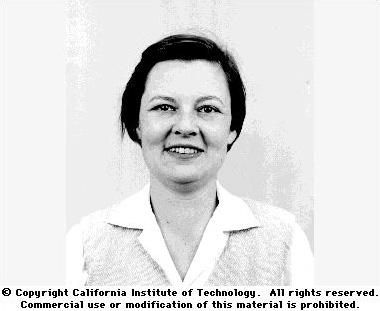
Martha Chase
. Individual portrait identified as Martha Epstein Chase by the Cold Spring Harbor Laboratory DNA Learning Center archive. Original named archive record. New to topics? Read the docs here!