Mass-distance degeneracy of an angular stellar orbit
ID: mass-distance-degeneracy-of-an-angular-stellar-orbit

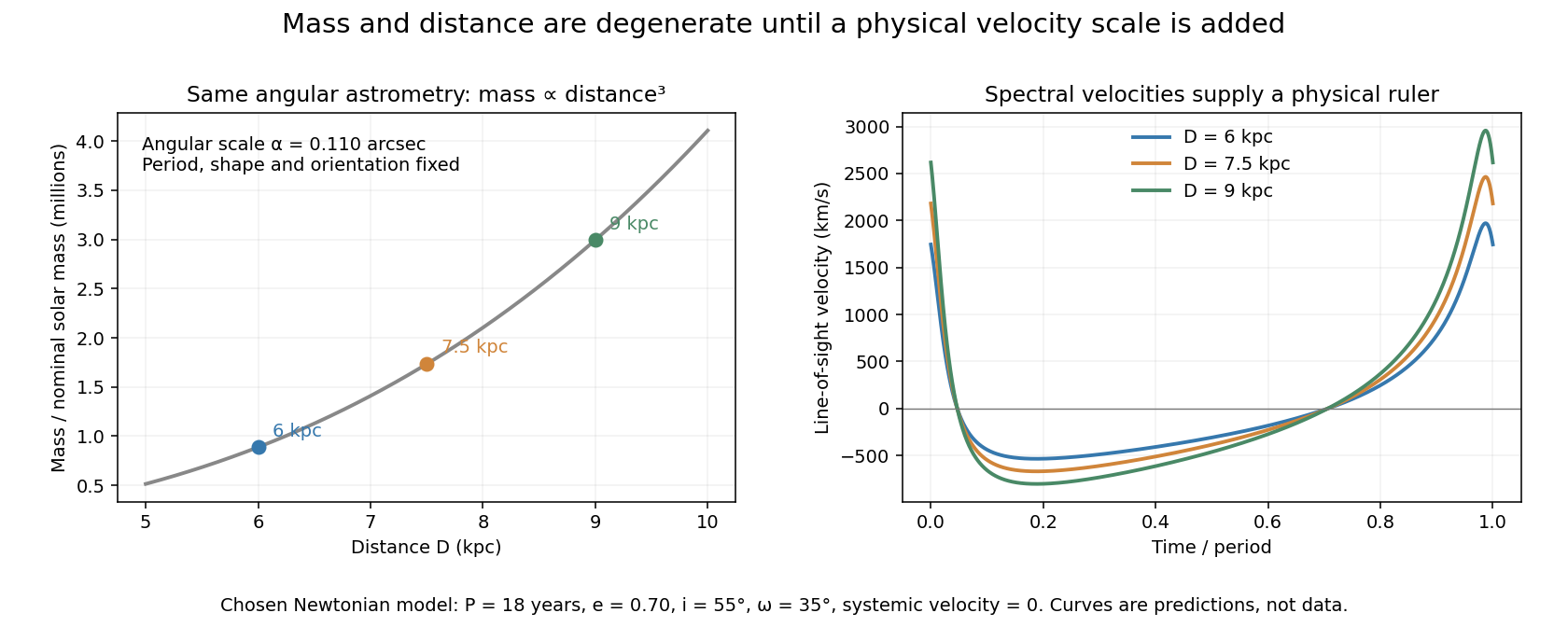
Angular astrometry determines the combination displayed by substituting into Kepler's third law. Keeping the fitted shape, orientation and orbital period fixed, the rescalingleaves the entire angular time series unchanged. A longer physical orbit around a larger mass can trace precisely the same angular path. More angular samples improve the fitted combination; by themselves they cannot break this scaling symmetry of the model.
The radial-velocity semi-amplitude isFor , combining it with the angular fit gives the orbital parallax distanceThe spectral velocity scale supplies the missing physical ruler. For a face-on orbit, , this radial signal vanishes and that method cannot supply a distance. In a partial or noisy data set, fitted orientation and systemic motion also correlate with the inferred scale.

New to topics? Read the docs here!