Astrometry measures the positions and motions of celestial objects. Repeated position measurements can distinguish stellar parallax, caused by the observer's motion, from proper motion of the source across the sky.
An astrometry measurement needs a date and a reference frame, as well as an angle. In an equatorial coordinate system, right ascension and declination label two viewing directions. A catalogue's reference date states when its quoted position applies; comparing entries at different dates without accounting for proper motion can make the same star appear misplaced. The observational problem is to infer a consistent history from successive incoming light directions, while accounting for the observer's changing position and measurement error.
To see the separation clearly, consider just one angular coordinate , with the numerical elapsed time in years. Assume a simplified circular orbit of the Earth, a fixed source Euclidean distance, constant proper motion in this coordinate and no other accelerations. Choose the direction and the starting date so that the annual stellar parallax projection is the cosine termHere is the coordinate without the annual stellar parallax offset at the reference date; the observed is . The proper motion coefficient is quoted in arcseconds per year, and is the annual stellar parallax in arcseconds. This is an illustrative choice of a full-amplitude projection. General sky directions have different projected amplitudes and phases in their two coordinates; their apparent paths need not be circles. Real astrometry uses the observer's calculated position rather than imposing this single cosine. [ref]
https://gea.esac.esa.int/archive/documentation/GDR3/Data_processing/chap_cu3ast/sec_cu3ast_cali/ssec_cu3ast_cali_source.html. ESA Gaia DR3: Astrometric source model
.Set , and , where is one thousandth of an arcsecond. The model gives , and . Same-season observations one year apart differ by because the annual stellar parallax contribution repeats. Subtracting that fitted straight trend leaves an annual signal between and . The existing stellar parallax distance relation then gives parsecs.
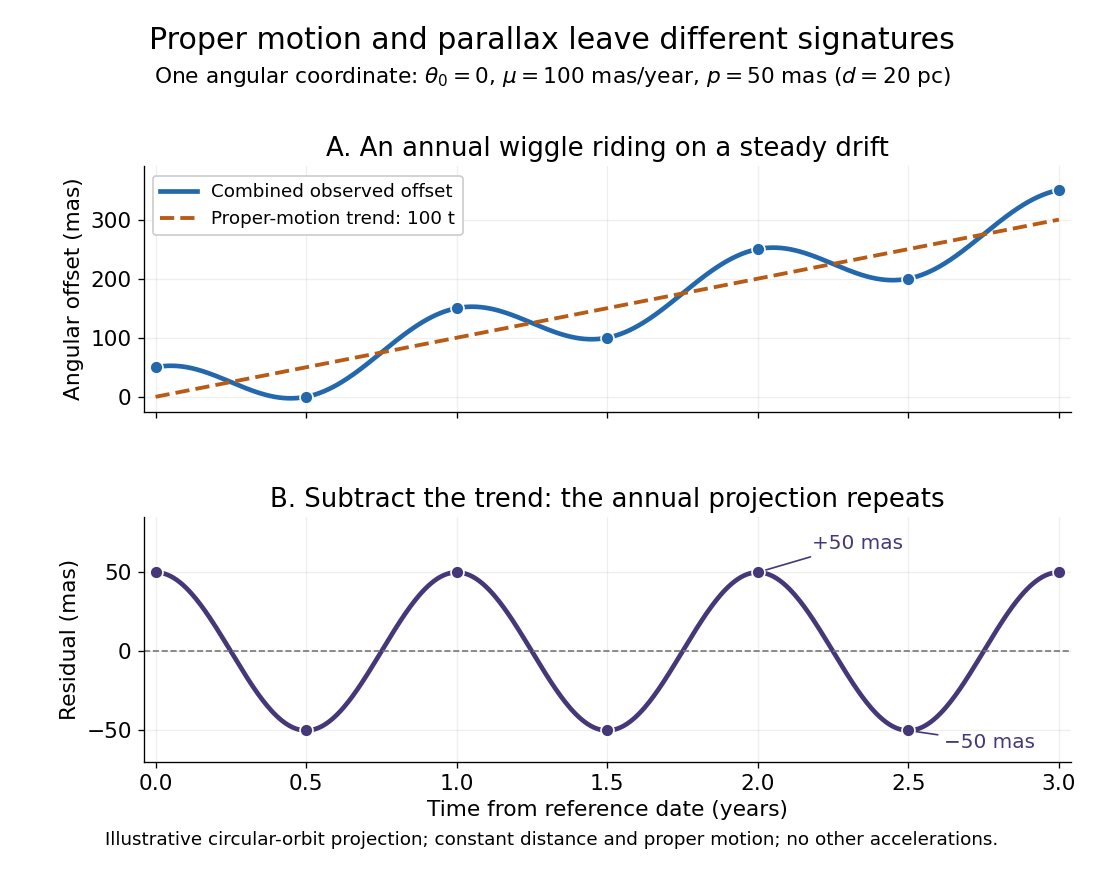

Observing only at the same annual phase would recover the proper motion trend but leave indistinguishable from a constant offset. Sampling several seasons as well as several years separates the repeating signal from the accumulating displacement. The two signatures answer different questions using the same measurements.
Articles by others on the same topic
There are currently no matching articles.