Matrix-chain split reconstruction
ID: matrix-chain-split-reconstruction

Extend the original example by a matrix with matrix dimensions , so . The Catalan number counts all possible groupings. Their scalar multiplication costs areThe optimum is , with cost . Enumeration makes a useful check here, but dynamic programming reaches the same answer by solving ten integer intervals, including the four single-matrix base cases:For example, . The three final-split candidates for the full matrix product supply a compact certificate:The first candidate already uses the better grouping of ; the worse need not be reconsidered at the top level. This is how optimal substructure lets the table represent all five possibilities with only three final candidates.
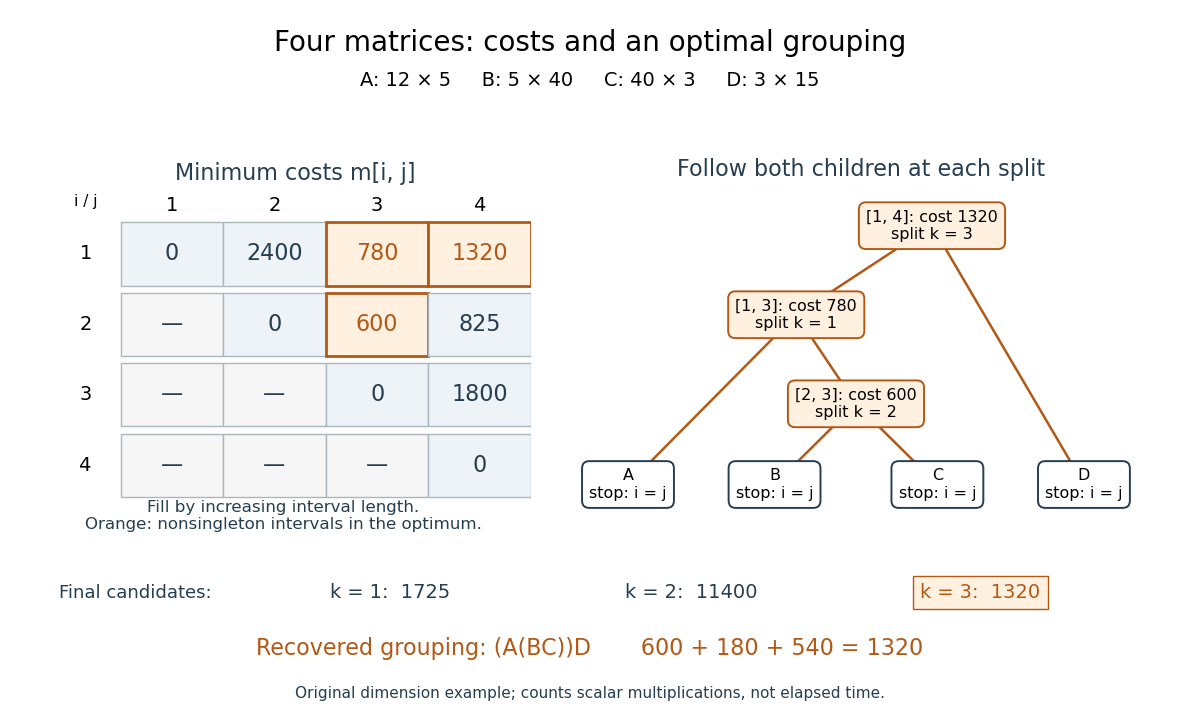

Read , which separates from . Then separates from , and separates from . This recursion stops at every , returning the corresponding matrix name. Combining the returned expressions recovers , rather than only its cost. Every recursive call uses a shorter integer interval, establishing algorithm termination; a tied minimum may choose any attaining split. The recovered binary tree has leaves and internal nodes, so reconstruction takes steps. Its attraction is the separation between an enormous family of groupings and a small set of reusable dynamic programming states.
New to topics? Read the docs here!