The Catalan number counts Dyck paths with semilength of a Dyck path . For a nonnegative integer ,The count includes the empty path. Of the paths with three up steps and three down steps, exactly five stay at nonnegative height. Their shapes and balanced parentheses encodings appear below.[ref]
Bijective Proof Problems by Richard P. Stanley. §5, printed pp. 38–39, formula (7) and Problems 154–159: Catalan counts, binary parenthesizations, binary trees and Dyck paths
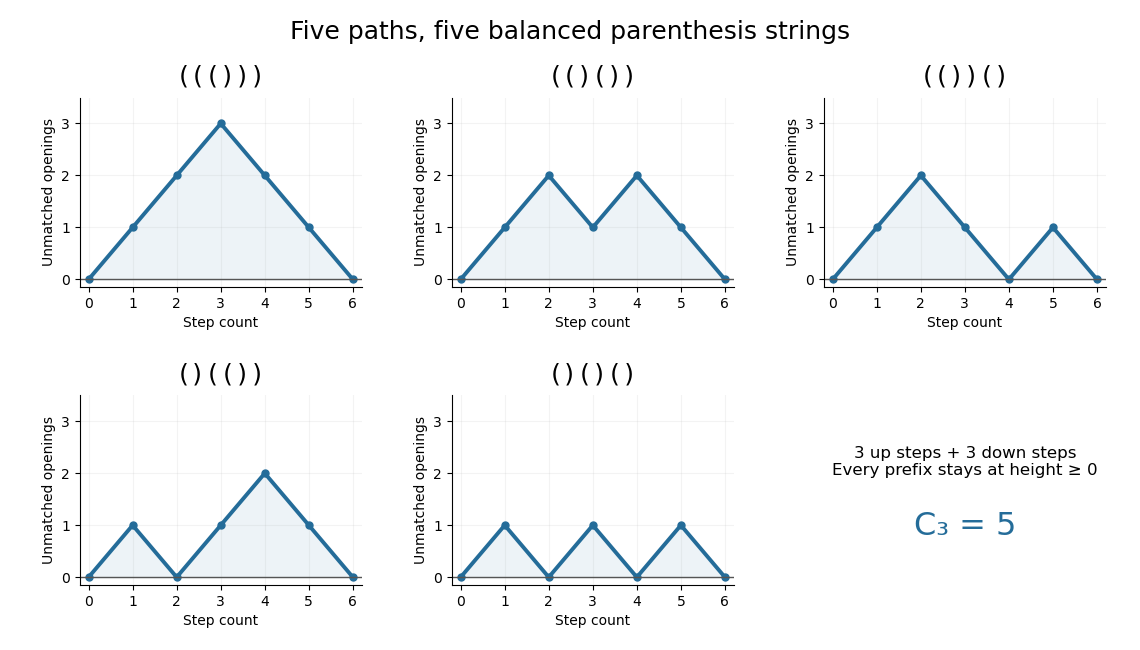
All five Dyck paths of semilength three and their balanced parentheses encodings
. Original enumeration of six-step up/down paths with nonnegative prefix heights. An up step encodes an opening parenthesis and a down step a closing one. Each panel shows one distinct string; no path shape or illustration is copied from a source. Details.The useful connection is a shared decomposition. A Dyck path splits uniquely at its first-return decomposition of a Dyck path; a binary tree splits at its root into left and right subtrees; a binary parenthesization splits at its last operation. Each removes one outer unit and leaves an ordered pair of smaller objects. The resulting Catalan recurrence lets one count several different structures with the same calculation. A count of five does not mean the structures are physically identical: a bijection supplies the precise translation between them.
The first-return decomposition of a Dyck path and the rule of product giveFor a given , choose the inside path in ways and its suffix in ways. Different first-return locations give disjoint groups, so the rule of sum adds their counts. For , the terms are . Iterating the recurrence relation computes the counts without enumerating every full path.
The ordinary generating function packages the Catalan recurrence. Its Cauchy product gives the formal power series identityThe constant term is . Solving the quadratic equation chooseswith the formal power series square root having constant term one. The apparent quotient at has constant term one after cancellation; the other quadratic solution has a pole and cannot be this ordinary generating function. The equation records the empty object or an outer unit with two ordered smaller objects.
A binary parenthesization specifies the order of binary operations on a fixed ordered list of operands, combining exactly two existing expressions at each step. It has a full binary tree as its expression structure: operands are leaves and operations are internal vertices. For four operands , the five possibilities are , , , , and .
A binary parenthesization of operands contains binary operations. At the last operation, its left expression can contain operations and its right expression . The Catalan recurrence therefore gives possible evaluation structures. The order of operands stays fixed; this is not a count of their permutations. Even for an associative operation whose result is unchanged, different structures can have different evaluation costs, as in the matrix-chain multiplication problem.[ref]
Bijective Proof Problems by Richard P. Stanley. §5, Problem 154, printed p. 38: binary parenthesizations of n+1 letters
Leonhard Euler's 1751 correspondence already studied triangulations of a convex polygon and gave a closed formula for their counts. Johann Andreas von Segner supplied a combinatorial recurrence relation in a paper written in 1758. Eugène Charles Catalan's nineteenth-century work connected the formula to bracketed products. This history, documented in Igor Pak's account, shows how the same counting structure reappeared through different objects; the modern name alone does not establish discovery priority.[ref]
History of Catalan numbers by Igor Pak. §§2–3 and §5, printed pp. 2–4: Euler correspondence, Segner recurrence and Catalan's bracketed products
Articles by others on the same topic


Catalan numbers are a sequence of natural numbers that have many applications in combinatorial mathematics. The \( n \)-th Catalan number \( C_n \) can be defined using the following formula: \[ C_n = \frac{1}{n + 1} \binom{2n}{n} = \frac{(2n)!}{(n + 1)!n!