Meissner effect and flux history
ID: meissner-effect-and-flux-history

Compare two ideal models for a stationary, solid, simply connected sample. In the perfect conductor flux-history model the interior electric field is constrained to zero from the moment perfect conduction starts. Faraday's law of induction then givesConsequently the interior magnetic field retains its value at that moment. Cooling in an already applied magnetic field freezes a nonzero interior value; starting perfect conduction in zero magnetic field and then applying a magnetic field preserves zero. The zero initial interior magnetic field often assumed in perfect conductor wave-reflection problems is one particular preparation, not a general prediction of expulsion. [ref]
9.8 Superconductivity. §9.8, Eq. (9.38) and the argument that zero resistivity conserves existing flux rather than expelling it
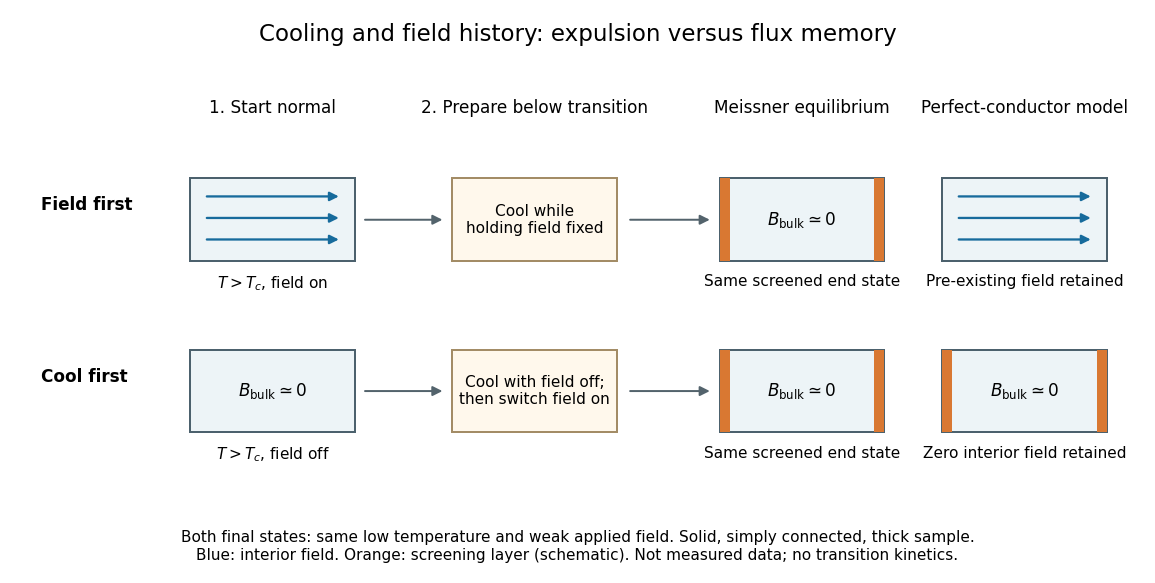

The Meissner state instead selects the screened equilibrium after either preparation, provided that equilibrium is accessible and the applied magnetic field lies in the Meissner state regime. The first London equation alone illustrates the missing information: at fixed , combining it with Faraday's law of induction givesThis permits an arbitrary time-independent integration field. The second London equation imposes the additional zero value of that bracket in the vortex-free local model.[ref]
Lecture notes on the electrodynamics of metals and superconductors. §2, pp. 12–13, Eqs. (64), (66)–(68): time-independent freedom and the second London equation
Establishing superconductivity during cooling is not the fixed-parameter, zero-electric field model: transient electric fields accompany changing magnetic flux, and itself depends on temperature. The equilibrium London equations predict final spatial screening, not the cooling rate or the time-resolved expulsion pulse. New to topics? Read the docs here!