A Meissner state is an equilibrium state of superconductivity without quantum vortex penetration, with screening electric currents responding to the applied magnetic field. In a solid, simply connected sample much thicker than the London penetration depth, the deep interior magnetic field is approximately zero. This is a statement about a phase and a geometry, not a rule that every sample exhibiting superconductivity always has . In particular, the Meissner state exists for sufficiently weak magnetic fields in both type-I superconductors and type-II superconductors. [ref]
9.8 Superconductivity. §9.8, Properties of Superconductors, paragraphs distinguishing type I, type II and their two critical fields
Take a homogeneous material exhibiting superconductivity in the half-space , bounded by vacuum at . Fix the temperature below the superconducting transition temperature, take a constant positive London penetration depth , and assume a local, linear London equation description in a Meissner state. The applied magnetic field is weak enough that it neither nucleates a quantum vortex nor appreciably suppresses the material's superconductivity. Assume translation invariance in , no imposed transport electric current, and a tangential boundary magnetic field . Here is the local surface magnetic flux density, equal to the imposed vacuum magnetic field in this infinite planar geometry; it is not automatically the far-away applied value for a finite object.
For a bounded, decaying interior solution, the London equations, magnetostatic Ampère law and Gauss's law for magnetism giveThe solution isAt one London penetration depth the magnetic field is of its surface value; at five it is . There is no finite depth where this exponential is exactly zero. The differential equation excludes the growing exponential through the deep-interior boundary condition. A constant normal component cannot decay in this geometry: Gauss's law for magnetism would require . A perpendicular applied magnetic field on a finite plate therefore requires a different spatial problem.[ref]
Lecture notes on the electrodynamics of metals and superconductors. §2, p. 13, Eqs. (68)–(74): London screening equation; the planar boundary-value solution here follows directly
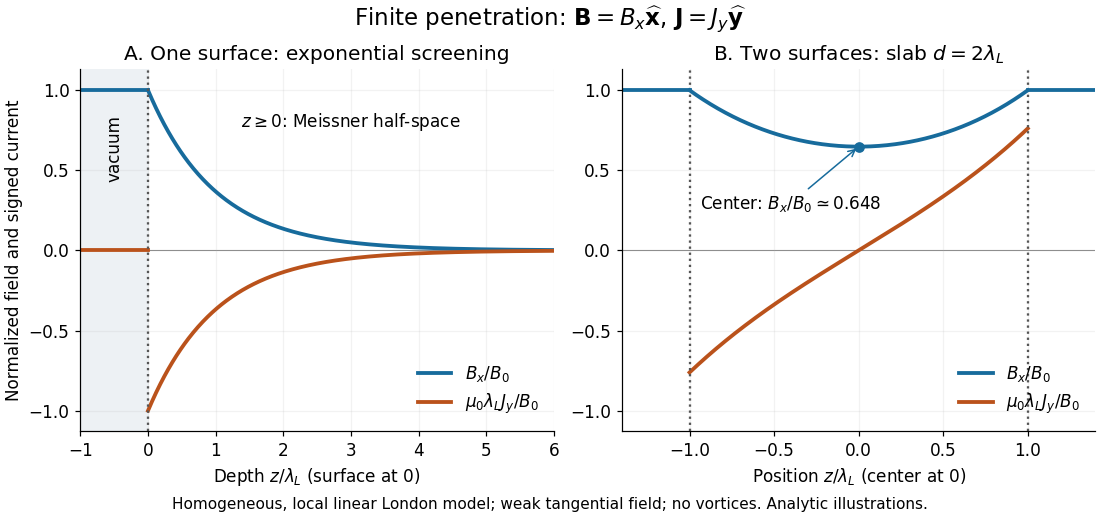

In SI units, the magnetostatic Ampère law gives the current density supporting Planar London screening:Here is the vacuum permeability. The sign follows from in the chosen coordinates. Thus requires electric current along . Its own magnetic field opposes the imposed magnetic field inside the material. The electric current is distributed over a finite layer; its depth integral is the effective surface current densityThe units are for and for . Shrinking at fixed increases the surface current density, while this integrated surface current density stays fixed. The current sheet approximation is the large-length-scale limit of this layer, not a claim that an actual sample carries an infinitely thin electric current. It reproduces the magnetic-field jump across a surface current between the exterior and a field-free interior, with outward unit normal .
To isolate finite size from quantum vortex penetration, keep the same weak-field London equations but replace the half-space by an infinite slab . Put equal tangential magnetic fields at its two faces. With now at the slab center, the even solution and its signed current density areThe hyperbolic cosine profile has equal boundary values, while the electric currents on the two sides have opposite signs. In particular,For the stipulated thickness , the center retains about and the mean is about , even though this is a Meissner state. For , the center magnetic field is exponentially small and the mean is about , reflecting the two surface layers. For , the mean tends to : little screening is possible across such a short distance. These are analytic model examples, not material measurements. Real finite objects also need their demagnetizing field and edge geometry accounted for; the slab calculation only isolates the effect of thickness.
Articles by others on the same topic
There are currently no matching articles.