Minkowski inequality for finite vectors
ID: minkowski-inequality-for-finite-vectors

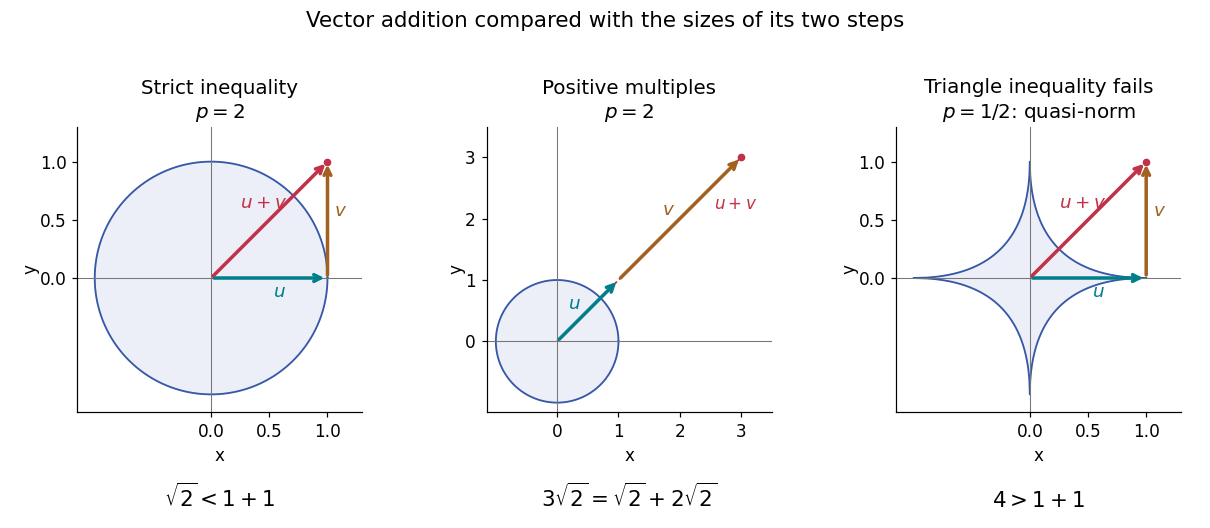
For vectors or , counting measure turns the Minkowski inequality intoFor , replace each displayed norm by the maximum of its coordinate absolute values. Take and . Both vectors have Lp norm one for every , but their sum has L1 norm , Euclidean norm , and L-infinity norm . Thus the same vector addition gives equality at , strict inequality at , and strict inequality at .
By contrast, and give equality for every : absolute homogeneity of a norm yields . At , the three sizes are , , and . Opposite vectors behave very differently: , so the inequality is strict whenever is nonzero. Cancellation is allowed; the bound describes the largest possible total size.

New to topics? Read the docs here!