For measurable functions with values in the real numbers or complex numbers on the same measure space , and , membership in the same Lp space givesThus adding two functions cannot make their combined Lp norm exceed the sum of their separate Lp norms. The measure need not be finite or a probability measure. The hypotheses require finite Lp norms; uses the essential supremum of the absolute value, not an ordinary pointwise supremum. For complex numbers, the absolute value is the complex modulus. As usual, Lp spaces identify functions equal almost everywhere. [ref]
Measure, Integration & Real Analysis by Sheldon Axler. Axler, Measure, Integration & Real Analysis, §7A, Definition 7.1, pp. 194–195, and Theorem 7.14, p. 199
The Minkowski inequality makes the Lp norm a workable notion of size: it supplies the triangle inequality needed to turn into a metric on Lp space. Applied to , it says that travelling through an intermediate function cannot shorten the direct distance measured by this metric. Applied to two error functions, it gives a bound on the total error even when the errors reinforce one another; Minkowski inequality for error aggregation gives explicit examples.
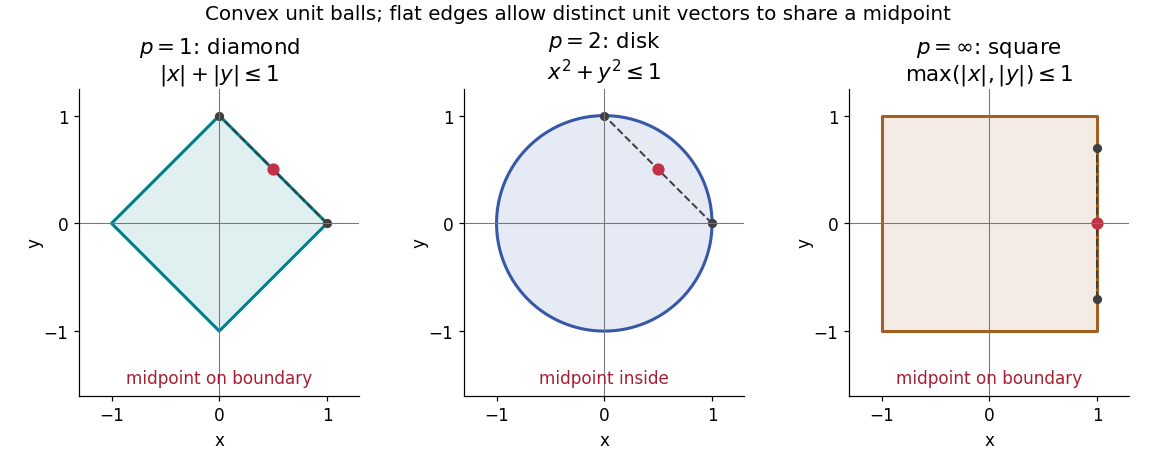
The geometry is already visible in the Euclidean plane. Under counting measure on two coordinates, the closed unit balls for the L1 norm, Euclidean norm, and L-infinity norm are respectively , , and . Every one is a convex set: if have Lp norm at most one, the Minkowski inequality and absolute homogeneity of a norm give for . The Euclidean norm has no flat boundary segments, whereas the other two norms do. This is the distinction captured by a strictly convex normed space and developed in equality in Minkowski inequality.
A short Hölder's inequality proof outline handles . First , so has finite Lp norm before any division. With conjugate exponents and , set ; then . The scalar triangle inequality followed by Hölder's inequality givesDivide if ; otherwise the desired bound is immediate. For , integrate . For , the almost everywhere bounds and give the result by the essential supremum. The same scalar triangle inequality works for real numbers and complex numbers.
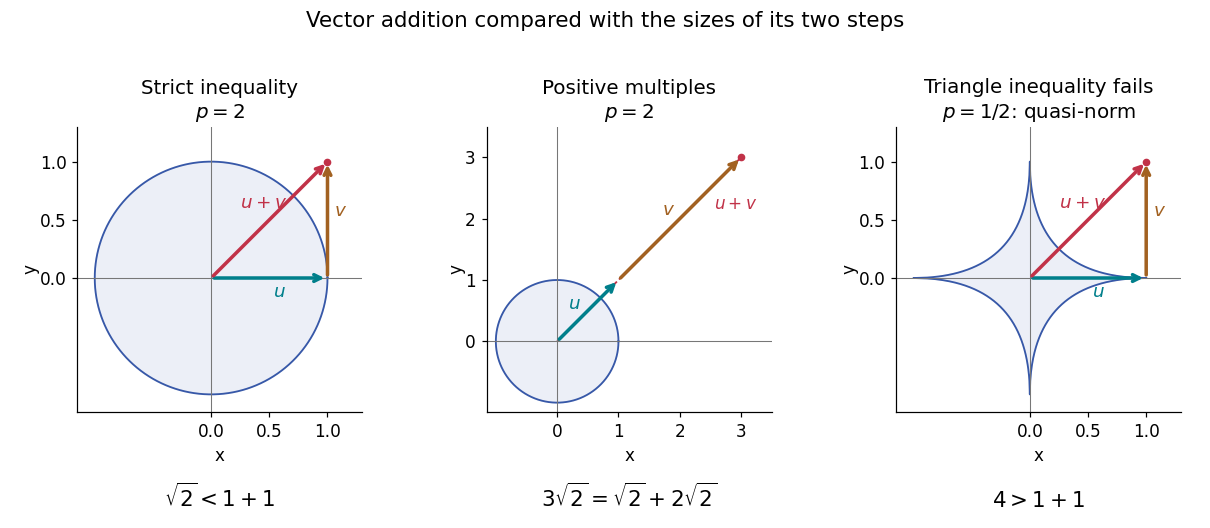
For vectors or , counting measure turns the Minkowski inequality intoFor , replace each displayed norm by the maximum of its coordinate absolute values. Take and . Both vectors have Lp norm one for every , but their sum has L1 norm , Euclidean norm , and L-infinity norm . Thus the same vector addition gives equality at , strict inequality at , and strict inequality at .
By contrast, and give equality for every : absolute homogeneity of a norm yields . At , the three sizes are , , and . Opposite vectors behave very differently: , so the inequality is strict whenever is nonzero. Cancellation is allowed; the bound describes the largest possible total size.
For and nonzero elements of the same real or complex Lp space, equality in the Minkowski inequality holds if and only ifEquivalently, almost everywhere for a single positive real number . The multiplier must be constant across ; matching signs at each input alone is insufficient. For complex numbers, an arbitrary complex scalar multiple is also insufficient: gives for nonzero . If either element is zero in Lp space, equality holds automatically, even if a representative has nonzero values on a null set.
The reason is strictly convex normed space geometry. Normalize to unit Lp norm and use weights and . Distinct normalized functions give a convex combination of Lp norm strictly below one. This follows by integrating the strict convexity of on the real numbers or complex numbers; equality therefore forces the normalized functions to agree almost everywhere.
At , equality instead means almost everywhere: the nonnegative difference has zero integral. For real functions, this is almost everywhere. For complex functions, their nonzero values must have the same argument wherever both are nonzero, but their magnitude ratio may vary. The disjoint-coordinate vectors and illustrate equality without constant proportionality.
At , no such constant proportionality condition is necessary: and have L-infinity norms one and a sum of L-infinity norm two. Nor must an essential supremum be attained: under Lebesgue measure on , give equality , although neither function takes the value one. The endpoint Lp spaces need not be strictly convex normed spaces.
Suppose an approximation is compared with a target through an intermediate approximation , with both error functions in the same Lp space. The identity and the Minkowski inequality combine two error budgets without any independence assumption. The L1 norm controls aggregate absolute error, the L2 norm controls the square root of aggregate quadratic loss, and the L-infinity norm controls the largest error almost everywhere. For equally weighted samples with the probability measure on each coordinate, the L2 norm is the root mean square error; the inequality still applies when this normalization is used consistently.
For example, two signed error vectors and have Euclidean norms and , while . Reinforcing errors and attain the bound ; opposing errors and cancel completely. The Minkowski inequality always allows reinforcement. A smaller combined budget requires additional information about the errors, not just their separate norms.
Iteration gives for every finite sum. For an infinite series, if all belong to one fixed Lp space with and , its partial sums form a Cauchy sequence in the full Lp norm. Completeness of this Banach space then gives norm convergence to an element of the same Lp space. A finite sum bound alone does not establish convergence, and completeness is an additional ingredient beyond the Minkowski inequality. [ref]
Lp spaces (Chapter 7 of Measure Theory). Hunter, Measure Theory, §7.4, Lemma 7.9, pp. 81–82, and Theorem 7.10, pp. 82–83: norm summability and completeness
For , write to emphasize that this is a quasi-norm, as in the Lq quasi-norm branch. On two coordinates with counting measure, and give , but . At , this is the explicit failure in the right panel of the diagram. The midpoint has , so the corresponding unit sublevel set is not a convex set.
A useful replacement survives: for nonnegative real numbers , . Together with the scalar triangle inequality, this yieldsConsequently is a metric on the equivalence classes of measurable functions with finite , even though itself need not be a metric. Do not replace the failed Minkowski inequality by a universal reversed bound for signed or complex functions: would give a zero sum but two positive separate sizes.
Articles by others on the same topic



The Minkowski inequality is a fundamental result in the field of mathematics, specifically in the areas of functional analysis and vector spaces. It is often referred to in the context of \( L^p \) spaces, which are function spaces defined using integrable functions. The Minkowski inequality provides a means of determining the "distance" or "size" of vectors or functions in these spaces.