
Module theory studies abelian groups with scalar multiplication by a ring. It extends linear algebra: a module over a field is a vector space, while ring scalars let the same language describe integer arithmetic and linear operators. The new phenomena are visible before any abstract classification: some nonzero scalars cannot be divided out, some modules have torsion elements of a module, and some have no basis of a module.
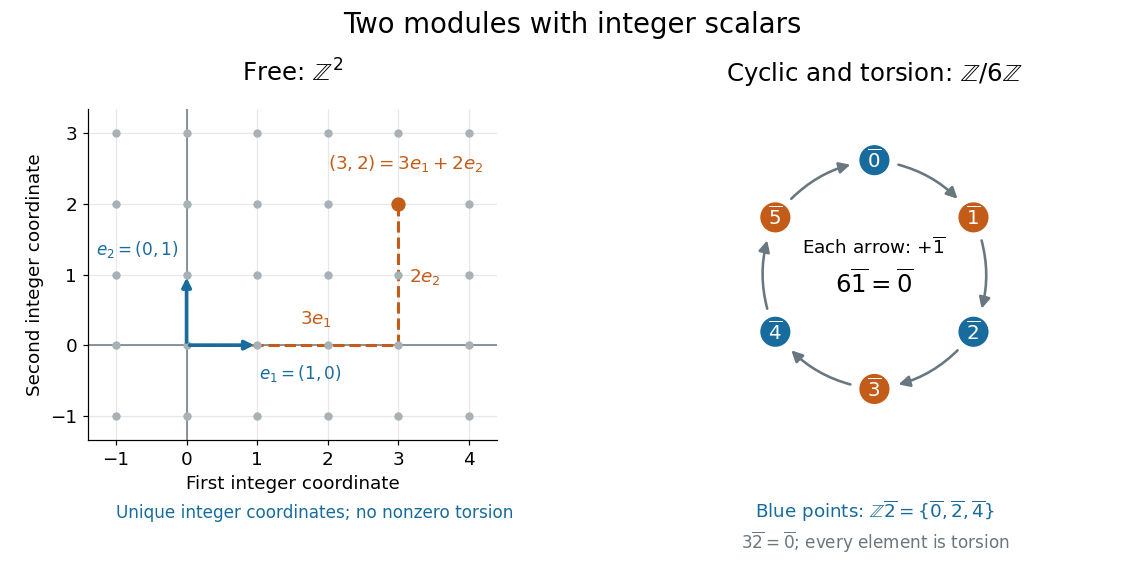
The distinction is useful because an integer relation such as carries information which disappears if one assumes all nonzero scalars have multiplicative inverses. A finitely generated module over a principal ideal domain can be separated into a finite free module and a torsion module; the structure theorem for finitely generated modules over a principal ideal domain unifies the classification of finitely generated abelian groups with the study of linear operators through polynomial rings. See Keith Conrad's Modules over a PID, Theorem 4.1 and the operator applications.
A historical anchor is Emmy Noether's 1921 paper [ref]
https://gdz.sub.uni-goettingen.de/id/PPN235181684_0083. Idealtheorie in Ringbereichen, Mathematische Annalen 83, pages 24–66
. Its first section studies rings and ideals under the condition that every ideal is a finitely generated module over its ring, and connects this to the ascending chain condition; later sections develop primary decomposition. This is an early source for the structural viewpoint underlying Noetherian rings. [ref] makes those statements accessible in English.

Module theory is a branch of abstract algebra that generalizes the concept of vector spaces to a more general setting. In module theory, the scalars are elements of a ring, rather than a field. This enables the study of algebraic structures where the operations can be more diverse than those defined over fields. ### Key Concepts: 1. **Modules**: A module over a ring \( R \) is a generalization of a vector space.
New to topics? Read the docs here!