
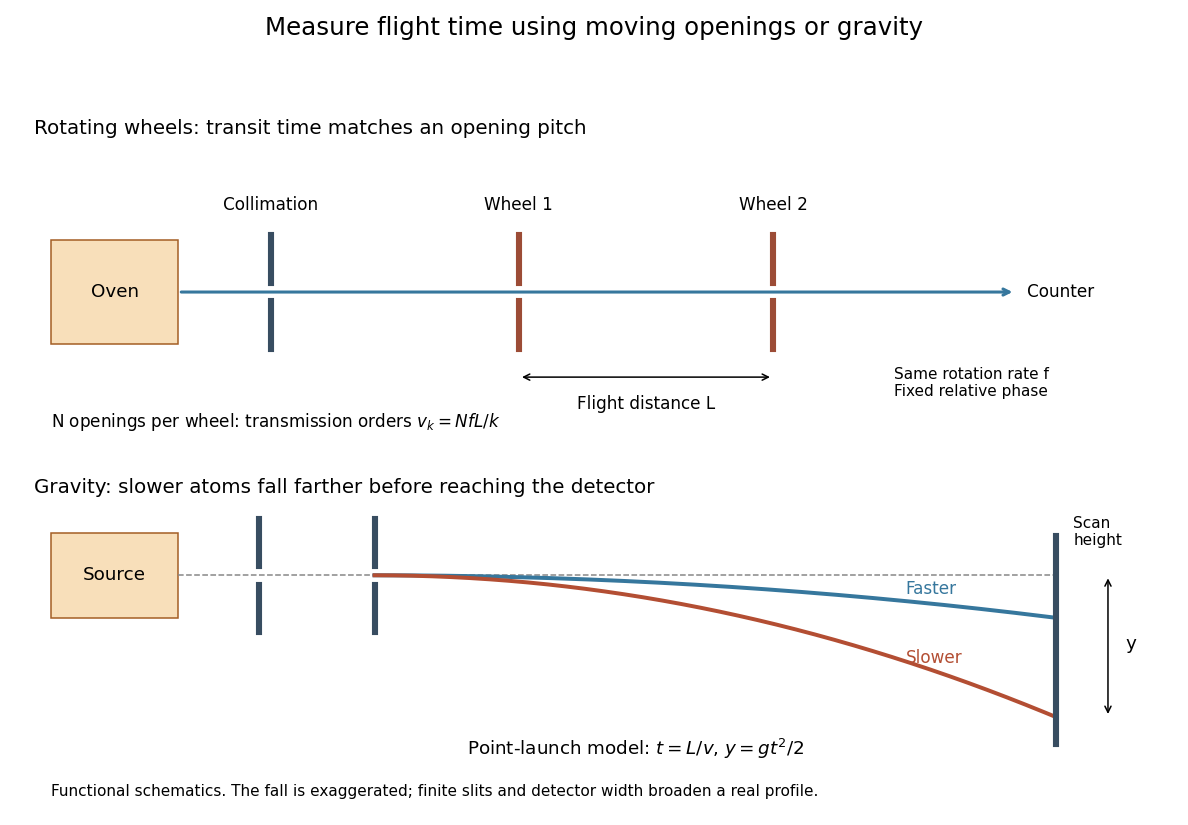
A molecular beam also includes a stream of chemical atoms, then called an atomic beam. An oven supplies particles; aligned slits restrict their directions, and a vacuum limits subsequent collisions. Narrowing the directions does not by itself make every particle's speed equal. This gives a useful separation of tasks: prepare a path, select or measure speed, apply an interaction, and read the resulting particle counts or deflection.
The advantage is unusually tangible. A magnetic field can separate spin components in the Stern-Gerlach experiment; even gravity can sort a beam by flight time. The effusive beam speed distribution explains which particles leave the source, while gravity deflection of an atomic beam explains how that distribution becomes a pattern on a detector.

Molecular beams are cool because they create a one dimensional flow of molecules, which makes it easier to observe certain single-molecule effects, as it removes the multi-particle issues from experiments.
Key molecular beam experiments include:
- Stern-Gerlach experiment, which confirmed the existence of spin
- Rabi's NMR experiment, which confirmed the existence of nuclear spin


A molecular beam refers to a directed flow of particles, typically molecules or atoms, that are produced in a vacuum environment. This technique is widely used in various fields of physics, chemistry, and materials science for studying molecular interactions, reactions, and properties. In a molecular beam apparatus (MBA), molecules are generated in a gas-phase source, often using methods such as effusive flow from a small nozzle or laser ablation.
New to topics? Read the docs here!