Motional electromotive force
ID: motional-electromotive-force

Motional electromotive force is the contribution from an electrical conductor moving with local velocity through a magnetic field. The cross product comes from the magnetic part of the Lorentz force. For a straight rod of length , perpendicular to both its velocity and a uniform magnetic field, its magnitude is . The sign depends on the direction of integration along the rod. [ref].
For a computed example, take , velocity to the right, and magnetic field out of the page. The rod lies along . ThenPositive electric charge is driven downward. For an isolated rod after charge separation has equilibrated, inside it, and the electric potential difference is ; the bottom is positive. This open-circuit statement does not imply a sustained electric current.
Close the rod's path with stationary U-shaped rails and an electrical resistance at the left. With out-of-page unit normal, the positive loop direction is counterclockwise, hence upward along the rod. If the rod's horizontal position is , the enclosed area is and the external magnetic flux is . ThusHere the resistive approximation neglects self-inductance. The negative electric current is clockwise, downward along the rod, consistent with the charge-separation calculation and Lenz's law.
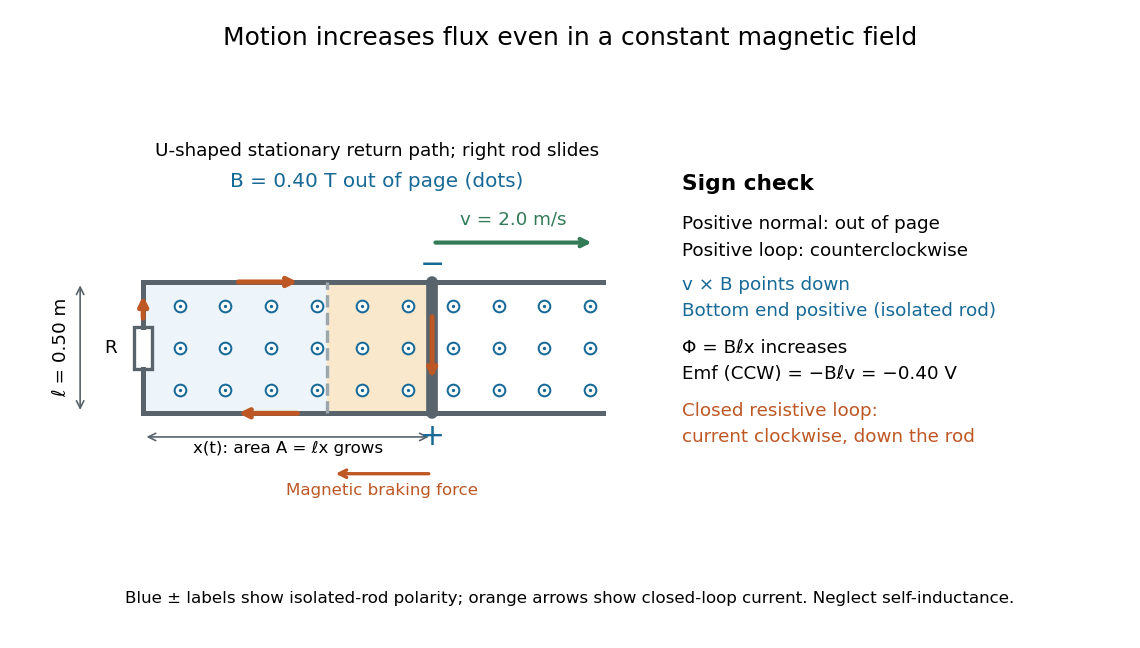

The closed-loop result illustrates why the moving-circuit form of Faraday's law of induction includes motional electromotive force: the magnetic field is constant in time, so the electric field circulation alone would miss this drive. Its mechanical consequence is electromagnetic braking of a sliding rod.
New to topics? Read the docs here!