Nuclear rotational band
ID: nuclear-rotational-band

A sequence of nuclear energy levels interpreted as different total angular momenta built on approximately the same intrinsic structure. For an axially symmetric, positive-parity, ground state band of an even-even nucleus, the allowed sequence is . The simple constant-inertia rotor hasHere is an effective moment of inertia, and the reduced Planck constant. The even- restriction belongs to this particular intrinsic symmetry and band, rather than to all nuclear excitations. The angular momentum operator eigenvalue supplies , rather than the classical replacement .
Set . Since , the model predictsFor a chosen model scale , the excitation energies are . The corresponding successive gamma ray energies are approximately , neglecting nuclear recoil. Level energies and emitted line energies are different lists. These numbers illustrate the formula and are not a measured isotope spectrum.
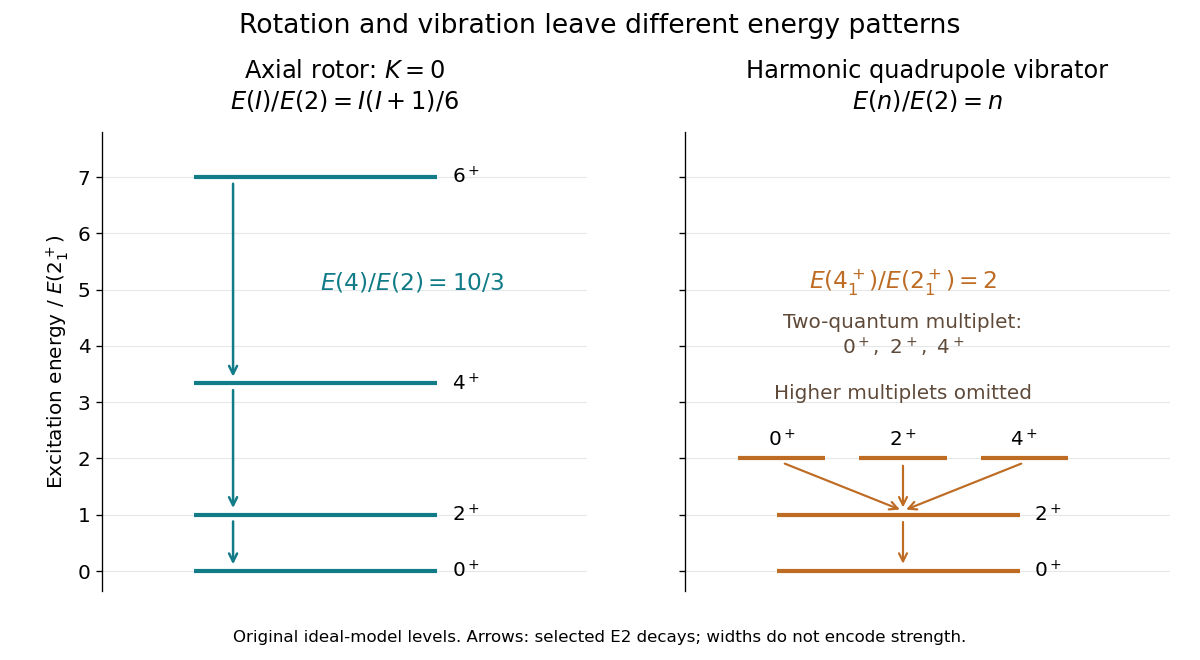

The fitted is a response parameter, not automatically the moment of inertia of a classical rigid charge distribution. Nuclear pairing changes this response; Ben Roy Mottelson connected observed inertias with correlations beyond independent-particle motion.[ref]
Elementary Modes of Excitation in the Nucleus by Ben Roy Mottelson. continuation after p. 237, pairing correlations and Fig. 1 potential-energy surfaces
At larger angular momentum, changing intrinsic structure or nuclear pairing can invalidate a single constant . A useful diagnostic is to compare across several levels: constancy tests the simple formula, while a drift identifies the need for additional physics. A successful ratio alone neither specifies every microscopic motion nor measures a literal solid-body rotation.
New to topics? Read the docs here!