Optical trap relaxation time
ID: optical-trap-relaxation-time

For a bead in a stationary viscous liquid, linear drag often dominates inertia on the observed timescale. Neglecting both inertia and the random thermal force, the deterministic force balance givesHere is the drag coefficient and the optical trap relaxation time: the time to reduce the deterministic displacement by a factor . The bead approaches equilibrium without oscillation in this overdamped model. The approximation requires times long compared with the inertial time and, for separated timescales, , where is the bead's mass. For a no-slip spherical bead of radius in an unbounded liquid of dynamic viscosity , Stokes drag law gives . Nearby walls change that drag coefficient.
For example, , and give and . A displacement of gives a restoring force of magnitude , and its deterministic displacement drops to after one optical trap relaxation time. These are predictions for the stated model, not measured trajectories.
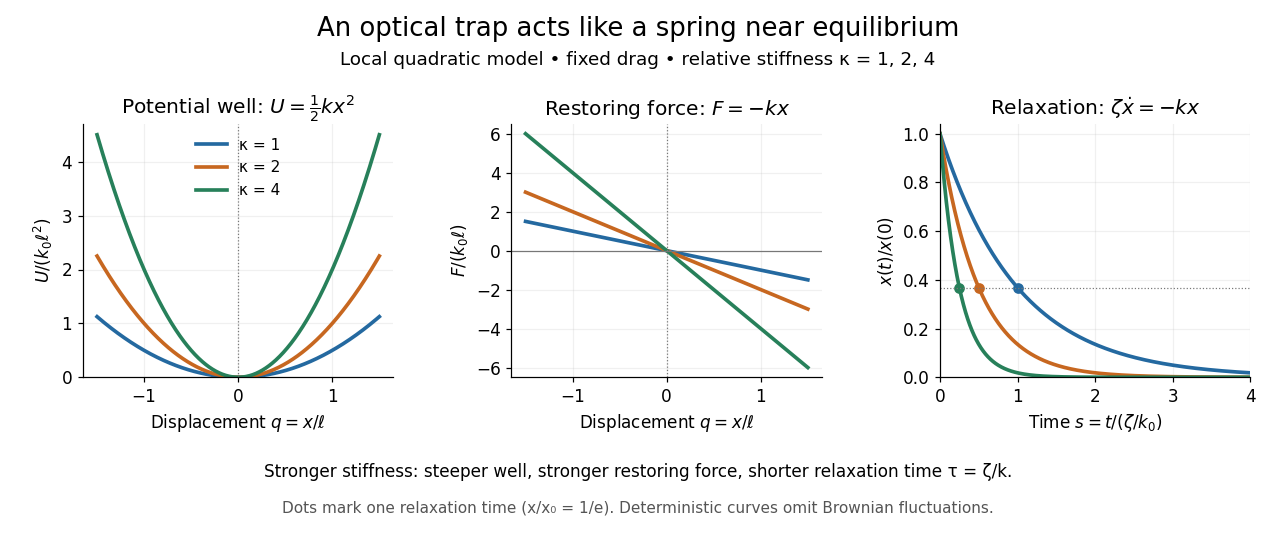
Local harmonic optical trap: potential well, restoring force and deterministic overdamped relaxation
. Details. 
The figure uses , and , with arbitrary positive reference length and stiffness . Thus , and, from , . At fixed drag, greater stiffness gives both a steeper potential energy well and faster relaxation. Thermal Brownian motion is omitted from these deterministic curves.
New to topics? Read the docs here!