Ornstein-Uhlenbeck stationary initialization
ID: ornstein-uhlenbeck-stationary-initialization

Set and draw independently of future Brownian increments. The Ornstein-Uhlenbeck process is then a strictly stationary process, withEvery time has the same normal distribution, and the covariance function depends only on the time lag. For a Gaussian process these properties also make all its finite-dimensional distributions invariant under a common time shift. The stationary distribution balances the continual random forcing against the contracting drift.[ref]
Applied Stochastic Differential Equations by Simo Särkkä and Arno Solin. Applied Stochastic Differential Equations, Example 6.8, printed pp. 91–92, equations (6.73)–(6.76): steady-state variance and covariance
With a fixed , the covariance function instead isIn particular, it is zero when , since the initial value has no uncertainty. The second term records the fixed start; it is the general scaling of the zero-start Ornstein-Uhlenbeck covariance. The pure exponential covariance function displayed above assumes stationary initialization. For a fixed start, that function emerges as the late-time limit at fixed lag, while the one-time probability distributions approach by convergence in distribution.
For the stipulated , , , stationary initialization has variance one from the outset. Its autocorrelation is , so the correlation time is one: a lag of one reduces the autocorrelation to . Its raw second moment includes the squared expected value; it must not be confused with the covariance.
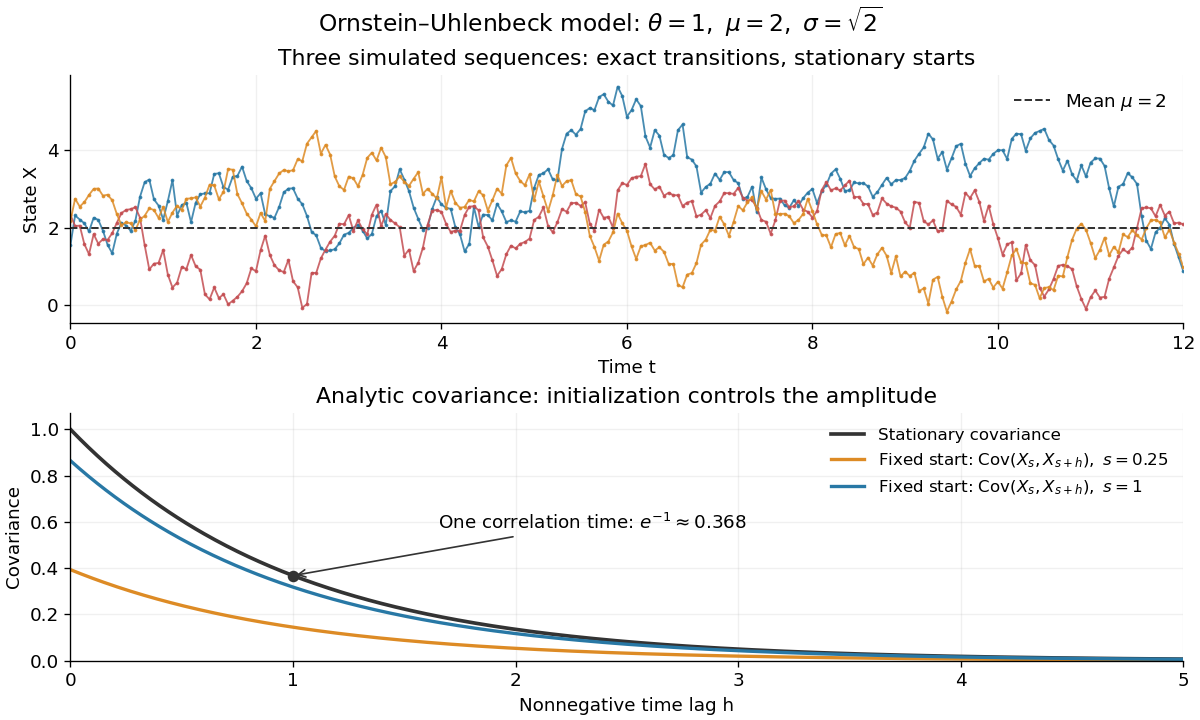
Simulated stationary Ornstein-Uhlenbeck samples and analytic covariance compared with a fixed start
. Details. 
The upper panel shows three simulated sequences with independent stationary initial values and exact transitions at spacing . Joining their points only guides the eye; it does not simulate a continuous sample path between those points. The lower panel shows analytic covariance functions: the stationary curve and, for comparison, for fixed initialization at two different ages . These are simulated samples and model curves, not measured trajectories or empirical covariance estimates.
New to topics? Read the docs here!