Parallel-plate capacitor
ID: parallel-plate-capacitor

A parallel-plate capacitor consists of two parallel electrical conductors with overlapping area and separation . If the gap is small compared with both plate widths and is filled by a uniform material of positive permittivity , its capacitance is approximatelyThis neglects the fringing field of a capacitor near the plate edges. The interior electric field points from the plate of positive electric charge to the plate of negative electric charge, and is approximately uniform. [ref].
For a worked vacuum example, stipulate , , and vacuum permittivity . This rounds the value in Fundamental Physical Constants — Complete Listing by National Institute of Standards and Technology and others. Within the approximation,At terminal electric potential difference , the electric field magnitude is , the plate electric charge magnitude is , and the capacitor energy is . These numbers use the stipulated rounded vacuum permittivity; finite plates also have corrections from the fringing field of a capacitor.
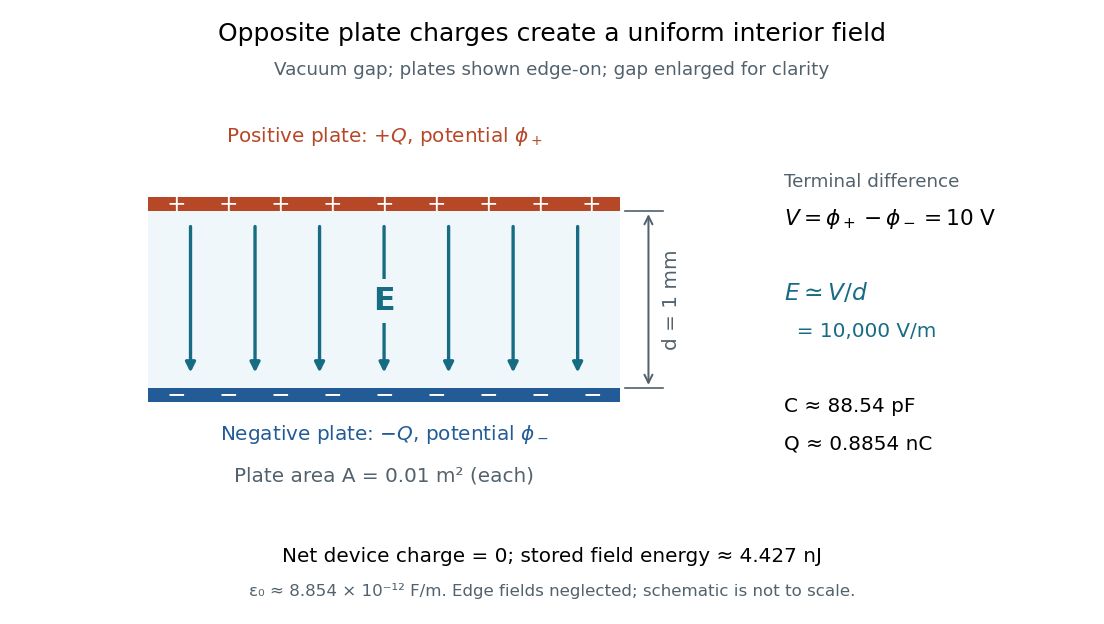

The formula makes design changes easy to predict: doubling the overlapping area doubles the capacitance, and halving the gap doubles the capacitance, with permittivity fixed and the fringing field of a capacitor neglected. Doubling permittivity also doubles capacitance if the material uniformly fills the gap and remains linear. This lets a compact device store more separated electric charge at the same terminal electric potential difference.
The short derivation uses surface charge density . In the interior, Gauss's law gives electric field magnitude . The electric potential difference is , so dividing by gives . A narrow curved capacitor gap has the same leading local approximation when its width is much less than the curvature radius.
New to topics? Read the docs here!