The capacitor energy is the electrostatic energy stored when electric charge is separated. For a linear capacitor of fixed positive capacitance , plate electric charge magnitude , and terminal electric potential difference , it isThe zero is the uncharged state. Thus the capacitor energy is positive for nonzero , even though the total electric charge of the two plates is zero. [ref].
For the parallel-plate capacitor example, capacitance and terminal electric potential difference giveThe plate electric charge magnitude is . Doubling terminal electric potential difference with capacitance unchanged doubles the plate electric charge magnitude and quadruples the capacitor energy.
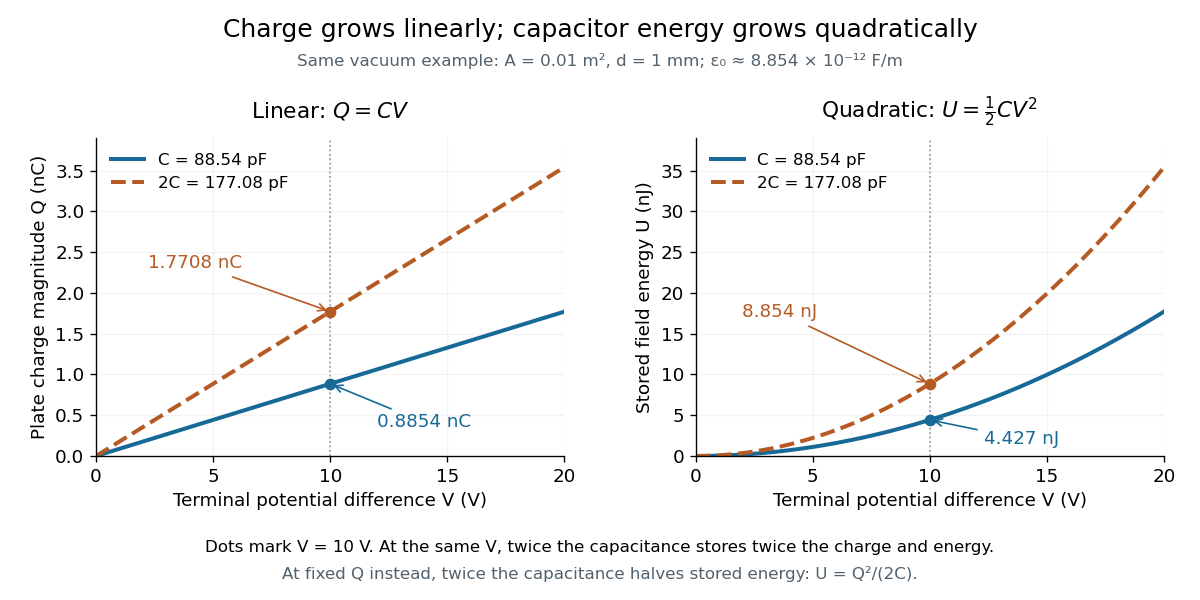

The electric charge is a linear function of terminal electric potential difference, while capacitor energy is a quadratic function. The second curve in each plot uses twice the capacitance: at a given terminal electric potential difference, both plate electric charge magnitude and capacitor energy double. These relations let us calculate how much energy an electrical circuit can receive when a capacitor discharges.
A brief charging argument explains the factor . If the plate electric charge magnitude has reached , the terminal electric potential difference is . Transferring a further amount of electric charge quasistatically requires work . With the geometry and permittivity fixed, the integral isUsing gives the other two forms. This integral accounts for the gradually rising terminal electric potential difference; it is the work stored in the capacitor's electric field, rather than a claim that all energy drawn from a fixed-voltage battery during charging ends up stored.
The field picture gives the same result. In the vacuum gap of a parallel-plate capacitor, the electric field has energy density . Multiplying by the gap volume gives the electrostatic energyFor the worked example, and reproduce . The electrostatic energy resides in the electric field throughout the gap, despite overall charge neutrality.
When capacitance changes, specify the constraint. At fixed plate electric charge magnitude , increasing capacitance decreases capacitor energy ; doubling capacitance halves it. At fixed terminal electric potential difference , increasing capacitance increases capacitor energy ; doubling capacitance doubles it. In the latter case a connected battery supplies additional electric charge and energy, and there may also be mechanical work. Use the fixed-voltage capacitor energy balance to account for all transfers before inferring a force from changing capacitor energy.
For thin parallel circular plates of radius and separation , the quasistatic axial field induces . Integrating cycle-averaged vacuum energy densities for sinusoidal drive gives . The same fields have radial Poynting flux , whose leading net inward power equals the time derivative of stored electric energy. The small ratio diagnoses the quasistatic regime.
For a quasistatic change of capacitance at fixed terminal electric potential difference, the capacitor energy is and plate electric charge is . Electrical work supplied to the electric field by the battery is , so mechanical work done on the capacitor is . Increasing the separation of a parallel-plate capacitor makes : mechanical work is positive even though electrostatic energy decreases, because electrical energy returns to the source. Conversely, when , the battery supplies : half increases capacitor energy and half is available as mechanical work done by the electric field. Differentiating capacitor energy alone at fixed terminal electric potential difference omits this exchange with the battery.
At fixed electric potential difference , a change of capacitance has electrical work input and field-energy increase . The remaining half is mechanical work done by the field, so the force in the direction of increasing overlap is . Equivalently the effective mechanical potential is . For a partially filled coaxial capacitor, this gives , directed inward when . The fringing field of a capacitor supplies the local field gradient and transmits this force even when its small correction to total capacitance is neglected.
Articles by others on the same topic
There are currently no matching articles.